
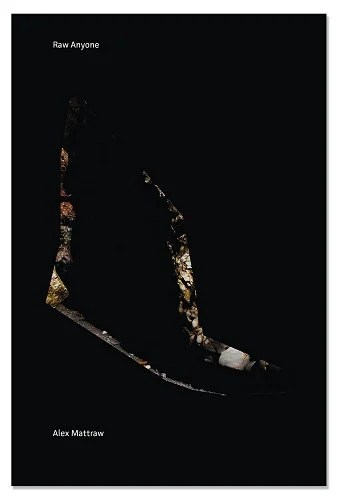
Raw Anyone is a title that asks us to ask what a title is. A title can locate (A Journal of the Plague Year) or gesture in a direction (The Wasteland). Raw Anyone feels like a fragment of language set free: uncooked, in a natural state, and in motion, searching, perhaps, to connect with an indefinite “anyone.” Raw Anyone is open to multiple interpretations, and that openness is the point of the title, so that trying to exhaust possible interpretations runs counter to the spirit of the book. Raw Anyone relies on our subjective experience rather than creating a text that rigidly controls our responses. The important thing is to register the uncertain quality of a title that forces us to ponder its meaning.
Raw Anyone is a deeply integrated, carefully crafted project, but it does not necessarily present itself that way at first glance. Blundering into the book, I’m reminded of André Gide’s advice to his readers: Do not understand me too quickly. We begin with “Dear Thought Climate,” a slender poem: a form we are familiar with. But the language challenges us: “rock / paper / Pfizer.” “I field you, / my liminal aviary.” And we end: “Stop : drop : coral / emporium, I am.” The lyricism of the language seduces us, as does the porous quality of the poem. The language invites us to collaborate with the poem to create its meaning. This initial poem is truly an opening, not a closure.
It would be a mistake to become comfortable with the forms of the poems too quickly. The second poem, “If only the reality is that I will,” is a prose block. The first two poems are written in different linguistic styles and arranged differently on the page. The fragmentary language of “Dear Thought Climate” demands the slender form—the lines arrive as packed pulses of language. And “If only reality” demands the prose block. We are reading sentences, though not necessarily the sentences of narrative or expository prose: “As if opening the glass will solve for the X in my neuronic flowerbed.” In the first two pages of Raw Anyone, we’ve encountered two very different kinds of writing: a very good sign for those of us who like to be surprised when we read poetry.
Raw Anyone has a clearly defined geography: a book of 83 pages, divided into four sections. The book begins with a poem titled “Dear Thought Climate” and ends with a poem titled “Dear Thought Climate.” There are six poems in the book with the title “Dear Thought Climate,” six poems titled “Dear Cell,” and six poems titled “A Room.” All of the “A Room” poems are clustered in part 2 of the book, but “Dear Cell” and “Dear Thought Climate” appear in different sections.
One possible entry point into the text is the sequences of poems with the same titles. The first poem titled “Dear Cell” is “after Mary Shelley.” Mary Shelley connects us with the fantastic, with science fiction, with popular culture, with a kind of romantic mixture of science and mysticism. In the notes at the end of Raw Anyone, we learn that the “Dear Cell” poems are erasures of Shelley’s letters and of the first volume on Frankenstein. From a poetic point of view, the use of Shelley’s vocabulary in a more contemporary poetic syntax is fascinating.
Mary Shelley’s masterpiece revolves around a project of romantic grandeur, and also of startling hubris: the creation of life by a human being. One meaning of “cell” connects with the biology of the pandemic, which is one of the most persistent and over-riding concerns in Raw Anyone. With the mRNA vaccines we have a project which is not entirely dissimilar from Dr. F’s: human beings are altering genetic coding at the molecular level, a level of hubris very like the Frankenstein project. The “Dear Cell” poems work as a discrete sequence, but also connect with the other poems in Raw Anyone on an intimate (molecular?) level.
The “A Room” sequence also has a dedication: “after Virginia Woolf,” and the “A Room” poems are erasures of A Room of One’s Own. With Woolf, we are on firm ground. A Room of One’s Own authorizes the empowerment of women writers, and postulates a woman’s space, a female space, a feminist space.
Before we enter part 3, the poet quotes an entire poem, one of Anne Carson’s translations of Sappho. Here the poems use a technique from Carson’s translations of Sappho: brackets to indicate gaps in the text. Unlike other translators, Carson refuses to interpolate to “complete” the silences left by the damage to the papyrus of Sappho’s poems. In part 3 of Raw Anyone the poems use a similar technique: brackets within poems that are composed of at least as much space and silence as of language.
These poems are hauntingly beautiful. The poems touch the limits of poetry, using a language of fragments surrounded by silence. Here are the opening lines of the first poem:
]
Any ]
] anguish
-fetish.
]
In the notes, we learn that these poems are erasures of the poet’s erasures of Woolf in “A Room”—we are reading erasures of erasures, and the silences force us to collaborate with the poet to create meaning. These poems represent the outer boundary of the process of Raw Anyone, the joint collaborative adventure in which we and the poet make meaning together.
The pandemic looms over Raw Anyone, and many poems engage the pandemic directly. “Pandemic Mouth” begins: “a shot is a vampire.” What a marvelous reversal: the vampire subtracts our blood, and the shot adds something to our biochemistry. The line evokes the fears that arose in response to the vaccines, and connects those fears with their ancient roots in magic. The mRNA vaccines are a Frankenstein project: human beings with the hubris to interfere directly with our most basic genetic coding. How best to understand all of this except in the language of magic and of dreams? (“…Gelatin moon scrolls / Ritalin moon I / teach chromium / text storm I / teach barium / fire risk I …”) The use of enjambment here creates the challenging couplings “Ritalin moon I” and “text storm I” and “fire risk I” and implicates the “I” in the connection with the Ritalin moon and the text storm and the fire risk. “… complex bedroom / scenes loop / Alcohol! It’s all / junk! blisters / how we might / Cut Scrape”: This troubling verbal violence is typical of the intoxicating, liberating, and terrifying use of language throughout Raw Anyone.
The surfaces of the poems are fragmented, disjunctive, difficult. As readers, we take on responsibility of making underlying connections, a process we see in the text that follows:
leans. Redwood roots tap nature’s way. of burning
letters. of recycling everyone is everyone is a text. Read :
Dioxin release. White heat melts roofs to jelly. Pills. Turns
coral skeletal. Erase the fourth wall. Douse rooms oil spilling
for anyone flickering in my dream is me. Sparks I
The poem compresses the apocalyptic future of global warming and compresses the macro-environment with the personal: “my dream is me. Sparks I …” The dream is a nightmare, and the nightmare is what we, collectively, have made as the “new makers.” The destruction of our environment (the biosphere in which we live) is the consequence of our “Black Magic,” the technology that creates our contemporary culture of instant gratification. The poem doesn’t work only on an intellectual level—it is personal, visceral, emotional, and devastating.
Exhilaration and excitement, anxiety and dread: read carefully and thoughtfully, Raw Anyone opens us to a rush of pure (raw?) and extremely powerful emotions, emotions that are difficult to name or to understand. The pulses of language are fragments, but these fragments want to connect, long to connect, need to connect. We collaborate with the poet to create the connections while those connections morph and transform themselves. Nothing is stable. This text will be different each time we read it, and our tentative interpretations will shift while we remember that the essential impulse of this book is a search for connection: “Water / keeps age, attaching your cells to mine.”
Raw Anyone, by Alexandra Mattraw. The Cultural Society, September 2022. 83 pages. $22.00, paper.
Edward Smallfield is the author of four book of poems, most recently to whom it may concern, and five chapbooks. With Valerie Coulton and Laura Walker, he is one of the co-editors at Apogee Press.
Check out HFR’s book catalog, publicity list, submission manager, and buy merch from our Spring store. Follow us on Instagram and YouTube. Disclosure: HFR is an affiliate of Bookshop.org and we will earn a commission if you click through and make a purchase. Sales from Bookshop.org help support independent bookstores and small presses.
 Heavy Feather Review