
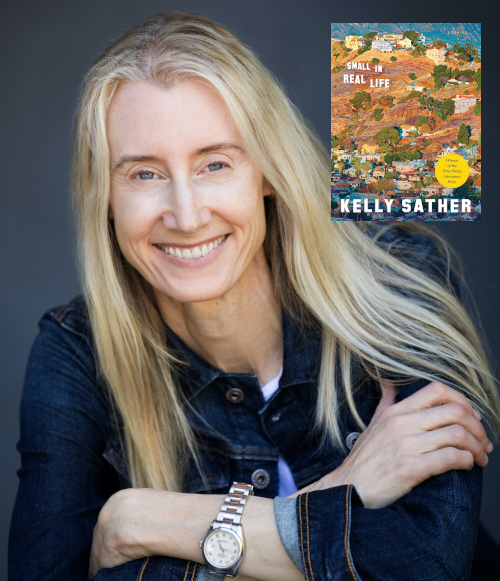
Kelly Sather’s collection of nine stories, Small in Real Life, reads with a sure-handedness that belies the fact that this marks her debut. It’s no wonder this book was chosen by guest judge Deesha Philyaw for the 2023 Drue Heinz Literature Prize and has garnered early praise from writers like Garth Greenwell and Yiyun Li. Sather manages both depth and range in this collection, which is steeped in Southern California sunshine and glitz, but doesn’t shy away from hints of noir. Included are stories of a paparrazo who winds up buddies with one of his celebrity targets at a ritzy rehab; of two girls who walk away from summer camp only to hitch a ride with a man turns out to be a criminal; of a widowed judge who finally agrees to go out on a date with a woman who discloses her darkest secret. Each story sparkles with wry humor and insight. This is a gem of a collection, so I was delighted to have a chance to discuss the book with Sather recently over email.
Joanna Pearson: Can you talk a bit about how you came to fiction, and to short stories specifically?
Kelly Sather: When I started writing fiction, I was a lawyer taking classes at night at UCLA, in screenwriting and short stories. UCLA Extension has great teachers. At the time I worked at Columbia Pictures in film production. I walked past soundstages on my way to get a sandwich at the commissary for lunch. So I was closer to movies, and that may be why I found screenplays easier to attempt. I also understood how screenwriters earned a living. And then I lucked out, a producer I knew hired me to write a screenplay, so off I went for a while. I took a break when my kids were young, and when I came back to writing, I wanted to write stories. They were short enough to manage, and I liked their compact power, in that way they reminded me of screenplays.
JP: My pet theory is that anyone who has ever been a screenwriter knows all sorts of helpful secrets about things like plot structure and dialogue that they bring to literary fiction. True, untrue? Are there tricks of the trade or ways you see your screenwriting past as particularly helpful to your fiction?
KS: I love writing dialogue. When I get to a conversation between characters a part of me lights up, there’s a feeling of Aha, we’re here! And I think that excitement comes from the time working on scenes. I have a sense of play and conflict, what’s interesting between these two people, how do their wants differ, what will they say to get what they want and how does that get redirected by the other person, where do they settle out with one another?
Deborah Eisenberg and Grace Paley are story writers whose dialogue has that energy of connect, disconnect, and humor. Dialogue at a slant.
The three act structure in screenplays, creating a beat sheet of scenes that escalate from one to the next with clear markers, inciting incident, act one break, and so on, those plot aspects are not something I follow in short stories. I lean in the other direction, into not knowing what will happen next, especially with first drafts. I try not to have a plan. Even while revising, I rely more on scene and dialogue instincts, they help me figure out whether a scene is meandering or less important to the characters and story.
JP: I found the jacket copy for your book so apt, which describes your collection as invoking “the myth and melancholy of Southern California glamour, of starry eyed women and men striving for their own Hollywood shimmer, of the seamy undersides and luxurious mystique of the Golden State.” I’m really curious to hear you talk about the myth and melancholy of Southern California as a source of inspiration for your work.
KS: I grew up in a small beach town inside Los Angeles and I felt like I didn’t belong there. I paid a lot of attention to how I should fit in better and how I didn’t. I imagine many writers may have felt this way, many people. My parents didn’t work in the entertainment business, but it was around, the movie billboards on Sunset Boulevard were enough to cast a Hollywood image of beauty and success. Whenever I was outside of California and people asked where I was from, they had a reaction, like the state meant beach and palm trees and famous people, and somehow this golden sheen made me more interesting, in their eyes, just because I lived there.
At times, especially when I was a teenager, it was an odd source of confidence. Reflected from someone else, and an image they had absorbed from movies or TV or culture created by our fascination with movies and TV and the sunny weather, the beaches and palm trees, too. Light bouncing off mirrors, and I’m interested in that juxtaposed against the real beauty, the sunset as you’re driving down the Coast Highway, and the shadow, the fact that so much of L.A. is covered in cement, its sprawl, the struggle to succeed here, the emphasis on appearance and youth.
JP: In two of my favorite stories, “Red Bluff” and “Oracle,” I felt in the best possible way echoes of Joyce Carol Oates and Tobias Wolf respectively, which may reflect what I’ve internalized as the reader more than your influences, but it brings me to ask: who would you consider your influences? Or, if influences isn’t quite the right word, what writers’ work has really stuck with you?
KS: That’s so nice to hear, thank you! Above my desk, I have this short piece by Mary Ruefle, “The Bench.” Amy Hempel sent it to me when I was in graduate school at Bennington, it’s about an ongoing disagreement between a woman and her husband about what size bench to get for their yard. There’s grief and understanding and humor. “The Bench” reminds me of the places of loss and togetherness I’m writing from.
A long time ago, I read Oates’ story “Where Are You Going, Where Have You Been,” and then found it again while I was revising “Red Bluff.” She builds suspense in small physical details and her portrayal of teenage girl hubris. As much as that gets Tessa into trouble in “Red Bluff,” I believe it might get her out of it. I also looked at Julie Orringer’s “Pilgrims,” I love that story for its chaos and inevitability. And, yes, Tobias Wolff. I read Maile Meloy’s stories as I started on the collection, and Edward P. Jones as I revised. Other influences, Hempel, Jennifer Egan, Mary Robison, Bret Anthony Johnston, and more recently, Garth Greenwell, I could keep on going here.
JP: How did Small in Real Life come together as a collection? Over what time span were these stories written, and how did you figure out when\what comprised the book?
KS: I wrote the stories in Small in Real Life over seven years and then put them together as a manuscript and worked on the collection for a few more years. Many of the stories were published in literary journals over that period, but reading them together helped me find areas that I wanted to go back and revise. In terms of what comprised the book, once I set a few stories next to each other, the manuscript developed a shape and I could tell what else to include. So it was sort of by instinct, also by tone.
JP: I love the title, which feels so perfect, especially now having finished the collection. How did you land on it
KS: I always knew the title story, which comes from dialogue in that story, and then eventually became a guide, a tuning fork for the collection. The story “Small in Real Life” was published in Santa Monica Review, a Southern California journal, so that’s an unexpected touchstone for the book. I was talking to SMR editor Andrew Tonkovich recently and learned it is one of the only journals, or the only, supported by a community college, Santa Monica City College. When I was twelve, I took a swim test at the SMCC pool to qualify for junior lifeguards that summer. I remember the taste of chlorine in the clear blue water, I swallowed a lot of pool water trying to make the time.
JP: I always want to steal other writers productive habits, so I’m curious to ask: how do you get your writing done? Do you have any fixed writerly routines?
KS: Ah, these are the answers I too want to know! I write in the mornings, at my desk. If I’m stuck I pull a book from the shelf and read a little. I’ll also scribble ideas in a notebook to see if that helps. I’ve tried using separate notebooks for different projects or genres—stories, essays, novel (I’m working on a novel!)—but I go back to the one notebook for everything, with lots of Post-its. It’s messy. If I’m traveling I bring a blank notebook with great plans to handwrite an entire story, but that hasn’t happened, yet.
JP: What have you read recently that you’ve loved and would recommend?
KS: Western Lane by Chetna Maroo, Direct Sunlight: Stories by Christine Sneed, The Late Americans by Brandon Taylor. I just started The Last Thing He Wanted by Joan Didion.
JP: Are you working on any new projects?
KS: A few essays, which ask for different writing muscles, and a novel, which feels familiar and also freeing, to roam the landscape of a hundred pages plus.
Joanna Pearson’s debut novel, Bright and Tender Dark, is forthcoming with Bloomsbury in 2024. Her second short story collection, Now You Know It All (University of Pittsburgh Press, 2021), was chosen by Edward P. Jones for the 2021 Drue Heinz Literature Prize and named a finalist for the 2022 Library of Virginia Literary Awards. Her first short story collection, Every Human Love (Acre Books, 2019) was a finalist for the Shirley Jackson Awards, the Janet Heidinger Kafka Prize for Fiction, and the Foreword INDIES Awards. Her fiction has appeared in various journals, including Alaska Quarterly Review, Colorado Review, Ecotone, Kenyon Review, Sewanee Review, Subtropics, as well as others, and has been anthologized in The Best American Short Stories, The Best American Mystery and Suspense, The Best Small Fictions, and Best of the Net. Joanna has received support as a fiction writer from the Sewanee Writers’ Conference and the North Carolina Arts Council/Durham Arts Council, and support as a poet from the Bread Loaf Writers’ Conference, Sewanee Writers’ Conference, and Yaddo. She holds an MFA in poetry from the Johns Hopkins University Writing Seminars and an MD from the Johns Hopkins University School of Medicine. Originally from western North Carolina, she now lives with her husband and two daughters near Chapel Hill, where she works as a psychiatrist.
Check out HFR’s book catalog, publicity list, submission manager, and buy merch from our Spring store. Follow us on Instagram and YouTube. Disclosure: HFR is an affiliate of Bookshop.org and we will earn a commission if you click through and make a purchase. Sales from Bookshop.org help support independent bookstores and small presses.
 Heavy Feather Review