
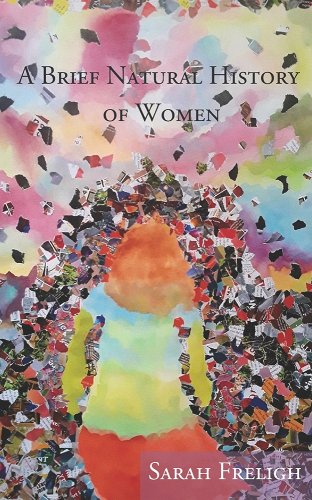
Every universe has its ruler, a tool that inches toward an unquestionable, crowning truth. Such is the case with Sarah Freligh’s A Brief Natural History of Women, her collection of flash fiction, some flash clocking in at a quarter of a page, others slightly longer, but all equally satisfying in their landings. If veritas is to be found in flash, it is this: make me care, and how can you not care upon meeting Freligh’s modern day troubadours as they wend their way into your soul.
Oh, they dance across the stages skillfully set by Freligh, anywhere from the waxed halls of skanky middle and high school halls to the stained lino of bars, from bathtubs to bodies of water. Bruised and smeared, the women in the stories shine for more than a moment, leaving a dark throb that reminds you: I was once there. And if you weren’t, Freligh will take you there.
Her women emerge from commonality, married in imperfect unions with vacillating states of being. Take a sister, mourning a brother: “You often don’t go home because what’s home about it anyway—a tiny apartment with a sinkful of dirty dishes, fist of hair clogging the shower’s drain, a scraggly orange cat that hangs out on your back stoop, howling his terrible need and hissing when you get too close.” Take women edging beyond the men and fathers of their childhoods: “We grow up, go away, marry men who are not our fathers, men with soft hands and clean fingernails. Men who read stories to their daughters about cloth rabbits and moons and spiders that die alone.” Consider (carefully, please) women for whom abortion was not an option: “Because there was no morning-after pill, not yet, no abortion that wasn’t back-alley Detroit or two weeks in Sweden.” Above all, consider the taut and targeted prose deployed by Freligh as she chronicles the lives of women.
This collection brilliantly conveys the basics of flash—there’s no soft landing, only a hard bounce on streamlined reality. The form allows no wasted words, no ink outside the frame, and nothing mawkish or overtly sentimental. Distress and pain mark every page of Freligh’s collection. We live murder, violent accidents, addictions and illness, we feel the ache of an alcoholic trembling for a drink, and tears of loss will course down our faces as we recognize undeniable guilt, grief, and sorrow.
In the flashes, Freligh often adopts the narrative stance of a group narrator in a huddle not unlike that seen in football, where arms link and heads gently bonk as they strategize. But it’s not Freligh’s intent to withhold, rather she leans into the strength engendered by numbers. The end result is solidarity, which is quite unlike the final point posited in “The Monolithic Unforgiving Group Narrator” by Dedria Humphires:
The group narrator is threatened only by individual agency. But, in a twist of fate, the group narrator grows by recruiting individuals. When the group’s desires go unfulfilled by the individual resisting affiliation, group aggression corners the individual until they are vanquished. Groups form when individuals relinquish their autonomy, but they cannot exist without individuals.
Freligh’s characters do not relinquish their agency. Turn “individual resisting affiliation” to oblivious, psychologically impaired men and the point becomes clear. Women understand one another in ways no outsider possibly can, a gift they possess as “bleeders”: “Here is this and this, they tell us: the tidy lima bean of uterus, the twin snakes of Fallopian tubes into which we’ll hatch eggs once a month for forever, such a lovely thing to be a girl, they tell us.” The collection’s gritty tone reflects women on the edge, women who’ve come to a point where nothing but truth matters, and Freligh is unsparing in her acknowledgment that each individual’s agency bonds the group.
It may feel as if the women have no agency or autonomy. Not so. What they have is Freligh’s attention and powerful voice. In her hands, these women are not stoics nor are they the weepy sort, which is a relief. Nor does Freligh deny them their emotions. Many of the narratives echo Ovid or Virgil in their wrastles with fate, which will not be denied. In this case, the chronicle IS the thing.
And like the penultimate moment in Tobias Wolff’s “Bullet in the Brain,” the collection’s silent chorus chants, “They is, they is, they is.”
A Brief Natural History of Women, by Sarah Freligh. Small Harbor Publishing, June 2023. 56 pages. $18.00, paper.
Catherine Parnell is an editor, educator, and co-founder of MicroLit Almanac and Birch Bark Editing. Her publications include the memoir The Kingdom of His Will, as well as stories, essays, and interviews in Switch, Emerge (ELJ), Cult, Orca, Grande Dame, West Trade Review, Tenderly, Cleaver, Free State Review, Barnhouse, The Brooklyn Rail, The Rumpus, The Southampton Review, The Baltimore Review, and other literary magazines.
Check out HFR’s book catalog, publicity list, submission manager, and buy merch from our Spring store. Follow us on Instagram and YouTube. Disclosure: HFR is an affiliate of Bookshop.org and we will earn a commission if you click through and make a purchase. Sales from Bookshop.org help support independent bookstores and small presses.
 Heavy Feather Review