
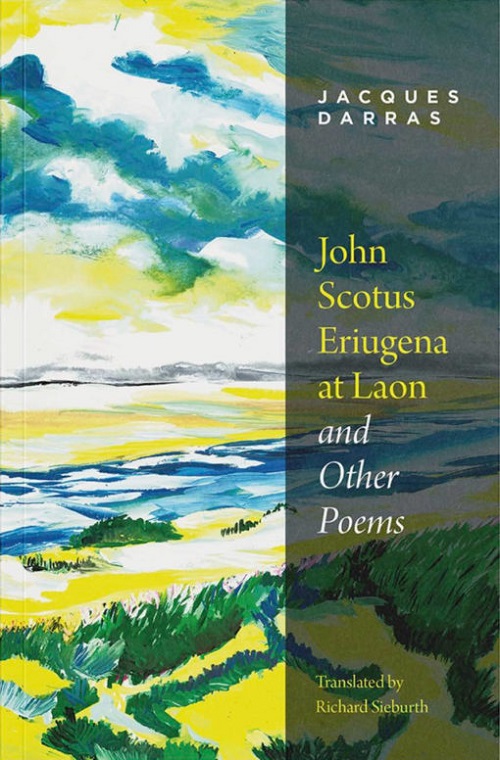
In “To Augustine: On Paradise”—a central text in Jacque Darras’ John Scotus Eriugena at Laon and Other Poems—he writes, in the voice of a pagan in the 5th century A.D.: “As a youth, raised by my direct contact with Nature, I was a pagan. Although I never observed the formal rites or sacrifices of the official cults of the Empire, I long believed in the powers and multiple shapes of the Divine.” For Darras, a pagan sensibility is characterized as a visual and aural sense that perceives and listens to the natural world, observes the landmasses and rivers, without the compulsive desire to measure or categorize the world so characteristic of the empiricists who are obsessed with “Splitting hairs, always splitting hairs!” Nature is complete in itself, in all its simplicity and complexity: “the sea does not rot / the sea does not sink … the sea does not cease … the sea is not what we please … we are governed by the sea.” The Absolute occurs in a horizontal rather than a vertical space: “Paradise” is here and now, not in some abstract heaven above, but rather observable in the way the wind moves, the sea surges, the cold breeze moves through the night air.
Jacques Darras seeks the often difficult and sometimes barren and cold terrain of the North (Ireland, Scotland and Wales) to chart his physical and intellectual path; he seeks to create a frame different from that posited by Christian theology: “I prefer to imagine that the path to Paradise entails a far more difficult sailing, in agreement with those who resisted Christianity or who converted without abandoning their ancient wisdom (such as the Celts of Hibernia who occupy an island far beyond the one I here face).” For Darras, the cold of the North resonates with a pagan sensibility: “The cold preserves.” The Northern tribes that bordered Rome, were late in coming to Christianity after the collapse of the Empire. It was Rome that moved “into the North with its thermae,” the name given to the vast complex of public baths, that offered relaxation and social activity. As opposed to these simple comforts, that promote laziness and stasis, and ultimately death, Darras sees the North as a world pregnant with possibility which offers a new way of seeing. In “An Island Tongue,” Darras suggests this in the following way, relating the terms of language to geographical space:
A tongue composed only of nouns, in the intervals of which would float a multiplicity of liquidities, syntactic elasticities.
An horizon of expectation, is this not what poetry engaged?
Always further out to sea, never deep enough into ocean
To steer an unreasonable course way from prose.
Away from prose, away from all its rhymeless reason
So that, should Paradise exist for the poem, it shall only be accessible in the stutter of an archipelago.
He will go “further out to sea,” charting the unknown rather than go deeper into the ocean: it is the difference between movement and stasis. There is a stutter deep inside Darras’ language, it is the language of the mythical Io, which is the voice of the intense fragments of desire. The stutterer destabilizes the imperial tongue.
Darras evokes the language of the Anglo-Saxons when he writes of the suffixes of those Northern nomadic tribes: “I take great pleasure in hearing the contrasts of consonants that mark the new names with which these people have baptized their settlements. All their rich suffixes—ham, hem, thun, ghen—supply the surrounding slopes with a kind of lilt that works well with the whipping wind.” One is reminded of the linguistic changes in the Middle English that have been linked to the influence of the 8th and 9th century Viking invaders who conquered territories in the vicinities of Northumbria (Basil Bunting’s territory), Lincolnshire and East Anglia. This is the Anglo-Saxon, with its “contrast of consonants,” that you can still hear in the poetry of Basil Bunting and Gerard Manly Hopkins.
Darras models his thought on nature’s terms. The movement of the river in its journey to the sea, the multiplicity of natural forms, is opposed to the arbitrary doctrines of the Empire:
My rivers attach me to the North. They are the liquid laisses of ancient French epics; they’re women who have been released from the small drudgeries of femininity. Free to seduce or not to seduce, they experience as much pleasure from distancing themselves from men as they do from setting out to the open sea. They have my vote as an aristocrat of democracy; to win them over involves accompanying them in all their twists and turns.
His vision of the universe is large and comprehensive: “As for Incarnation? Its language is only apprehended through the mutual speech of bodies.” Furthermore, “More difficult than the love of our equal is the love of humanity.” To “write” like the movement of the rivers, is to express oneself in alignment with the voice of Nature: “I consider myself a man who retells rivers … whose speech might lead to the ultimate sea.” The waves of the sea can be said to convey one aspect of how Nature functions and point to an Absolute that is independent from Christian thought.
When a pagan looks at rivers and landmasses he really sees them, knows them, experiences their history; it is a way of knowing and seeing that is “free from the frigid dictatorship of the eye” which is the “single, solitary eye” of God; he learns that these rivers are a part of our lives, not distant fictions, and relates them to something like the materialization of human soul. Darras is interested in a horizonal (material) not a vertical space (heaven):
This is the deep secret of rivers: they cross through us only inasmuch as they flow in the direction of our lives. They’re time turned to water, sometimes slipping ahead of us like a materialization of the soul. They require no particular mood. To gather them in merely requires us to accept things as they come.
For those nomadic Northern tribes, Nature itself is a kind of manifestation of God. The forms of the natural world are multiple, not singular. The lands of the earth contain the remains of an ancient language in the breeds of its fauna. Instead of a Christian theology, Darras offers an alternate view of nature, where God could be perceived in the “islands of the earth” not in some ideal City: “Up to now it has been the islands of the earth that have most reflected my desired image of the City of God. Magnetically attracted to each other, at times broken-backed in their highlands, retaining the spoor of ancient breeds in their fauna, more or less tracing the circles of their own contours, do these islands not bear the stamp of analogy?”
Darras elucidates a kind of pagan metaphysics that relies not on Christian theology but rather on sensation. Sensing the cold breeze that bends the leaves of a tall tree, the sand being blown by the wind from the sea, he writes: “I’m aware I’ll have trouble conforming to the City of God, endowed as I am with this vitality, this legacy of Nature.” For example, we cannot see the wind moving the branches of a tree but it can be sensed. We do see without seeing: it is an “oracle of wind within trees / saying nothing not already said / before or beyond / this silence / demanding focus, a body / alert to the source, to the liquid / beyond reach …” In Nature, listening is being receptive; it is open ended and requires concentration. Meaning is not generated by thinking about something but by experiencing it sensually; the way you bite into a fruit and feel the luscious juices in your mouth. There is an intimacy in such a relation to the natural world; there is pleasure, also, independent of any human law or morality: it is “a question of infinite tact, of eros.” Furthermore, Darras writes: “I know no other flame more beneficial to a man’s body than the heat kindled by his encounter with female flesh … Fire and flood fall upon the house of the human body when desire bursts into flame – our safeguard, our annihilation … Love is not of the same essence as Evil …” This relation to sensual experience largely disappeared after the major religions came to dominate the East and West and codify their laws; as a result of which, many of these pagan experiences had merged with Catholic doctrine and ritual: “Everything contracted into a locus of theology.”
It is interesting to remember the relation of this Christian theology to Ancient Greek thought, which believed that faith in logical reasoning was an attribute of the good life. For the Greeks thought had a terminal point beyond which any idea is considered irrational and not worthy of logical consideration; indeed, what is beyond the spherical world (the earth) and the fixed stars was unthinkable for the Ancient Greek. Diogenes Laertius, in his Life of Anazagoras, writes, “When someone asked him what was the object of being born, he replied: ‘to investigate the Sun, Moon, and heavens;’ for Diogenes, this was an enclosed, spherical world, that could be investigated and apprehended through Reason. The distance between the center of the sphere and its outer boundary, the fixed stars, is constant for the Ancient Greek. So the distance between the One or Unity is constant in relation to the man. And the spirit that emanated from the sphere alternately created enthusiasm in the thinker. But it was a rational passion that always sought to profoundly understand the all-encompassing unity of the One by contemplating the perfection of its form. The world, for an Ancient Greek philosopher, conceived of as a sphere, gathered no darkness from an unknown outside; this darkness, in temporal terms, referred to the world of the nomadic tribes that surrounded the State.
The Greek philosopher Philostratus uses the word “barbarian” (βάρβαρος) to describe the Medes, who were an ancient Iranian people who lived in an area known as Media (northwestern Iran) and spoke the ancient Median language. He describes them as “degenerates … whose lives are ruined.” But for Darras, in “To Augustine: On Paradise,” it is important to travel, to keep on the move, to be nomadic, both intellectually and physically, winding and twisting like a river on its way to the sea, its final destination: “There is nothing barbarian about wanting to fare forth into elsewhere, except in the eyes of those who enthralled by the stillness of death. It’s hard for me to imagine, given the strength of my desire for eternity, that in crossing this final strait, however narrow it might appear from the landlocked view of our demise, we not undergo an increase in motion, an increase in love.” In this Darras is close to Dante’s idea that Love is the force that moves the stars.
But our human bodies are imperfect and cannot resonate in the same way with Nature; our self-expression is imperfect because it contains that which cannot be said: our language does not give a full account or reality while the natural world is self-sufficient. Humankind is complicated by his own desires, because, in a certain sense, Nature remains anonymous and distant from the human: “Nature at its most spectacular dominates the space of human activity without annihilating it altogether, possessing as it does the superior advantage of anonymity.”
Man is alienated in an age where the “inner self” receives so much attention, whether from the point of view of a materialist or a spiritualist. Darras’ poetry offers a different viewpoint more in line with a Northern sensibility. He elucidates a kind of negative metaphysics in relation to God. We can only see nature as parts of the whole; the totality of existence is beyond human comprehension. For the German philosopher, Meister Eckhart, this very lack, this darkness, was employed to prove the existence of God. Eckhart writes: “Truly, it is in darkness that one finds the light, so when we are in sorrow, then this light is nearest of all to us.” Eckhart’s thought influenced John Scotus Eriugena, an important philosopher from the Carolingian period; like Eckhart, he also invokes the ideas of negative theology. For him, evil and sin are negations that do not exist and cannot be caused by God. In a kind of ecstatic poem, “Sea Choirs of the Maye,” Darras writes, invoking John Scotus Eriugena’s Neoplatonic ideas about light:
I love the light
like anybody else I love the light
I love the sun above all I love the light
I love the lightness of the light …
enroll in the school of light …
you cannot see light until you have seen light
light luscious fruit when the time is ripe
For Darras, it is through the darkness of sorrow that one finds the light.
In order to experience God we have to empty ourselves, as Eckhart taught. God cannot be known in terms of gendered language or through the common use of thou or ye. Darras writes:
It, it seems to me, plays as great a part in the person of God as does the thou or ye or the he or she that bind us all into a collectivity, engineering mutual exchange. A lever, this it lifts burdens from our backs, fickle enough to ease the weight of heaven from our shoulders.
I compare this neuter to a discrete emissary of the divine, granting us both laughter and enigma, without our quite knowing how they differ. And if God were nothing but matter? A sudden anxiety. What if we no longer recognized our shapes as human in the morning light of Paradise?
So if we “could rid ourselves of our names without thereby ceasing to explore our recognitions of the other, we’d no doubt be far more at ease.” But what if God was not conceived of in an abstract beyond, but can be seen in the way the breeze bends the branches of a tall tree, or the sea waves crash against the shore, or the way the light plays upon the sand? What if Paradise was the here and now? These are Darras’s questions. His poetry suggests that we should move away from thousands of years of theological thought that consistently distance us from the direct encounter with nature, without sacrificing our sense of the Divine. Darras writes:
What will the verb ‘to be’ mean to philosophy when the cold weather reaches as far as God, and our noses start running after the slightest stroll on the beach? Perhaps you can now better understand why I have chosen to make my home near a northern strait. I intend to make my way to Paradise just as you have, but wanting to take into account everything that lies nameless and dark within us – this desire you so despise, these crowds among which you announce the disaggregation of our individual freedoms.
Darras’ project is nothing less than an ontological revolution; instead of defining or gendering ourselves, we should use the neuter, in order to close the gap between ourselves, Nature and God, to envision not The City of God, but the City of Earth, where Paradise is visible in the present, in the sensual experience of other bodies, in the experience of looking at the sea. And the cold of the North preserves; it preserves the language hidden in the natural world, that of our nomadic ancestors who roamed the periphery of the Empire; in this respect we are all immigrants.
John Scotus Eriugena at Laon and Other Poems, by Jacques Darras. Translated by Richard Sieburth. New York, New York: World Poetry Books, September 2022. 142 pages. $20.00, paper.
Peter Valente is a writer, translator, and filmmaker. He is the author of twelve full length books. His most recent books are a collection of essays on Werner Schroeter, A Credible Utopia (Punctum, 2022), and his translation of Nerval, The Illuminated (Wakefield, 2022). Forthcoming is his translation of Antonin Artaud, The True Story of Jesus-Christ (Infinity Land Press, 2022), a collection of essays on Artaud, Obliteration of the World: A Guide to the Occult Belief System of Antonin Artaud (Infinity Land Press, 2022), and his translation of Nicolas pages by Guillaume Dustan (Semiotext(e), 2023).
Check out HFR’s book catalog, publicity list, submission manager, and buy merch from our Spring store. Follow us on Instagram and YouTube. Disclosure: HFR is an affiliate of Bookshop.org and we will earn a commission if you click through and make a purchase. Sales from Bookshop.org help support independent bookstores and small presses.
 Heavy Feather Review