
I Want to Live in Your Old Lady
I want to live in your old lady, I messaged the woman on Airbnb. I hoped my phrasing might catch her attention amidst the booking requests, evoke a certain voluptuousness for life. A deep, deep need to stay in this very trailer on the beach.
From the photos, the exterior was old lady enough, with its retro curves and pallid peach awning. But inside, inside was a bare shell. The walls read white-washed adobe, with recessed shelving in all the right places—those organic rounded touches that spoke to millennials, whispering, in here, nothing hurts.
It worked. I pictured myself coming in from a day at the beach, rinsing off and then slipping into crisp sheets, placing my glasses into the curved hole next to the bed. I couldn’t wait to fill each shelf.
When I arrived, I found old lady jammed into a trailer park. The woman kept the pavement and the other shining metal homes out of view in photos, as if old lady was off on her own. Inside, the trailer felt sonically different, like the entire space was encased in a sound-proof foam. I knocked on the walls with my knuckles, and the plastic of the walls bounced back. I had to laugh.
I wrote a letter of encouragement to myself there, tucked it into the kitchen drawer. My friend swears by this—catching yourself off guard in the reflective company of spoons.
I spent the day at the beach forgetting, because going to the beach is like blacking out but blue. I walked, I sat in the waves, I slept. When I woke, I said out loud, if we opened me up, we’d find beaches, quoting Agnes Varda just to try it on. Beaches so vast there’s no there there (Varda, quoting Stein). The beach was nowhere, home free.
A group of strangers walked closely by, and I realized I was playing the role again, a woman with a broken heart rebounding by the beach, my sunhat dipped to my chin, my palms up, receiving.
It got dark. I trudged back to old lady, first picking up some sea-things off the beach. I poured a plastic grocery bag full of sand onto the biggest shelf in the trailer, pushing the shells in.
I slept poorly. In the dark, I got up without my glasses, walked over to the beach scene I’d made. I held a shell to my ear, thought the sound of the ocean would soothe me—the trailer so insulated I could’ve been anywhere. I couldn’t hear a thing in that shell. I’ve heard more ocean inside a glass of champagne.
The next morning, I decided to spend the rest of my stay on the beach. I wheeled my suitcase, towels, belongings, all out onto the sand. A man in a sun chair looked at me, as if to say, you’re going to bring all of that out here? I smiled. I wore my underwear and t-shirt, because what else does a woman wear when she brings the inside out?
To keep my phone and keys safe, I placed them in a large shell, shaded from the heat. I used a piece of driftwood as a lap desk, balancing my laptop on top of the wood on top of my knees. But then I had the idea to use the sand as a desk. My laptop was ancient anyhow, and pushing the black box into the sand, watching the grains barely bury it, was even more satisfying than putting a phone in rice. I stuck pens into the sand sticking straight up for easy access. A hermit crab came over to investigate. I gave a pen to the hermit crab, watched it place a claw over it. Something to think of me by.
Hermit crabs buzzed around a pile of trash near me: soda, fish tins, empty cans of beans. I picked up the garbage into my plastic bag, drifted to sleep to its sad balloon shape. I woke in the night to a hermit crab using a mackerel tin as its shell. I never ran faster, heaving myself across the beach with the bag of trash, placing everything back like I’d found it.
I spent the rest of the night on my phone, reading about the ecosystems of hermit crabs. How when they find a new shell, they line up in shell-size order, get naked and trade shells down the line. A hermit crab climbing into its new home resembles a woman sinking into a hot bath, a welcomed stretching in and down.
I tried calling out for crabs, so I could lead them back to their tiny pile of homes. I waded in the ocean, looking for roomy shells to place near the pile of trash, giving them the natural option. I held a shell in one hand, and a tin in the other, and thought about which I’d rather live inside. The shell was harder, safer, but the tin seemed better for the back. I couldn’t sleep, thinking about the bare butts of crabs.
When I dozed, I dreamt the crabs were writing me a eulogy for my current relationship. It took the whole family of crabs to hold the pen.
The beach was no longer nowhere—it became home the minute I hauled myself into the sand, started caring for crabs.
And then I started thinking about his lap, his crossed-legs, bony but home, the way his dog was always resting there. I knew I couldn’t ask to climb into his lap without him thinking kink. I left him, the dog in his lap the whole time I was leaving.
His dog in his lap reminded me of a memory, collecting tiny clams as a child into a bucket, taking with it sand and water. Squatting there next to the bucket out on the balcony, seeing tiny soft-bodied creatures bobbing in each shell. Realizing the shells were already home to those creatures, that me bringing them home displaced them; that no matter how hard I tried to dump them back where I found them, it was different ocean.
That once displaced, you spend your whole life searching for home, placing your heart into another, then another, another; forcing the fit.
Mini-interview with Christina D’Antoni
HFR: Can you share a moment that has shaped you as a writer (or continues to)?
CD: I took a workshop with Sheila Heti this past summer, and during class she shared with us something she had written in the middle of the night in her hotel room. She emphasized the importance of catching a moment of being, writing it down before she misses it.
I’ve always been a more measured writer, one that really trusts my Notes app, that whatever I have written down will reveal what I need it to when the time comes to write.
I think both can be true, but I’m paying closer attention to my “moments of being,” especially if that moment holds some fire, or if it feels like the seed of a flash piece. Now I’ll hurry to the laptop to get something down.
HFR: What are you reading?
CD: Everything from Dorothy Project, especially Renee Gladman’s Ravicka novels, and Some of Them Will Carry Me by Giada Scodellaro.
HFR: Can you tell us what prompted “i want to live in your old lady”?
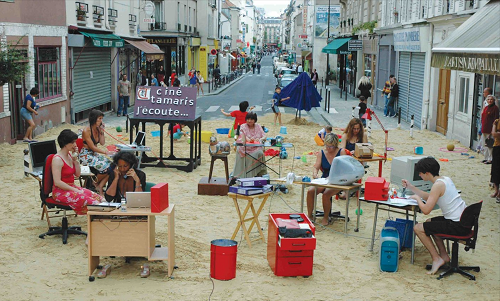
CD: I watched The Beaches of Agnès directed by Agnès Varda and fell in love with that first scene, where she says, “If we opened me up, we’d find beaches.” Then I found an article where Varda references Gertrude Stein describing her childhood home: “There’s no there there.” I started to make connections in my own life about what the beach did for me, how it temporarily cured my long-felt displacement after Hurricane Katrina. I decided to include these quotes directly. Also the scene in The Beaches of Agnès where Varda builds a temporary beach/office on Rue Daguerre where she used to live is so delightful. I could write a whole novel about a professional woman “working from beach.” I was also reading Molly Reid’s The Rapture Index at the time, which has such memorable coastal imagery.
HFR: What’s next? What are you working on?
CD: I’ve just graduated from my MFA, so I have a couple book projects that need revising. The one that’s closest to being finished is a collection of short stories about the lives of people from the Gulf Coast post-Katrina.
HFR: Take the floor. Be political. Be fanatical. Be anything. What do you want to share?
CD: A few things on my mind: Administrative assistants deserve the world. A baked good in the bath is always nice. And this one-line short story entitled “Memoir” by Amy Hempel: “Just once in my life—oh, when have I ever wanted anything just once in my life?”
Christina D’Antoni is a writer born and raised in New Orleans, Louisiana. She received her MFA in fiction from Arizona State University, and reads flash fiction for Split Lip Magazine. Her work appears in the latest issue of Washington Square Review. You can find her on social @cgdantoni or at christinadantoni.com.
Photo courtesy of Cinema Guild
Check out HFR’s book catalog, publicity list, submission manager, and buy merch from our Spring store. Follow us on Instagram and YouTube. Disclosure: HFR is an affiliate of Bookshop.org and we will earn a commission if you click through and make a purchase. Sales from Bookshop.org help support independent bookstores and small presses.
 Heavy Feather Review