
Either he dies or I die.
—Duk-Koo Kim, before his 1982 world championship boxing match with Ray Boom Boom Mancini
I.
The boxer Duk-Koo Kim grew up poor in Kojin, a fishing village east of Seoul.
Whenever he asked for money his mother walloped him.
His mother married four times.
At fourteen he moved to Seoul, lived on crackers, slept under a bridge.
He wrote in his journal: “Poverty is my teacher.”
In Seoul Duk-Koo learned to box.
He met a girl named Young-Mi, bookkeeper at a tea company.
Young-Mi worked above Duk-Koo’s gym. He flirted with her in the hall, awkwardly.
Young-Mi was Christian, proper, pale. Duk-Koo was dark-skinned. She ignored him.
He thought of her while he boxed. Fell in love.
He won her over with letters. He wrote: “When a man cries because his heart aches, the whole world, heaven and earth, cries with him.”
They say Duk-koo, not a great fighter, became a brave one. In just a few years he went professional, got a title shot.
They were engaged when Duk-Koo flew to Las Vegas for the lightweight championship of the world.
So distraught by his leaving, Young-Mi could not wave goodbye.
She was pregnant.
II.
Duk-Koo’s opponent, Ray Boom Boom Mancini, was young, aggressive. Hungry.
Mancini’s father, also called Boom Boom, had been a serious boxer, a contender.
That ended in 1944, near the French town of Metz: he was wounded by shrapnel from an exploding German mortar shell.
Duk-Koo said, of the slot machines, “This is like heaven.”
Duk-Koo wrote in blood on a bathroom mirror: “LIVE or DIE.”
III.
Early rounds of the prize match, Duk-Koo fought well.
He wore Mancini down. Tore open Mancini’s left ear, puffed up his left eye. Mancini’s left hand swelled twice its size.
Then, in Mancini, something shifted.
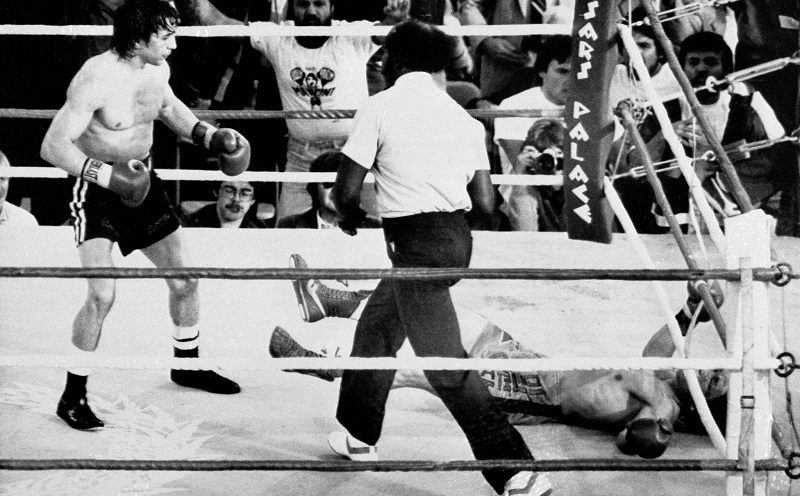
14th round, Mancini charged, hit Duk-Koo with a right. Duk-Koo reeled.
Mancini, missing with a left, caught Duk-Koo with another right that lifted him into the air, off the mat.
Duk-Koo fell hard, rolled over, slow, staggered, held the ropes. As if just born. Amnesiac beside a gushing river.
The referee, Richard Green, stopped the fight.
IV.
Duk-Koo on a stretcher. In a coma.
Subdural hematoma. After surgery, he died.
The neurosurgeon said it was the punch, that hard right, that killed him.
Duk-Koo’s mother flew to Vegas in time to turn off his life support.
Duk-Koo, buried on a hill in Kojin.
Three months later his mother drank pesticide, died.
One year later Richard Green shot himself with a handgun, died.
V.
Was it a “lucky” punch?
Sugar Ray Leonard, commenting on the fight, said round 13 was even.
Could Duk-Koo just as easily have punched Mancini to death?
A childlike part of me imagines I’ll know the day I die.
That if I have a motorcycle accident, there will be warning signs. I will be forewarned, waking that morning, climbing on the bike.
But we do not know.
Death says, Surprise.
VI.
Twenty-eight years later, Mancini paid to fly in Young-Mi and her son with Duk-Koo, Jiwan.
It’s all on film in The Good Son, a documentary about Mancini and his father.
Yet the moment when Young-Mi and Jiwan arrive, near the climactic end of the doc, seems off somehow.
One of the cameras: hand-held in neighbor’s bushes. Piano music indicates deep feeling.
At dinner, Mancini voices his guilt.
Jiwan, wearing a powder blue blazer and elegant glasses, watches the old boxer patiently.
Jiwan says, in English, “When I saw the fight the first time, I feel some hatred to you.” He learned over time to forgive Mancini.
Mancini seems contrite.
It’s scripted, heavily edited: impossible to know what passed between them, or was revealed.
At one point Mancini examines a photo on the mantel: his own father, the elder Boom Boom.
The father’s wide fawn eyes swollen shut; dried blood on his lips, towel over his head.
He’d just beaten Billy Marquart to a pulp, in 1941.
John Wall Barger is the author of six collections of poems. His book of essays on poetics and film, The Elephant of Silence, comes out in spring 2024 with LSU Press. He’s a contract editor for Frontenac House, lives in Vermont, and lectures at the Writing Program at Dartmouth College.
Image: nytimes.com
Check out HFR’s book catalog, publicity list, submission manager, and buy merch from our Spring store. Follow us on Instagram and YouTube. Disclosure: HFR is an affiliate of Bookshop.org and we will earn a commission if you click through and make a purchase. Sales from Bookshop.org help support independent bookstores and small presses.
 Heavy Feather Review