
In 1976, a busload of children was hijacked by masked, gun-toting men. The Chowchilla, California (near Sacramento), bus kidnapping and live burial remains one of the most bizarre, and under-reported crimes in American history—from the $5 million ransom the wealthy perpetrators never got to demand, to the daring, bus driver-led midnight escape from the underground quarry bunker where the screaming kids were held hostage.
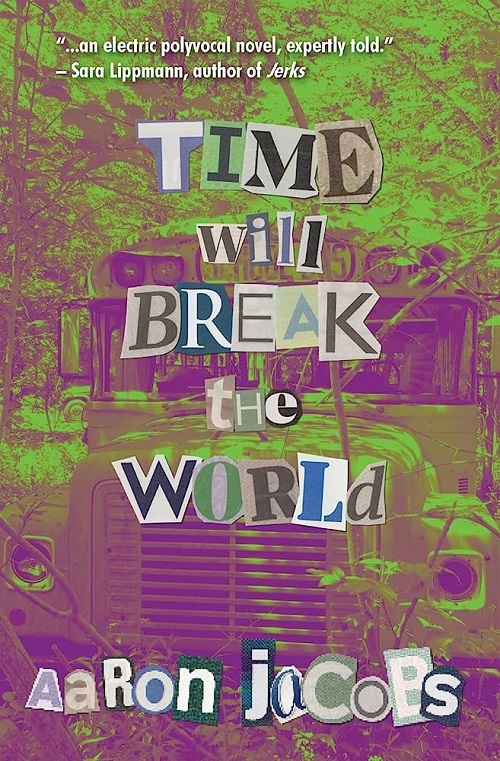
This real event is the subject of Time Will Break the World from Aaron Jacobs. Though fictionalized and reset in 1984, the book examines what goes through the mind of a child during a terrorist attack or school shooting, when Mom and Dad and other beloved ones are too far away to hide behind, hold, or die alongside.
Time Will Break the World recreates what we need to know most—what happened, why, and who does one become when childhood, according to one real victim, suddenly ends when the kid is only six or so years old during the trauma? After the unforgettable.
The decision to move the kidnapping to 1984 is a consequential one. It shifts the story away from the territory of a thinly veiled historical depiction and lets it become a living and breathing novel. Jacobs repurposes the crime for his own uses—to investigate the long-term effects of random acts of violence, set against the backdrop of a society that pays little more than lip service to mental health.
First, the creepy school bus environment takes over, from the interrelated characters defined, rebelling, controlled, and bullied, just as they are in school. When masked gunmen board, putting a gun to the driver’s head, the children’s first existential encounter launches the narrative’s shifting machinations.
Brenda and Emily Mashburn—twin sisters, rely on each other’s creative ideas of how they’ll die by forced drowning from the intruders, Calvin and Jason Schott. Escaping that imagined horror becomes their priority as the terrorist brothers detour the kids many miles from childhood’s wonder years—thus, the book’s clever title.
Thirty years after the crime, Calvin Schott hopes for his exit from state prison, as previously paroled Jason Schott urges his brother’s release prior to their bitter mother’s pending death. From the characters’ violently interrupted childhoods to their manic adult years, Jacobs guides a literary walking tour of the doomed passengers’ psyches.
Just 10 at the time, Emily Mashburn is now a mother herself, suspended in monomania: keeping Calvin Schott in prison through victim activism, hoping to co-produce a film with sister Brenda about the kidnapping. Brenda Mashburn is a broadcast journalist with no real interest in her sister’s documentary, compelled to help only out of loyalty.
Pat Earl, the bus driver, blames himself for letting the Schott boys hijack the bus, struggling with guilt, though by today’s standards he is clearly a heartbroken hero. One we root for.
Then there’s Andy Kraven, seven at the time. Imagining he’s in a gang with his friend Kaito Watanabe, Andy fails to see the kidnapping for the ordeal it is. Until he ages, years away from the school (and Japanese immigrant) Kaito, who’ll later enter the bond market and the edgy world of sports gambling.
With Pat Earl, Martin Mendoza masterminds the escape of all from the Schotts’ underground captivity, like two heroes attempting to escape their own heroism.
Passenger Lindsay Robinson, at 12, was convinced she’d marry Matt Dillon. In a narrative scenario like one real-life Chowchilla kidnapping victim, Lindsay grows up to say that her “childhood ended” that July afternoon when the bus failed to arrive at home—a frequent topic of her podcast, The Awakened Mind.
The alternating narratives—1984 and 2014—complement and contrast each other. Dark scenes of the students’ captivity are offset by moments of present-day introspection and small comforts offered by family members. Characters’ memories are shown to be faulty, or willfully edited to protect the psyche. Twins and doubles proliferate throughout the novel, like the perpetrator Schott brothers, the Mashburn twins, and two 13-year-olds named Lance “Doodoo” Viscuso and Martin Mendoza (the sad yet intelligent target of Doodoo’s bullying), enriching the parallels between past and present.
America’s fears in 1984 were certainly Cold War fantastic, yet gymnast Mary Lou Retton—who plays the youthful Olympic hero in Time Will Break the World—was distraction enough to subside such mundane domestic terror worries, and offers a counterpoint to the Schott’s mundane child-mind destruction.
Ultimately, the intensely suspenseful Time Will Break the World relives the characters’ greatest fears, illustrating how some folks, no matter how capitalist and free, won’t get beyond childhood traumas—a refreshing, acceptable view by Jacobs in light of literature’s unrealistic preoccupations with redemption, learned morality, and preachy recoveries.
Time Will Break the World, by Aaron Jacobs. Run Amok Crime, July 2023. 294 pages. $18.99, paper.
Activist Brandon M. Stickney began as an intern for a top rock journalist “when publishing used to be cool as fuck.” He then profiled murderer Timothy McVeigh and controversial 1880s fashion celebs the Seven Sutherland Sisters, now in consideration for a Marley Morrison film. Stickney’s expose, The Five People You’ll Meet in Prison, was published by Bancroft in 2020.
Check out HFR’s book catalog, publicity list, submission manager, and buy merch from our Spring store. Follow us on Instagram and YouTube. Disclosure: HFR is an affiliate of Bookshop.org and we will earn a commission if you click through and make a purchase. Sales from Bookshop.org help support independent bookstores and small presses.
 Heavy Feather Review