
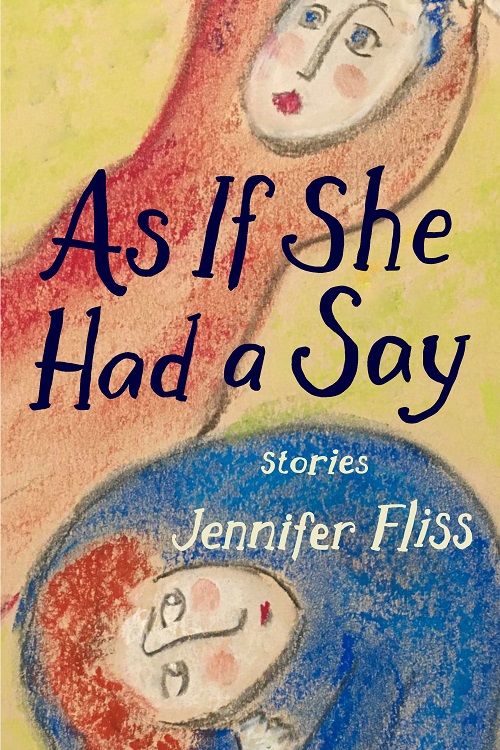
From miscarriage to monstrous pregnancy, the women in Jennifer Fliss’ second collection, As If She Had a Say, often find their bodies in odd situations beyond their control. One woman finds herself dissolving into a puddle of water, then discovers it’s happening to every woman in the neighborhood. Another, a woodworker by trade, keeps getting splinters, over and over, until she learns she’s pregnant with a miniature house. A third woman, just seven centimeters tall, haunts a dim refrigerator amid pickle jars and butter dishes, longing for the man of the house—the only other person who knows she exists—to yank open the door, bathing her in cold light. Other women remain present through their absence, such as Natalie, the wife and mother who’s killed in “Solitaire,” leaving behind a haunted widower who obsessively pushes his daughter’s stroller past the house of the driver who ran a red light and ruined his life.
Alternately realistic and fabular, the thirty short and very short stories in As If She Had a Say are yoked together through the theme of body as home/home as body. Through so many of these tales, Fliss explores what it means to be at home within a body, then lose control of it, or parts of it, through death, miscarriage, abuse, or abjection. At the sentence level, these stories are sharp as knives, and Fliss’ characters are dissected both voluntarily and involuntarily. For example, in “Pieces of Her,” another widower, with a different dead wife, desperately uses clear packing tape to preserve “her long seaweed hair, now freed of her body, stuck to the white subway-tiled wall of the shower in fine brown swirls and curlicues.” In the Lynchian “The Potluck,” one Mrs. Court participates in a suburban cannibalistic ritual, transforming the body of her elderly husband into prizewinning jerky. In “Here We Sell Hands,” our nameless narrator runs a whimsical shop that sells disembodied hands to do “the tasks old age makes cruel: shaving, opening jars, using the toilet.” “Projection” introduces us to Jackie, a college co-ed who can project movies on the wall with her vagina; she is soon forced to perform against her will by a pack of hooting frat boys.
Many of Fliss’ characters seem to revel in their own slow decay, like the woman from “Hineni” who confesses, “I like it when my gums bleed. When I spit peppermint and a string of fire-red trails in the sink,” or the protagonist of “In My Sleep I Am Wounded,” who scratches her scalp to “pull away with skin beneath my fingernails.” “This Heart Hole Punch” follows an impoverished itinerant who is obsessed with hole punches: “I’m looking for something to punch into my skin, I want to say, but don’t.” In “The Ink That Doesn’t Dry,” a twentysomething descendant of Holocaust survivors gets a tattoo of a Venus flytrap, “trigger hairs depicted like teeth,” that unceremoniously washes off after her father’s Rosh Hashanah dinner, refusing to be indelible.
Beyond the “house” of the female body, literal houses and homes are also lost throughout As If She Had a Say, to causes as disparate as natural disasters, land development, and divorce. In “Losing the House in D Minor,” “The Cresting Water,” and “Notice of Proposed Land Use Action,” beloved ancestral homes are sold, washed away by hurricanes, or sodden by flooding. To her credit, Fliss never gets bogged down in exposition, instead letting motifs accrete weight and meaning through repetition. Some of these remain mysterious, however: multiple couples cook salmon that’s left uneaten, and there are more allusions to head lice than you’d expect in a book featuring so few children.
Peppered throughout the book, Fliss’ ventures into formal experimentation are ludic and novel, perhaps reminding us of Judy Budnitz or Miranda July. “As She Melted” is structured around a facetious multiple-choice questionnaire, asking us to select what certain characters said, or which color nail polish they applied. “Maude’s Cards and Humanity” taps into the dark humor of the R-rated Apples to Apples-esque card game Cards Against Humanity, using verbatim transcripts from the game’s cards as headers for each section of the story, including: “Spontaneous human combustion,” “M. Night Shyamalan plot twist,” “Aaron Burr,” and “Women in yogurt commercials.” The results are laugh out loud funny if you’ve ever played Cards Against Humanity, and surreal if you haven’t. By contrast, flash fiction such as “This Is a Full-Rate Telegram” felt somewhat unfinished next to the book’s longer, more satisfying stories.
Like her equally engrossing 2021 debut, The Predatory Animal Ball (Okay Donkey Press), As If She Had a Say is remarkable thanks to Fliss’ twin knacks for finding levity in her characters’ tragicomic circumstances and inventing fresh story conceits that transform prickly emotion into powerful metaphor.
As If She Had a Say, by Jennifer Fliss. Evanston, Illinois: Curbstone Press, July 2023. 176 pages. $20.00, paper.
Jess Bowers is the author of Horse Show, forthcoming April 2024 from Santa Fe Writers Project. Learn more at jessbowers.org.
Check out HFR’s book catalog, publicity list, submission manager, and buy merch from our Spring store. Follow us on Instagram and YouTube. Disclosure: HFR is an affiliate of Bookshop.org and we will earn a commission if you click through and make a purchase. Sales from Bookshop.org help support independent bookstores and small presses.
 Heavy Feather Review