
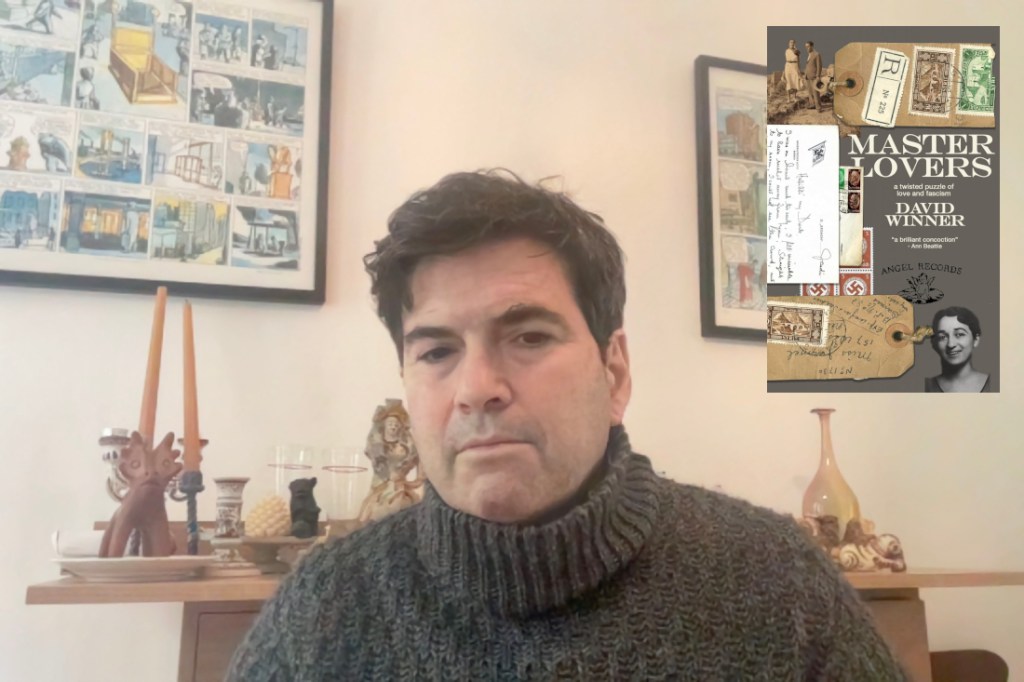
While clearing out his great aunt’s midtown apartment after her death, author David Winner discovered artifacts of her storied existence: notes from opera stars, love letters, and artifacts from the Middle East of the 1930s. His Aunt Dorle had been a co-founder of Angel Records and a prominent figure in the mid-century classical music world. But the more he learned about her world, the more complicated her story became, a twisted puzzle full of fascism and fraud and a record of a young woman (and now, years later, Winner, himself, in the pages of this novel) grappling with her attraction to lovers with hair-raising political ties. For all its value as a work of personal, familial, and global history, Master Lovers is perhaps most remarkable for its unfiltered portrait of a novelist at work. I was as moved by Winner’s emotional journey as by the adventures he lays out for us.
Winner is a senior editor at StatOrec magazine, the fiction editor of The American, a magazine based in Rome, and a regular contributor to The Brooklyn Rail.
Abby Frucht: You call Master Lovers, which uses your Great Aunt Dorle’s love letters along with broader historical documents as jumping off points for your imaginative leaps into Dorle’s life and love affairs, a novel. I admire the book’s resistance to form, it’s eschewal of novelistic structure and temperament. Were you tempted to call it nonfiction, or something else in between? Which do you more often feel, while writing? Hemmed in, or liberated by genre?
David Winner: Ever since I started more than a decade ago, this thing, whatever it is, has gone on its own engine regardless of genre. I’ve taken to calling it a “fiction/nonfiction hybrid,” which doesn’t really mean anything, but any book with willfully invented elements may be some species of novel. In the final version, the narrator (me) tries to slyly slip in a roadmap for readers to help them separate fact from fiction, but previously I’d left that question up to common sense. I hoped that readers would understand that I had no way of knowing, for example, what happened when Dorle Jarmel, my great aunt, met with her lover, geneticist JBS Haldane for the last time around 1935 in England. She was taking a ship from England to France and talking about meeting him, so I placed them in a café in Portsmouth near the ferries. If there was a way to learn something about Dorle, her lovers, and her times, I tried to find it out. But I had only the letters that Dorle’s lovers sent to her, so the real stories of the love affairs could only be invented.
AF: Your fascination with Dorle dovetails with your interest in Jewish American history, antisemitism, and sexism, which in turn dovetail with your learning of your family’s “claims to infamy,” revelations that you find “shameful” and “uncomfortable to think about.” But Dorle seemed to celebrate her and her lovers’ moral and ethical misdemeanors. Did your pangs over Dorle’s indulgences draw you nearer to her or pull you away?
DW: That question takes me back to her ancestors. Neither Dorle nor anyone else really talked about the family story. Dorle’s maiden name was Jarmel, which had been changed from something else, but that was pretty much all I knew.
I was already in my thirties when I happened to be walking around Chinatown with my girlfriend, and her eyes crossed upon a tall neo-classical building on the corner of Canal and Allen with a prominent bank insignia, S. Jarmulowksy and Sons. Sender Jarmulowksy, who turned out to be Dorle’s grandfather, brought tens of thousands of Jews on ships from Eastern Europe to the Lower East Side via Hamburg and held the accounts of nearly half the Jewish Lower East Side in his bank. But before I could feel pride in my suddenly significant Jewish roots, I learned that the bank went under in 1914 due to her father’s (my great grandfather) and her uncle’s real estate speculation in Harlem (where, apparently, they were responsible for early redlining) and the outbreak of the First World War in Europe. On Black Tuesday, hundreds of impoverished Jews from the Lower East Side rioted in front of the bank. And marched up to Dorle’s family’s uptown apartment building. Dorle told me she remembers escaping the mob via the rooftop. One man who lost his money in the bank nearly stabbed Dorle’s uncle to death. The terrible incident freed Dorle and Faie from the strictures of their orthodox Jewish female roles, but it left a stain, making them personae non grata.
A second broader claim to infamy involves the connections that her family members and lovers had to fascism and colonialism. She may not have known that John Carter was connected to Nazism but certainly knew that Bill Barker served as a Black and Tan in Ireland and police officer in Mandate Palestine. Her husband, Dario (my great uncle who I really loved), and her brother-in-law, Percy (my grandfather who I didn’t really know), were both Jews who supported Italian fascism. Dario, an officer in the Fascist army in Eritrea, fled Fascist Italy once Mussolini had bonded with Hitler, but not before shooting a cheetah in Asmara. I’ve seen a photo of it. Our connection to evil can depend as much on where we happened to have been and who we happened to have known as on moral decisions that we have made. This ethical complexity just makes Dorle more interesting to me. The mind and psyche of that blind, deaf, slightly senile, totally charming great aunt who I visited so regularly towards the end of her long life contained so many conflicting narratives like a sort of DNA sample of early twentieth century politics for better but mostly for worse.
AF: Dorle thrived on bending herself to the various tropes and identities assigned her by her lovers. Likewise, characters in books bend to their author’s requirements of them. What did you, David Winner, require of Dorle? How did your needs, as an author with a story to tell and as a nephew grappling with aspects of his past, influence what we see of her?
DW: When Dorle read the letters from her lovers, I wonder if she observed how each man cast her: the vamp, the wild beast, the sensible professional woman. This book required that I try to cast Dorle myself. My last female protagonist was a satiric version of Patricia Highsmith, and there are some similarities. They were both women writers born early in the twentieth century. They both liked cigarettes, booze, and men though Highsmith didn’t want them in her bed. But Dorle, for me, will always have a basic goodness, and a challenge here was to try to bring that across while being honest about a lifetime of dubious friends and bedfellows.
AF: You describe the elder Dorle of smelling, when you visited, of “perfume, mothballs and rotten teeth.” I love this affectionately unflinching detail and hope you take no offense at my asking: Did Dorle believe that her perfume masked the other odors, or was it a mark of her dignity to wear it even though she knew it didn’t?
DW: I had never been involved with Dorle’s “toilette”: the makeup, the clothes, the complex ablutions that at least privileged women of her generation went through before they presented themselves to the outside world, things that husbands and sons and certainly grandnephews were never supposed to know about. By the end, though, I was taking her to the literal toilet and helping her take off her clothes, but her perfume remained a mystery. By her mid-nineties, things like dentists were out and her teeth were left to rot at will while moths were (despite the mothballs) eating up her clothes.
AF: Like some of your family members, my parents were only nominally Jewish, although my mom once shrugged, “If the Nazis come back, they’ll get us, too.” Reading Master Lovers, I understand that, in part, such disavowals of Jewish tradition are in submission to antisemitism. With this in mind, what you think Dorle and her sisters gained, and lost, once the strictures of orthodoxy no longer applied to them.
DW: Dorle and her sister, my grandmother, certainly gained tremendous freedom when the strictures of orthodoxy were stripped away. They could work professionally outside the home. They could travel back and forth across the Atlantic. They could sleep with and marry whom they chose. Your mother’s comment is so interesting, of course. Jewishness, on some level, cannot not help but be defined by the murder of Jews. Dorle argued with her lover, John Carter, over the boycott of Austria and Germany for their antisemitism. In Master Lovers, I imagine Dorle’s reaction to events like Kristallnacht, but she seldom discussed the oppression of Jews and the Holocaust, as if she felt tainted by it somehow, perhaps the “submission to antisemitism” of which you speak. There was a colorful family figure on Dario’s side, Zio Arturo, who was implicitly gay and therefore somehow comic. The closest thing to a family story about the Holocaust involved Zio Arturo getting arrested by the Fascists, but even that got played for comedy when the naïve Arturo, not getting the gravity of the situation, tries to send his manservant out to collect his clothes.
AF: In her essay, “Are You Jewish?” (Threepenny Review, Fall 2022), Sarah Deming concludes a story about her family’s religious identity with the line: “Before we hung up, Mom told me, ‘The best thing about being Jewish is that you don’t have to believe in God.’” Can you parse out this thought, a little?
DW: Well, certainly, the Jewish story in Master Lovers is not really one about faith. The Jews in my family did not exactly believe in God, or at least I don’t think they did. For Dorle, I think religion had more to do with a sense of order, a reassuring predictability. When a family member died, the living went to the temple and Jewish cemetery way out in Queens. You knew what to do under the saddest of circumstances. My mom was the child of Catholic immigrants from Prague whose faith didn’t make it over the Atlantic, and my Jewish atheist father had no relation to any cemeteries or synagogues. But for much of my life, I had an illogical fear that I would have to return to that same Jewish cemetery to bury my parents. Having no connection to death rituals, Jewish or otherwise, I buried their ashes in my mother’s rose garden in Charlottesville. It was the best I could come up with, and I hope my parents don’t haunt the new owners of the house.
AF: Dorle was a writer, too, and the snippets you provide show her to have been of a marked poetic sensibility. Were she a young writer today, how might she have critiqued this book?
DW: By the standards of her ecstatic prose (she loved the poet Swinburne above all others), my own scribbling might seem earth-bound and stolid, and I don’t think she would have countenanced the politics of the book, which are sort of standard-issue progressive and a little dated due to my age. Colonialism was so part of the firmament of her era that she certainly would have admired soldiers of empire in her life: her lover, Bill Barker in Ireland and Palestine, her husband, Dario, in Eritrea.
I like how your question specified Dorle as a young writer, because that takes my mind away from some older women (Catherine Deneuve, Charlotte Rampling) who have been among the naysayers of the #MeToo movement. Dorle also had some retrograde beliefs about gender. She felt great pride in thriving during a gazelle hunt in Syria when women were generally disallowed and was very disappointed many years later when Dario’s club, the Century Club, started permitting women members. I wonder how she would have reacted to the way in which I try to narrate moments from her life that happened decades before I was born. Rather than being annoyed that her adulterous affairs were outed, I think, Dorle would have felt that my versions weren’t sufficiently romantic.
Abby Frucht is the author of two short story collections: Fruit of the Month, for which she received the Iowa Short Fiction Prize in 1987, and The Bell at the End of a Rope (Narrative Library, 2012). She has also written six novels: Snap; Licorice; Are You Mine?; Life before Death; Polly’s Ghost; and A Well-Made Bed (Red Hen Press, 2016), on which she collaborated with her friend and colleague Laurie Alberts. Abby served as mentor and advisor for more than twenty five years at Vermont College of Fine Arts and lives in Oshkosh, Wisconsin. Her new book, Maids, tells the story of Abby’s efforts to speak to and about the women employed by her parents when she and her sisters were girls on Long Island in the 1960s, 70s, and 80s. Maids, and was published in 2020 at Matter Press.
Check out HFR’s book catalog, publicity list, submission manager, and buy merch from our Spring store. Follow us on Instagram and YouTube. Disclosure: HFR is an affiliate of Bookshop.org and we will earn a commission if you click through and make a purchase. Sales from Bookshop.org help support independent bookstores and small presses.
 Heavy Feather Review