
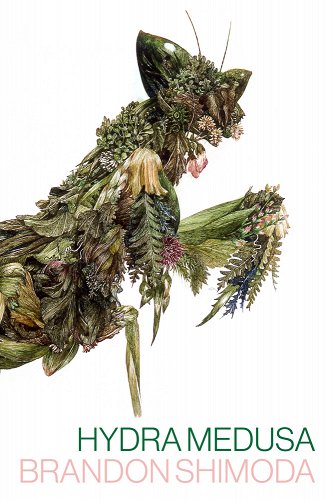
Brandon Shimoda’s Hydra Medusa or Give the One You Want Away is a tantalizing book, one that unfolds through myriad echoes, motifs, and repetitions. Begun as a three-years-long daybook in response to the poet family’s peripatetic life and work and as a continuation of Shimoda’s 2018 The Desert: The Song Cave, this also conjures up a desert landscape as both a physical place—the family lived for a number of years in Arizona—and a visionary force. It is also perhaps more confrontational about Shimoda’s larger subject, the world as shaped and distorted by the “malignancy” of Americanism. Some of the essays that punctuate Hydra Medusa especially explore the consequences of that disease: a paranoid mental realm that Shimoda describes as the Garden of Earthly Delights viewed through a spinning kaleidoscope. Aside from the essays, the book is made up of poems and prose poems and reported dreams that read like prose poems. They dramatize daily walks, migrations, wanderings, and ritual actions inside this flowering nightmare garden. They are populated with figures both real and known to the poet—most notably, dozens of friends and family—and many others, acquaintances and strangers whose doings dramatize both the sufferings and delusions of those traveling through the modern American world. Yet the poems and essays go further to suggest solace and even ways out or, more accurately, deeper in or deeper down.
The essays of Hydra Medusa do what Shimoda always does well: write clearly and cogently, but with turns that take us somewhere we recognize but didn’t anticipate. For instance, “The Descendant” begins with the medieval legal doctrine of cruentation: a corpse bleeding over again in the presence of the accused as evidence of murderous guilt. Shimoda then moves on to consider the murder of Japanese men in the WWII concentration camps where they were imprisoned; in particular, he focuses on the unpunished killing of Toshio Kobato and Hirota Isomura by Private First-Class Clarence Burleson. Shimoda then connects these killings to the history of legal alienation and government surveillance of Japanese Americans; to the unpunished killing of Mexican teenager Jose Arturo Rodriquez by Border Patrol Agent Lonnie Swartz; and to the larger history of fearful white American violence against anyone perceived as other. So far, so trenchant. What is more surprising, though, and the core of his essay, is his meditation on the meaning of ancestors, with definitions given by a number of survivors or descendants of Japanese American imprisonment leading to a reimagining of ancestors as both curses and prophylactic responsibilities. Burleson the killer becomes the descendent of the men he killed, an affront to them but perhaps a needful one: “The dead, meanwhile, inherit, against their will, an association with the murderer that, for being undying, requires an act of severance. Burleson becomes responsible to their ghosts as we all do to our own as part of our shared burden of history as Americans. As Shimoda describes them in a poem he places at the center of the essay:
The ancestors, bedecked in robes of night
occupy a pantheon
we see ourselves in, imagine
ourselves
in the shapes
of sparest humility
Hang me in the alcove, I say
to the future faction
that might draw me out of the well
This whole book is full of echoes of ancestors, ghosts hungry for our humble attention, even if they and we are still in that well.
The poems in this book, as I suggested above, deal primarily with the actions in a real and imagined desert, with Shimoda’s family itself and with others engaged in acts of memory and survival, aided by the desert environment but beset by its poisoned land and thoughts. One of the first, “The Desert,” dramatizes a migration through an arid, surveilled landscape by people who could be Japanese-American, could be migrants from anywhere, could be anyone forced into captivity or searching for sanctuary. They need healing:
A woman had a clear plastic tube in her left arm
her vein. She needed it
removed.
[…]
There were many of her, or one
of many,
with similar needs
that could have been addressed in minutes
but the oversaturation was taken for granted
then where would the women go?
The speaker tries but is impotent to help this woman, and no one else does, for the migration in this poem is no exodus, leading to no promised land. Instead, it ends with an array of visionary animals, suggesting that what is needed is there in the land we inhabit but absent from our world. Later poems enact rituals, syncretic Christian and otherwise— “Holy Week,” “All Souls Procession,” “San Xavier”—but at their center is the essay “The Ghosts of Pearl Harbor,” which describes among other things the University of Arizona’s monument to the aircraft carrier U.S.S. Arizona as a purely nostalgic ritual, “a euphemism of the mask of innocence the U.S. wears to conceal its monstrousness.” It’s worth noting that the ritualistic poems described above are grouped with two both titled “Operations Crossroads,” the name for the nuclear tests at the Bikini Atoll conducted prior to dropping atom bombs on Hiroshima and Nagasaki. The saving agent in these rituals are the words that enter the earth, flower, and fruit in strange ways
that illuminate subterranean life
where the cross enters the earth
children lay flowers
the cross turns at night
into snakes
This illumination is not a revelation of sin, but a remaking of a worshipped instrument of murder into something truly fertile, a turning back of Christian sacrifice from all its transcendentally bloody lineage to its earthly indigenous origins. Shimoda doesn’t describe rituals one can remember and reenact, as in a mass, but hints at those yet to be written and performed. Thus, it makes sense that the one of the most hopeful poems in this part of the book is called “The Bookstore,” and that the dream-like bookstore it describes is as much landscape as store, its books more like plants:
The woods
were filled with throats
no clearing No one read
Books
Disintegrating
At the base of trees
emitting smoke of spores
to see? Can I live here?
Honestly, the ritualistic poems in the middle of Shimoda’s book almost all contain a moment like this, moments in which the speaker or the gathered worshippers desire some surrender to flower, to fruit, and to a future that may not contain “I” but will contain a life worth the name. That moment often feels desperate, but it is often described with great beauty, as it is here.
At this point, it may seem like Hydra Medusa is, like that title, compelling but beset by monsters. That isn’t the effect this book leaves, for a number of reasons. One is how populated the book is, how many other people, family, and friends are in it. Many are named, there are lines and poems by other people throughout; even Shimoda’s young daughter gets her say. Another is how powerfully the book evokes the visionary and real world of the desert. The epigraph by Etel Adnan is from an email Shimoda received from the poet, and it reads, “The desert shimmers at moments as if it owned the whole planet, and we needed it be so.” Her point is that the desert in its immense, intransigent presence cuts through to the spectral bullshit of ideology, opinion, and warped passion that fills our heads. People sometimes seem to serve the same purpose in this book: they lead, if not to revelation, then to thoughts that are not deadening or dead. In this regard, I think of an essay late in the book, “The White String,” the central image of which is a priest and worshippers chanting together, all connected by white strings hanging from a ceiling grid that is also tied to a golden Buddha statue. And I think of poems like “The Field” in which “Two daughters began talking to us / several more daughters appeared // until there were eleven or twelve,” telling the family about a Field that they go off to discover and where the experience not only the pleasure of an unknown oasis but its aftermath, a kind of brief transfiguration:
our crossing the stream
was tantamount
to liberating ourselves from believing, belief
we were a family of deer,
passing into the camouflage of the mystic
Reading this book and encountering so many moments like this, one isn’t just enraged or saddened about our American predicament, but for a moment, to riff off another of his poems, one walks more freely through the seasons.
Hydra Medusa or Give Away the One You Love, by Brandon Shimoda. Brooklyn, New York: Nightboat Books, June 2023. 144 pages. $17.95, paper.
Dave Karp is associated with Margin Shift, a Seattle, Washington, reading series dedicated to supporting writers outside the mainstream. His articles and reviews have appeared in Golden Handcuffs and Heavy Feather Review. He has taught high school English in Seattle for 26 years.
Check out HFR’s book catalog, publicity list, submission manager, and buy merch from our Spring store. Follow us on Instagram and YouTube. Disclosure: HFR is an affiliate of Bookshop.org and we will earn a commission if you click through and make a purchase. Sales from Bookshop.org help support independent bookstores and small presses.
 Heavy Feather Review