
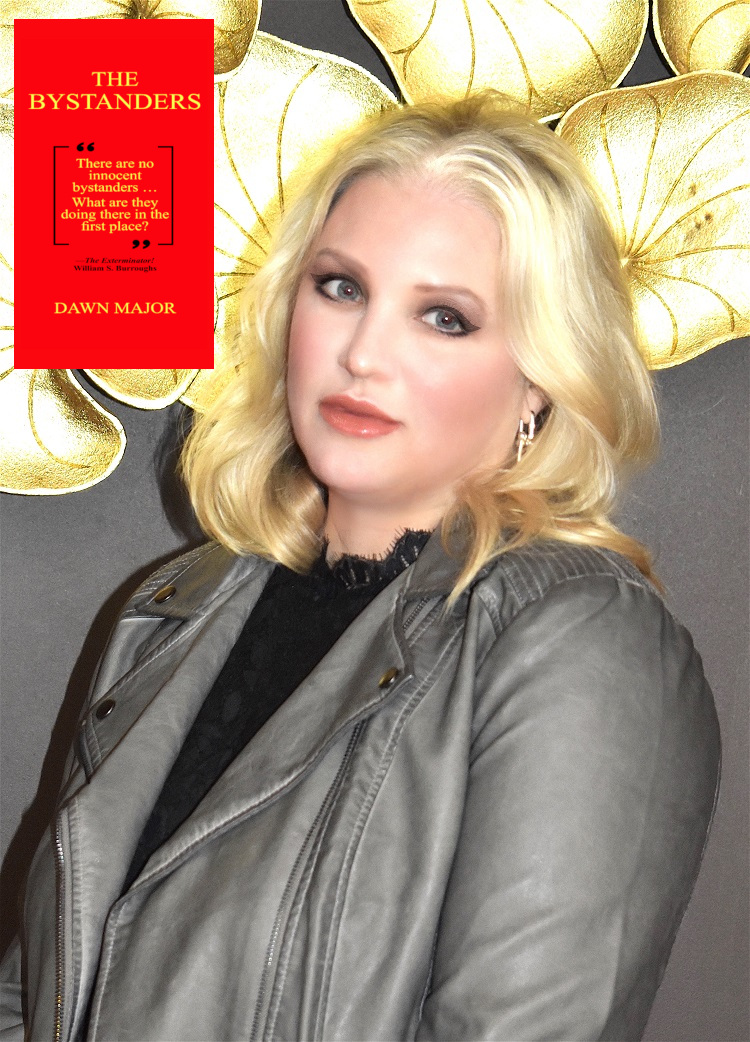
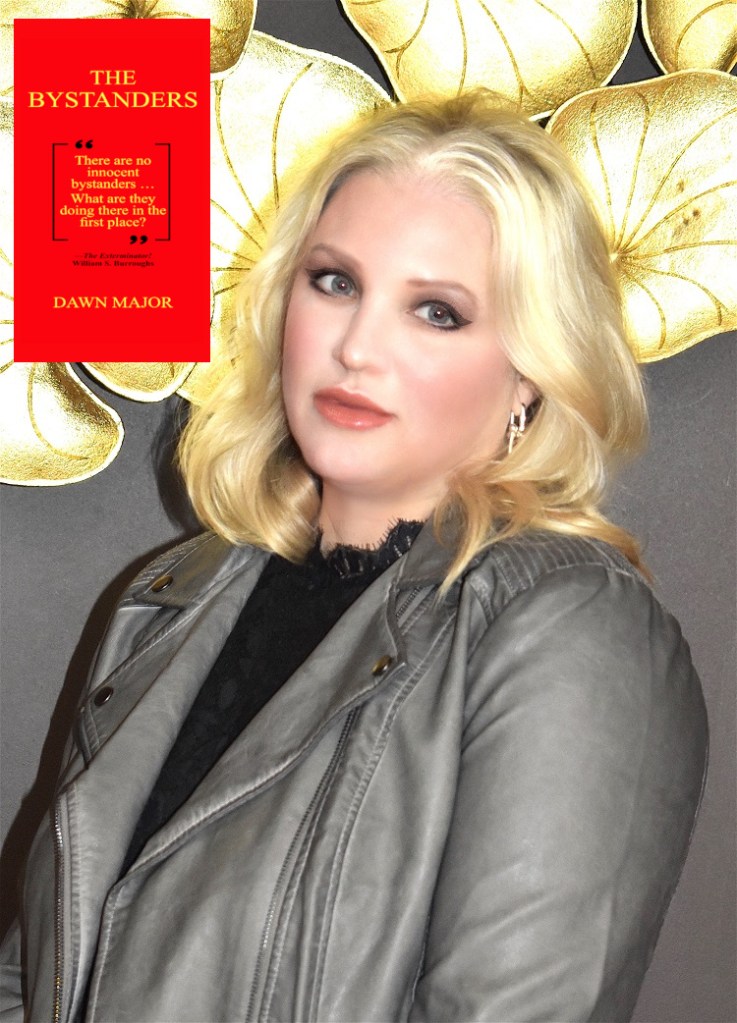
An avid fan of the rodeo and cowboy hats, Dawn Major has crafted her debut novel, The Bystanders, which, at first glance, appears to be an academic commentary about American society. But appearances are deceiving.
Set in a small town in Missouri in the 1980s, this story uniquely captures the essence of the characters’ lives and the undercurrents which rock their foundation when an unlikely couple from California moves in and shakes things up for the locals.
Mary Ellen Thompson: Your introduction begins with, “First, I would like to say that I have always been interested in the psychological phenomenon known as the bystander effect ever since I learned about the tragic story of Kitty Genovese from whence the term originated.”
Was that originally your intention when you began writing The Bystanders, or did it evolve or change during the process?
Dawn Major: With the title story/chapter, it was my initial intention to address this psychological phenomenon. Structurally, The Bystanders is a linked narrative novel, or essentially interconnected short stories all set in the same town with the same characters and told in chronological order. I wrote the first piece early on. It made me reconnect to earlier childhood feelings when I felt like a bystander. Being young, I was not able to react to or stop situations where adults should have stepped in. I started wondering why no one offered help. Why didn’t someone say something? I revisited moments in my life and used those as inspiration.
The first chapter was inspired by an event at a gas station when my family was filling up the cars when we were moving from Missouri to Georgia, but the event happened between my eldest sister and my dad. Of course, I made the piece way more dramatic. But he struck her over absolutely nothing (let me say I do not think there should be any reason to strike your daughter, though), and then my mom and him started arguing about not moving while all our belongings were packed up. It set the tone for how things were going to be living with my dad again. He had been working out of state, like the character Dale, and now back in the family fold, he was establishing who was in charge.
I realized there were opportunities to weave the bystander effect throughout the entire novel. Sometimes, I did this very subtly like with “Nativity,” and sometimes I took a heavier approach as with the last chapter “Calendar Days” where I contemplated if a town or community could be a bystander: “Would there be a mark left on Lawrenceton? Did towns scar?” So, to answer your question, it was a little bit of both in that it was intentional, but my idea of the bystander effect evolved as I drafted the book.
MET: The Bystanders transported me past the tip of the iceberg, past the water line, and down into the depths of your oceanic story.
Can you tell me the essence of how differently the story felt to you by the time you had finished writing it from the time you began?
DM: I started writing The Bystanders while attending Emory Continuing Education and received a certificate in creative writing. “Nativity” was my capstone project.
After that, I did NaNoWriMo (or National Novel Writing Month where you draft a novel in one month). I suggest all writers take advantage of it just for the fact that it forces them to write. Now, I will say that after one month it was not publishable, but it was a start.
Then, I decided to get my MFA in creative writing. It was at Reinhardt University, where I began putting the pieces together structurally. You work closely with mentors and your final creative thesis is supposed to be a completed book (or at least 40,000 words). That is where this book truly came together, but still, it was not finished. After I graduated, I joined a critique group and worked on
it for another year. I thought it was finished and began querying. I started getting some rejections but with decent feedback that I used to my benefit. At one time I had a contract but that did not pan out and I worked on it for another six months, constantly improving it and working with another workshop group from my MFA program who I am currently with now. Then I found Moonshine Cove and signed a contract, but when my manuscript came back for final edits and I had not looked at the book for almost nine months, I wanted to change even more. Technically, I was not supposed to do that, but I did it anyway. So, it is completely different from when I began writing it. Part of this is due to having a great writing community who read it a zillion times and part of it was due to me becoming so close to the characters and town over the years. I got to really know them and the setting. When you meet a new friend or you move to a new town, it takes time to get to know that person or town.
MET: The Sisters of the Most Precious Blood in your book do, in fact, exist in real life. Sister Bienenkönigin loves her bees, and her name means “Queen Bee” in German; Sister Abeille is French for “bee,” and there is Sister Lapin who seems from her demeanor that she may have rabbit-like qualities. How did you choose their names?
DM: This town is full of German and French heritage, so I thought using these names would honor this fact.
Oh, and “diener” means “servant” in German! I equated Mr. Diener, the eighth-grade teacher, as being Sister B’s drone. The seventh-grade teacher means “teacher” in German. Mr. Lehrer largely stays out of the drama and does his job, which was to teach. My seventh-grade teacher at St. Agnes was my favorite teacher. I credit him for my interest in writing. At the beginning of the week, he would give us a writing prompt and then we would read our stories in front of the class on Friday afternoon–my favorite time of the week. And I went for it, too! I wanted to honor him here. My other favorite teacher was a nun who taught fifth grade. I nicknamed her Sister Dear. She was so sweet, so kind to the children. She always reminded me of a white bunny rabbit. She was very pale, and a tuft of white curly hair sticking out on her forehead from under her habit. That little tuft reminded me of a little bunny rabbit tail.
But my intention in authoring this chapter/story was to bring awareness to the plight of bees. My attempt at an environmental piece, but I am no Janisse Ray! I live in downtown Atlanta and a couple of years ago I decided to try my hand at container gardening on my balcony. The problem was I could not get any bees to fly up five stories to pollinate my plants, so I would go out in the morning with a small paint brush and pollinate them myself. It did not work. I decided to mix in flowers to attract bees. That helped somewhat, but still there were not enough bees and it was a failed project. I noticed a lack of bees not just visiting my balcony but all over the city. This not only saddens me, but it is dangerous for our future. I did some research and discovered colony collapse disorder and how bees defied instinct and fly away from their colonies. I am simplifying here. Pesticides can cause colony collapse. Invading insects not indigenous to the area can cause it because they kill them off. Again, oversimplification, but you get the message.
I saw a natural parallel between the Sisters of the Most Precious Blood and bee colonies. They were kicked out of multiple countries and even the state of Illinois until they found a home in Missouri. With that history I imagine they were very protective of their order, which was surely also declining, like bee colonies, with less and less women being interested in joining. In addition, Sister B saw Shannon as an invader who was disrupting her colony. St. Agnes School was another colony she controlled as Queen Bee. Most readers will not catch onto the meanings of the names, but maybe some will. Hopefully, it adds a bit of richness to the chapter/story. Thanks for asking.
MET: In what time frame does The Bystanders take place? How do you feel it reflects the social customs and mores of that time? Aside from the Samples living in a trailer park, which sets them apart, what is the social hierarchy of the other characters?
DM: The Bystanders takes place in the 1980s, and pretty much spans the entire decade. Social class systems were another theme I explored in The Bystanders. In “The High Priestess” chapter, I explain the hierarchy of the small towns and of the schools in the region. Others who grew up in surrounding areas and attended the local Catholic and/or public schools may disagree with me. Plus, this is a work of fiction and exaggerated—one literary technique I gravitate to and credit to southern writers is hyperbole. Southerners do love to tell tall tales. For myself, I felt a division between the two parishes that fed into the Catholic elementary, middle, and high schools. It appeared to me that the Saint Lawrence Parish was on a lower rung. Though Eddy’s dad works at the Lime Kiln, his tuition, like Shannon’s, was paid through via the proceeds of a massive annual picnic. Boys from one parish would pick on the boys from the poorer parish, for instance. I also felt that the Catholic-educated kids looked down on the public-school kids (who I refer to as PSKs in the book but were entirely fabricated). The Catholics and the PSKs rode the same bus but were not friends and did not interact. It was like they were invisible. You could write an entire novel based on bus dynamics.
Also, music was everything in the 1980s. I came of age in the late 1980s and 1990s listening to Duran Duran, Billy Idol, The Cure, and The Smiths. There are tons of references to specific songs from the 1980s, but also from the 1950s and up through the 1970s. As an example, Neil Young, The Doors, and The Eagles would be the music that encapsulated Wendy and Dale’s generation. Then there are classic Christmas songs sung by the likes Frank Sinatra and Nat
King Cole I associated with Holda and Lena. As a side note, while writing that chapter I would listen to Christmas tunes. It was the middle of summer and drove my family to madness. In fact, there is a suggested playlist in the back of the book, and I sort of imagined readers listening to the playlist associated with each chapter, that those songs served as soundtracks for the different characters. “California Dreamin” by the Mamas & Papas is very much Wendy. Madonna’s “Lucky Star” and “Like a Virgin,” and “Girls Just Want to Have Fun” by Cyndi Lauper represent an earlier version, or younger, Shannon. “Non, rein de rein” sung by Edith Piaf shows up in a super creepy way in Sister B’s nightmare. “LA Women” by The Doors is how Victor perceives Shannon. “Delta Dawn” by Tonya Tucker and the old country songs belonged to Tina who worked as a bartender at the Dew Drop Inn, another real setting, and would have heard that song on the jukebox.
Your financial means or lack thereof determined what group you ended up hanging out with, but another massive factor in the 1980s and 1990s was music. Music determined your social circle. There was some crossover. The soccer players would hang out with the skaters. The skaters would hang out with some of the metal heads. I tended to dip in and out of cliques, but I cannot say I ever fit in with the preppy kids or the jocks. You figured out who your group was on day one, though, because there was safety in numbers. I remember quite a few fights in high school purely based on cliques.
I also considered the popular movies from that time period that dealt with social strata: Pretty in Pink, Revenge of the Nerds, Porky’s, Sixteen Candles. John Hughes was a master of depicting social hierarchy in high schools and I tried to tackle some of that in The Bystanders as well. The Breakfast Club—probably better than any other movie from that time—captures the epitome of the 1980’s caste system. There was the jock, the metal head/troublemaker, the nerd, the freak, the preppy princess, and the authoritarian played by the principal.
Fashion factored into social class as well. At the beginning of the book, Shannon dresses a lot like a version of an1980s’s Madonna, which sets her apart from the rest of the town but also makes her look older. Her fashion choices play out in a very funny way in “Nativity.” Towards the end of the book, she starts listening to darker music, transforms into a Goth, and buys most of her clothes from the Goodwill. I used to come home with a garbage bag of clothes from the Goodwill and since my mom was an excellent seamstress, she would alter them. Pretty in Pink truly influenced me! The trailer denotes the Samples’ class, but their style of dress does too. Dale and Wendy are simply stuck in the late 1970s with their fashion choices, but so is their relationship.
How the family spoke affected the town’s perception of them, too. Dale was from Indiana originally, so he spoke more like the townspeople. But Shannon talks like a Valley Girl. You can alter how you dress, but it is way more difficult to change how you speak. Shannon came to terms with the fact she was poor and never going to ever quite fit in, so she went even further outside. I had that attitude growing up as well. If you’re not going to make it in with the popular crowd, then be the absolute best outsider of all. There is some power in that decision. You know you are going to get made fun of, but your peers are equally fascinated. It gave Shannon a bit of mystique.
MET: How do you empower your female characters in The Bystanders?
DM: In the late 1960s (maybe 1967), The Beatles wrote the famous song “All You Need Is Love,” right? How many times did they repeat the lyric love is all you need? They absolutely pounded the concept into the listener’s head. Though I was born in 1972, I grew up listening to The Beatles. When John Lennon was murdered, I was in third grade, and bawled my head off. I did not want to go to school. “All You Need Is Love” is an anti-war song, but when you think about all the love songs and women, like my own mother who was a Baby Boomer, listening to all those love songs even if “All You Need Is Love” is not a love song in the true sense, it indoctrinates women to not only think they need love, but it is absolutely essential for their livelihood. My mom would tell you today that she bought into the lifestyle of the “stay at home mom,” because that is how she grew up. Nana did all the domestic work and Papa had a successful career. And I am not saying there is anything wrong with that if you want it. Mom never had that lifestyle. She became the breadwinner in our family, but boy did she have to scrape and work hard to get to where she did.
Wendy’s character was socio-economically dependent on Dale’s income while she was going to nursing school. In one of my workshops, someone told me (in the early stages of “Calendar Days” she could not understand why Wendy would not just leave Dale. Two things here. One, she needed him financially, and two, she was in an abusive relationship where she feared if she left him, he would hunt her down and kill both her and Shannon. And he would have! If you have never been in a domestic abuse situation (hopefully you have not), it is harder to relate to a character like Wendy who lives with so much fear. Times were very different back then, too. Police viewed fights between husbands and wives and the children as a family issue and they did not want to intervene. I speak from personal experience. Wendy was like a beaten down dog. I had to make her get out of her car, to stop cowering, and get into a physical fight with Dale whether he killed her or not. She had to stop being a bystander in her own battle if that makes any sense. She had to take her power back and it had to be physical because that is how he controlled her.
In “Roadtrip” I also wanted to empower Tina at the end, to realize she did not need Dale, to see that the life she chose for herself—her little apartment above the dive bar where she worked and randomly slept with men— was just fine. No judgment here. She was changing herself by dieting, upgrading her tanning package, getting fake nails, and ultimately taking a nightmare bus trip to Georgia, and for what? A man who was married and would never consider doing the same for her? No, no, no. That was just not Tina, but I have done it. Every woman I know has shapeshifted into the ideal woman for “love.” And this is not to say, men have not done the same to get a woman, or women for other women, and men for other men. But it is unstainable and eventually the true self, who you never should have to hide in the first place, will come out.
In “The Annual Picnic,” Shannon had rose-tinted glasses on when she first encountered Victor. And let me say that I intended for Shannon to be ambivalent about losing her virginity. Some may view it as rape. I liked the ambiguity in that scene. Maybe it worked. Maybe it did not work, but I tried to sprinkle in symbols like the song “Little Pink Houses” by John Mellencamp and the church birdhouse with the bell. Look what Shannon did with the birdhouse and what she saw near her feet at the end. She was calling bullshit on her maidenhood and saving herself for marriage, which is why I set the scene at a church picnic. I was not trying to be disrespectful of the church or religion, but I wanted her to take her power back since Victor thought he had one on her. She did not care at all!
Mary Ellen Thompson’s interview with the legendary Pat Conroy was published in A Lowcountry Heart. A lead features writer for Beaufort Lifestyle Magazine for eight years, and columnist for Lowcountry Weekly for ten years, she has also written for Pooler Magazine, Effingham Magazine, Carolina Arts Magazine, St. Mary’s Magazine and Eat, Sleep, Play Beaufort. Mary Ellen has very happy feet and loves to travel. Raised on the Main Line of Philadelphia and the Eastern Shore of MD, she has a B.S. From Skidmore College in Business. Currently living on Saint Helena Island, SC, she hosts a Writer’s Residency for the Pat Conroy Literary Center and is writing a retrospective narrative.
Check out HFR’s book catalog, publicity list, submission manager, and buy merch from our Spring store. Follow us on Instagram and YouTube. Disclosure: HFR is an affiliate of Bookshop.org and we will earn a commission if you click through and make a purchase. Sales from Bookshop.org help support independent bookstores and small presses.
 Heavy Feather Review