
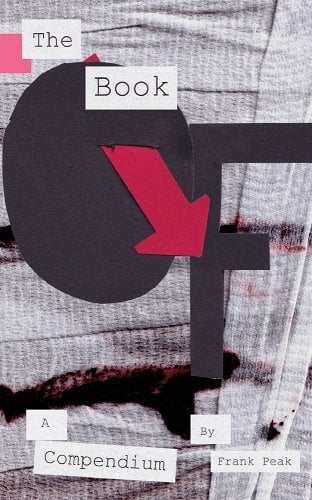
Early on in Frank Peak’s The Book Of, a man named Hat breaks a dollar for two quarters with a newspaper vendor. He checks the dates on the coins, and if his “private smile” at the vendor means anything, maybe those coins are a Bicentennial and a 1965, like the two quarters he’s carried around, failed talismans, squeezed in the hand just before he’s hit in the side of the head by an assailant in the dark, felled outside of a phone booth, like a handset knocked off the receiver. When his colleague Iggy points at the coins and asks why, they get into a tiny spat about the nature of coincidence. Hat says it’s a sign of the divine, but Iggy corrects him: it’s a “plebian meddling of the divine.”
Whichever side of that argument you land on, it’s fitting that Apocalypse Confidential’s first book release should be a work that’s so cryptic about its relation to the divine and demonic alike, the spirit of obfuscation clouding even the title like smoke: The Book Of what exactly, or who? And when the book comes clearest to explaining itself to us, at the end of the first section when Hat drives out to meet a recluse named Carl, Carl makes it clear that even the question why means nothing in this book’s strange eschatology. “Why is a non-factor,” he says, when you run up into something that’s “just too big to incorporate into your world,” an “alien concept” that might go far beyond or merely shoo aside questions of “good against evil.”
“You probably have a lot of questions,” Gus says to Carl in the second section of the book, composed of short flashbacks to the late 90s where Carl, a psych patient off his meds, has just witnessed a hairless giant of a man getting shot in the head. Carl becomes Gus’ getaway driver, and this speeds his initiation into the business of “killing demons,” or “the Lord’s work,” as Gus has it, in one of the rare moments where we are told, just told, what all this driving past burnt-down churches and knocking on doors with a gun in hand is really about.
But to call this a book about demon killers would be an obfuscation all its own, as the book lingers a while on the almost provisionary, foggy world that these killers move through. Iggy walks past an “endless stream of nondescript stores”; in the paper, “grimsly crime scene photos of no one important to anyone”; the police radio spits out “some arcane diatribe that means nothing.” Even Hat’s assailant is named “the unimportant man,” never to be seen again, a shadow amongst shadows who occasionally maim, or trail you into a bar. The effect of all this world-emptying, of raising details only to turn them away, is a slightly tiresome read—this is not quite a world of red herrings or missteps, but a world where the characters only ever arrive too late, where despondency pollutes the air, where each demon killed behind closed doors does not add to any meaningful tally: “Nothing is fixed. Nothing is okay.”
True to the title, one feels a missing center in this book that the characters keep driving listlessly around, some conspiracy(?) as obscure as the book that Gus reads in his apartment, itself a mystical compendium in an arcane language, referred to only fleetingly. But there is no ooga booga, no clap of thunder upon closing it—the book is no Necronomicon, and whatever evil there is to be released has, seemingly, been here from the start. This is, if not the book’s point, certainly crucial to its atmosphere: the demonic and the desolate dailiness of this world go hand in hand. There are a few moments that outright scream Horror in this book, but on the whole, Peak is opting for a world where the demons are only recognizable as demons up close, when you realize they are wearing someone’s body as a suit, their eyes milky white and their breath reeking of rot. They are parasites that do their damage slowly. To be generous, maybe so much of the environment cannot reach the threshold of significance because the demons’ presence enacts a greater kind of possession, an ignorance in which a quieter apocalypse happens. The bars are littered with people who wouldn’t know that the name Iggy might come from St. Ignatius, who haven’t a clue about what the regulars do for a living. And those that do get clued in do so at their own mercy, made privy to a knowledge that often leads to a gun to their head, self-inflicted or otherwise. “We are the caretakers of thoughts,” Carl says near the end of the first section. “The way they were before the world got to them. Before they turned dark.”
The Book Of: A Compendium, by Frank Peak. Apocalypse Confidential, May 2023. 182 pages. $15.99, paper.
Atsushi Ikeda (@ah_daradara) is a writer/musician in Montreal, whose work has appeared in new_sinews, ergot., Propagule, Expat Press, Apocalypse Confidential, and more.
Check out HFR’s book catalog, publicity list, submission manager, and buy merch from our Spring store. Follow us on Instagram and YouTube. Disclosure: HFR is an affiliate of Bookshop.org and we will earn a commission if you click through and make a purchase. Sales from Bookshop.org help support independent bookstores and small presses.
 Heavy Feather Review