
I finish my story; I’m very proud of it, but I’m sure there are some loose parts that need tightening, or my ending could be less metafictional, so I bring it to workshop to get that little bit of feedback it needs.
But instead of telling me how brilliant my characterizations happen to be, Kate the writer of unflinching domestic dramas says, unflinchingly, “Isn’t this pretty much the same as your last story? I mean, instead of a twin or a double you have a ghost, and one or two minor plot points are different, but this is the same story as “Mom’s House,” with the same bad witch figure, the terrible best friend and countless zany doppelgangers running around, only you’ve got an aunt in it instead of a mother.”
“All that’s missing is another shallow Illustrated Man allusion,” mutters the guy in the back of the room who usually never says anything. The other members of the workshop nod their heads in agreement, pointing out how, in truth, all my stories have pretty much been the same story. As they provide evidence and examples, it becomes clear that they are correct. The list alone of all the instances I use the word so, or how often a twin or talking animal or Taylor Swift reference shows up in my work is excruciating. It’s all I can do to not run from the room.
Finally, our workshop leader, the famous author with his equally famous beard, speaks. And because he’s the Professor Beard I’m paying serious money to sit in his workshop, I brace myself to take what he has to say without sobbing.
At first he just gives me that “I’m trying to weigh your soul but I just can’t seem to find it” look. Then a long, drawn out, “So?” He’s gesticulating with sweeps of his right hand like he’s telling us where the airplane should land.
“So.” Now it’s the airplane crashing down gesture he uses when he’s making a point he believes to be important. “What’s wrong with that? All of you should count yourselves lucky if you can come up with that one story you can write over and over and over. How do you all think I got to be where I am?”
It’s true. Professor Beard’s last three books were pretty interchangeable, even if the reviewers wouldn’t say so out loud.
“The only question we should be asking is whether this is a good Behm-Steinberg story or a very tired Behm-Steinberg story. Show of hands, how many think this one is tired?”
Everyone raises their hand. Even Steve the fabulist and my best reader in the room sheepishly raises his hand. “So, I think that wraps up our discussion of this story,” says the famous author. “Shall we move on to the next story in the queue?”
I don’t hang out afterward for drinks.
Later, after much grim processing, I call my sister Hannah (who happens to be my twin but that is entirely coincidental) and tell her all about what happened.
After a half hour of me venting, she interrupts. “Are you done feeling sorry for yourself?”
“No,” I say, truculently.
“Look,” she says. “If you want to write your very best story, forget about being original. Just try writing the same story every day for a month, and for once just try to get it right. No copying, no looking at the last story. New old story, every day, one month.”
“What, like Exercises in Style?”
“No, more like if Exercises in Style actually had its shit together and got its story right in the first place,” she said.
I’m struggling to decide whether I should take Hannah’s advice, even though I should trust she knows what she is talking about. She’s the one who just published her seventeenth book in a very successful series of urban fantasy YA novels, not me.
So I open my laptop and I write another story, this story, again, only this time there’s a grandmother in it, and she’s covered in tattoos only the protagonist can see, which move because each of them is its own story, and we’re in a grocery store only it’s haunted, not with ghosts but with stories, possible endings in every item on every shelf, and it occurs to the people in my workshop that what I am doing is brilliant and subtle and very, very original. Professor Beard promises to introduce me to his agent, the one with even more spectacular facial hair, so lush everyone calls it a national forest.
Stephanie the fabulist looks at me like I’ve betrayed her somehow.
Hugh Behm-Steinberg’s prose can be found in X-R-A-Y, The Pinch, Joyland, Bull, Heavy Feather Review, and The Offing. His short story “Taylor Swift” won the Barthelme Prize from Gulf Coast, and his story “Goodwill” was picked as one of the Wigleaf Top Fifty Very Short Fictions. A collection of prose poems and microfiction, Animal Children, was published by Nomadic/Black Lawrence Press. He teaches writing and literature at California College of the Arts.
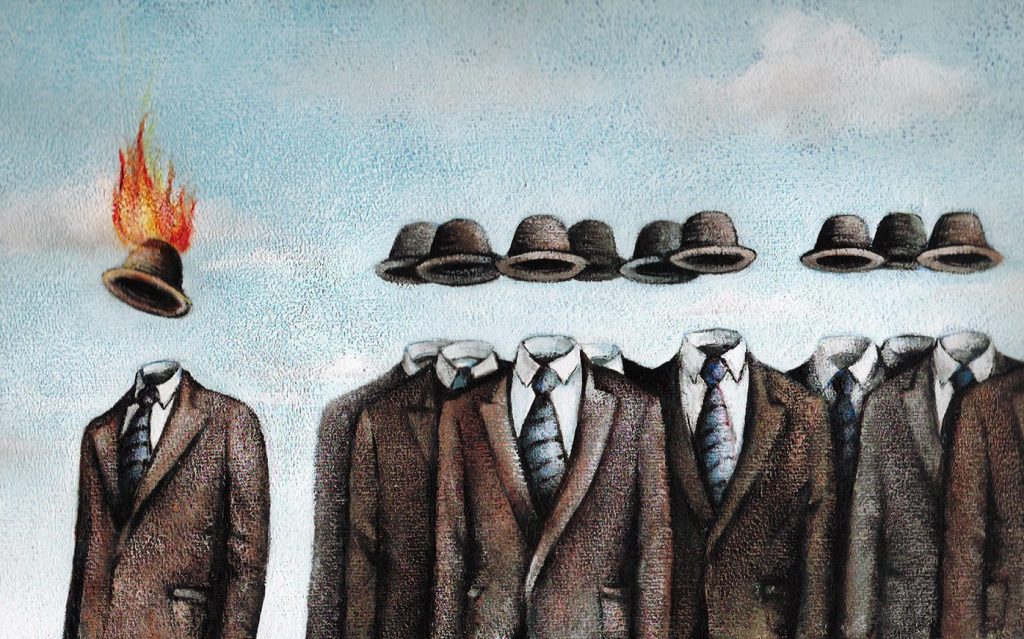
Image: “Inspiration,” by Martin Roemer, martinroemer.wordpress.com
Check out HFR’s book catalog, publicity list, submission manager, and buy merch from our Spring store. Follow us on Instagram and YouTube. Disclosure: HFR is an affiliate of Bookshop.org and we will earn a commission if you click through and make a purchase. Sales from Bookshop.org help support independent bookstores and small presses.
 Heavy Feather Review