
“Arriving last of all he stands on the periphery of the melee, just slightly out of reach of the fun. The same way he’ll stand at so many parties when he gets older.”
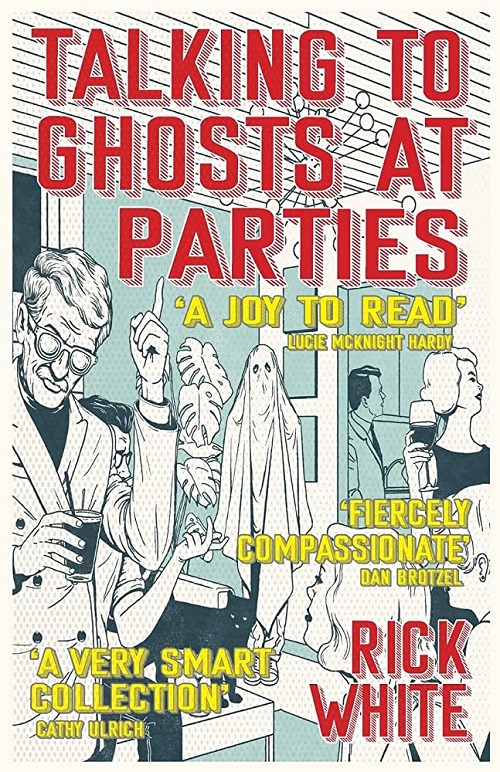
Good flash fiction is best thought of as a meal. The required ingredients are simple: a lure, speed, a surprise, and set to simmer without boiling over. After reading his debut collection of short stories, Talking to Ghosts at Parties, I can confidently report that Rick White has a winning menu. Over the course of 30 tales ranging from acidically absurd to bitterly mundane, White successfully draws us into his little worlds and successfully pulls the rug out from under us upon repeated bites.
Like a chef specializing in a regional cuisine, White has subjects and modes in which he is clearly most comfortable operating in: primarily the areas of corporate malaise and more abstract excursions. When exorciating the business world, be it in white-collar England (“The Clamp Down”), actual Hell (“Infinite Growth”), or a vauger afterlife still (“In the place where all your old bandmates go”), White demonstrates a deft hand and a keen eye for details. Most notable is a feeling of first-hand knowledge which is something incredibly hard to create with so few ingredients. His settings are recognizable, and his characters feel grounded, and every insufferable HR-infused interaction feels absurd while remaining immediately recognizable. This is easier said than done, considering some of these characters are actual malevolent demons.
White also thrives when he allows his stylized prose to lead. The opening story, “Uncle Charlie’s Bicycle,” makes use of staccato sentencing and vivid imagery to soften what is on the whole an incredibly bleak tale. A child in an abusive group home finds release and perspective through professional wrestling. And while the story remains grounded, it is a perfect encapsulation of a gut punch that can only be delivered by flash fiction.
Also of note is “Lycanthropy (Werewolf Kitchen),” which tells the story of a lupine chef making a meal for an ex and her new beau. This story contains a lot to like, from the excellent use of cooking imagery to the broiling rage, supernatural twinges, and the strain of someone desperately holding back something. White suffuses his odd genre tale with enough humor and heart to make the entire presentation memorable.
If the collection were to falter in any section, it would be in the more grounded stories told more conservatively. To be clear, White can craft absolutely lovely dioramas for his more grounded tales to operate in, and his characters maintain their cleverness throughout. Acerbic gems (“Dog-Face Malone, meet Linda”), empathetic family drama (“Stinky McGurk”) and more straightforward portraits of human-connection (“Bee’s motherfucker!”) all read well individually while containing the elements that make the entire book an enjoyable read. However, reading the entire collection at once makes one wish that the ratio of absurd stories to grounded ones were slightly skewed the other way. Knowing how good White is when he’s at his most creative or stylistic makes the down-to-earth sections feel like just that.
However, I would not change a thing if that meant missing out on stories like “The Principle of Gentleness.” As a standout story, it blends a broad scope of time through the funnel of a children’s jujitsu class. In one moment, you are watching a father take his son to a self-defense lesson, and by the end of the page you have encountered the entire lives of two people and the bitter mélange of time passing too quickly. It’s a sensation that sneaks up on you, and only after you’ve moved on to the next story do you realize how impactful it really is. It’s a work that makes a reader want to put the book down in the absolute best way possible.
Like any fine dining experience, there are going to be items on the menu that may not exactly line up with every individual palette. However, there is more than enough in Talking to Ghosts at Parties to justify a visit. White’s work proves his talent for imaginative storytelling, vivid imagery, and empathetic character work can make for an entertaining read. It’s well worth a try, and after all, the proof is in the pudding.
Talking to Ghosts at Parties, by Rick White. Storgy Press, August 2022. 200 pages. $13.99, paper.
Adam Camiolo (@upandadamagain) is a writer, and occasional firefighter, who lives in New York. His work can be found in the Schuylkill Valley Journal, The Daily Drunk, The Foreign Policy Book Review, Heavy Feather Review, and he contributes to Poparatus.com.
Check out HFR’s book catalog, publicity list, submission manager, and buy merch from our Spring store. Follow us on Instagram and YouTube. Disclosure: HFR is an affiliate of Bookshop.org and we will earn a commission if you click through and make a purchase. Sales from Bookshop.org help support independent bookstores and small presses.
 Heavy Feather Review