
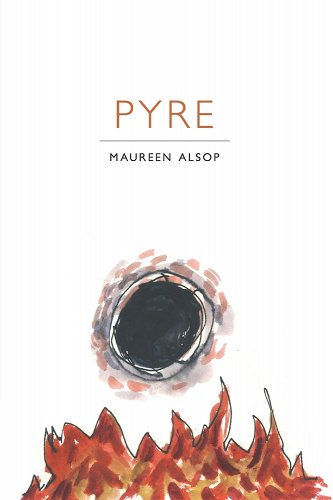
You probably won’t play the haruspex, as the interlocutor reveals the noumena via their mode of inquiry but is rendered too distanced to be biographical; you will play the attendant through aisles, the ciphers above the doors on your walk through Maureen Alsop’s imaginary garden with incantatory toads in them. Whereas Mirror Inside Coffin traces fourteen (by my count) such practices—from Onomancy through Lithomancy—and Later, Knives & Trees, which predates Mirror Inside Coffin, concerns its praxis with different studies entirely, Pyre, Alsop’s most recent collection, contents its focus on a single divinatory practice, divination by the observation of the phases and appearances of the Moon, as it were, as the poet’s epigram defines it.
The practice of derivation—not to be conflated with divination—and derivative poems—which may be poems which themselves read poems—succeed when, like an alchemy, they, the poems themselves, draw gold from the tradition’s baser matters. These poems show an adept reading of other poetries, and via such modality, I consider Alsop’s work worth its seat at the table with major ecofeminist work. I should say I reject the premise that all poems are boxes with locks needing the key of a fruitful reading, but the poems in Pyre are multifaceted enough that I’d point to “Botany’s secret / is a mural of constellations, remedies soiled roots, and mistakenly / I’d abandoned a leaf’s indigo socket, but there and there each acre / became a horse’s master. We were those who live against fire’s spine” in “Sky an Oar” as indicative of the parsing skill necessary to unlock Pyre’s rich variegation. Something approaching a hermeneutic principal would be to read the murky text by the light of the clear text. But it takes effort to navigate by only moonlight.
Consider the “green frost under the sun as we enter the aborted orchard. Spared bees stifle a circadian heat—afterlife’s adaptation, or a passive threat” from “Selenomancy Looking Southward” whose scientism only tacitly fraternizes with a certain vein of speculative poetry, and note the enfolding of “heat” to “threat” as an eye rhyme, the recurring soporific verbs speaking to circadian being; growth, waves; the absence of aural rhythms: is writing circadian circadian enough? Is reference enough? Plant-intelligences give voice to the poetic pith, sure, but will the green survive the frost? The moods are successfully expressed in the imperative, but, unfortunately—for, via the poet’s chosen mode of inquiry, namely, selenomancy, fate is why we’ve gathered—the subjunctive is less successfully expressed. The rhythm is the ritual.
An ecofeminist poetic can be incantatory. Ecofeminism circumnavigates an onanism of Earth-to-Moon: a pyre is a ritual, and the ritual is the undoing of the natural, echoes, sylphs the catamenial, the Moon becomes autosexual, prolapsed, a ghost-language, platonic in its adherence to form and synonymization—but I do not read the synonymization of the sun to the pyre nor the sun as the primary pyre if the article assigned to pyre, as I read it, as an “a,” the nameless one among may others, is not “the sun’s sun” in “Approbation” from Mirror Inside Coffin, which is a text with notable parallels to Pyre, the title being prominent among them—queer in its oneiricism, makes canon the witchy: “the first of the season inverts the sun.” Therefore the sun as giver becomes the sun as taker—shadow, moon, wombless as inverted sun, the object becomes its shadow. “Twilight fingered the grass” therefore onanistic therefore pleasure-producing, rewarding, studious, during “the night, as in sun dead, father. All black the blackening has been. As in mourning” from “Midnight Botanica.” But night is not the outside: night refuses to be flattened into death. The ghost outliving its host, the body lost beyond the gates, the outline bound forever by shadow. The Moon would not be visible without the sun, all facts cast their shadows, and so selenomancy is as dependent on “her mouth—drags / slow—the language into a terrain divided by sun: a valley / of tree-casts, check points”—from “Where the Apparent Wobbling of the Moon Is Known as Libration”—as the image is to reflection: a force so hungry it ignores the proper names of the dishes of fodder fed to it, of the hand-picked flowers and their Latin names, the suits of the cards, the names of victims, apeiron, signifier-signified; ghosts our interlocutors, now-summoned, the reading is becoming-ghost in the Moon’s pull as in grammatical mood: inflection is this selenomancer’s chief force. A ghost arboretum, its imperatives ghost-lit: the Moon is the ghost of the sun and light by which we entreat.
The Moon violates the otherwise utterly dark night. Escape occurs by moonlight: the sun, being the self-sufficient principal of light, is reflected in the mirror of the cipher. Fire is the lesser crepuscular death, the light the gods accidentally granted us, fated us; the Moon being the primary egregore, watching even as it is watched.
An introduction is a reading in the first instance and is the first review. By means of a sober account, Andrew Wessels writes that “Alsop’s poems wait for us to set them alight and burn them into meaning,” which speaks of the death of the sign-giver; we only half-mourn the death of our guide. Pyre does not become a self-immolation save by the self-obfuscation of the poetic. I agree with Wessels when he writes that “where pyre and poem break down is in the concept of repeatability. A pyre is made for a single occasion and, once burned, ceases to be. While a poem might also be written initially for a single occasion, after being written and published, the poem as an object sustains.” Divinatory praxis is the contranym as a pyre is a contranym, the answering question, the selenomancer’s equivalent Lance of Longinus: the blade that wounds heals. That which can grow can burn. And this is the case in much the same way a funeral may concern the entirety of its program by celebrating the well-lived life, and we’re to “work the night’s quick orbit” in “Sky an Oar,” indicated to work along the tide’s working, and in The Solar Anus, Georges Bataille names this the “organic coitus of the earth with the sun … but like the circular movement that the planet describes around a mobile center, then a car, a clock, or a sewing machine could equally be accepted as the generative principle,” where death becomes a death of the generative principles. The shadow is the indeterminacy the pyre casts. More than cauterizing, a pyre ritualizes and encodes the living through the gates of lamentation to the halls of death, death being lightless, unillumed, an unintelligible husk. For, in the final glas of “Sky an Oar,” we’re imparted to “follow the sun’s physicality which lies upstairs in dream figures.” Consider an early Alsop poem, “Solstice,” from Mirror Inside Coffin, which anticipates the death-encoding (death-encoding being parallel to lamentation being posterior to divinatory praxis) where “death came, / a horse scented with juniper, leaning / at once into the darkness. Now goes only / your body / close into words. Where language / is carried across the field, / and ritual itself. / transforms your shadow.” What will you decide as the generative principal? Ask the yarrow, the tides; flip to a random page, a favorite page. The ontological character of the event of the lunar priamel; the imperative; campfire stories; camp; speculative Ecosophy?
When Wessels accounts “the construction of a poem is a process akin to making a type of pyre wherein letters and ink become words, words are arranged into lines, and the lines are combined into language objects that are waiting for us as readers to alight them by reading them” we’re of course left to a living science as a language of furrows as well as fissures, but ultimately, a science as a language of insurmountable space as that of the space we live between the through-lines one lives between plants and within the staked and unstaked left margins. Flora being as desperate for the manure as any other causality. But Alsop’s ghosting is not a sublation: shadows do not reduce gaps. What can the seasons think which the planters can’t? The poems Pyre occasions are physical but are not objects. The subject-object dualism becomes dream-flattened, and the texture connections craft and that Alsop has crafted from noun to verb to noun again move in and out of occupiable space in ways that which we typically call objects can’t. The referent blooms but only with enough light. Rhizomes—the Aristotelian argues—speak of intentionality, here let’s say the intention of crafting a pleasing poem or nurturing a plant pleasing to the senses. In the way a pyromaniac’s herb-patch might fail to resemble a traditional horticulturalist’s herb-patch, Alsop’s poems brutally eschew attention to line-breaks, the fallow furrows. If I’m to be harsh on any aspect, it’d be the line-breaks, the poet’s decisive power.
Pyre is categorically not lucid, but nor is it revelatory as one might hope. Are moods given or received? Where two gather, there is the ghost-articulation, moods in tow. I find the poet files cantrips but leaves us to our own devices. Whether you wield them successfully or not is up to your abilities as a spellcaster. Alsop is rarely didactic, which may simultaneously contribute to the enjoyability of the read yet never pass us through the threshold toward higher-level spells.
Pyre, by Maureen Alsop. Los Angeles, California: What Books Press, October 2021. 98 pages. $17.00, paper.
S.G. Mallett is the author of the full-length poetry collections Disparate Logoi (Alien Buddha Press) and Sunolon (forthcoming from Vraeyda Media), the chapbooks A Brief History of Scarecrows (Back Room Press) and Markov Chainmail (forthcoming from Cactus Press), and acts a Poetry Reader for Chestnut Review.
Check out HFR’s book catalog, publicity list, submission manager, and buy merch from our Spring store. Follow us on Instagram and YouTube. Disclosure: HFR is an affiliate of Bookshop.org and we will earn a commission if you click through and make a purchase. Sales from Bookshop.org help support independent bookstores and small presses.
 Heavy Feather Review