
Transients
I tossed garbage bags full of last items into my Honda. Wire hangers, rolls of wrapping paper, a comforter. The orange tabby cat appeared, jumped into the back.
“Damn you!” I shouted. The cat arched and skittered to the ground, running behind the (no longer) rented bungalow. I expedited to the driver’s seat, my foot hovering above the gas pedal. The cat’s green-eyed stare taunted. She stood stock still awaiting my next move. I gripped the steering wheel as the car revved and exited the driveway. From the rearview mirror I saw the cat holding its stance, then shooting into the shrubs. I turned out of my former street with a racing heart.
I regretted not killing the cat, then regretted feeling that way. Typical.
***
“How nineteenth century,” my new therapist said.
“Doesn’t that happen to other people? Is it that unusual?” I asked, willing my right leg to stop bouncing, wishing I’d combed my wispy hair.
“Losing both parents? Foster homes? In the early 2000s? And you made it to college, grad school? Very Oliver Twist. Did you have a patron of some sort?”
“A patron?”
“Yes, like a mentor.”
“Well, I had some teachers I liked.”
“And we’ll discuss them later. Time’s up.”
***
One of my foster families, the Craters, had an orange cat exactly like the one at the bungalow. That cat rubbed against my skinny kid legs and when I reached down to pick it up clawed me with pin-like talons. That cat also deposited a dead mouse on my already dirty pillow case. The Craters called that cat Shmootzy. Shmootzy.
***
The bell rang, the doors opened, and I exited onto my new floor which smelled subtly of Ortega taco seasoning. I fumbled for keys, balancing a brown paper grocery bag.
“Hello, neighbor!” A round older lady with red hair touched my elbow.
“Jesus Christ,” I said.
“My heavens! Not Jesus, Catherine. Can I help you?”
“I’m just—” The lock finally released allowing a waft of fresh paint. “Nice to meet you.” I shut the door in the woman’s face.
Her soft steps receded down the hallway. A distant door opened, closed.
***
“Seems strange,” the therapist said.
“Why?”
“Oh, just moving from a house that seemed perfectly nice in the suburbs to a high rise—that one across from the mausoleum? For no good reason.”
“I have my reasons.”
“The cat?”
“I hate them. And that one—it keeps coming back. I keep moving. I swear it’s the same cat every time.”
“Okay.”
“I need to escape that cat.”
“Huh.”
***
In my line of work I see a lot of hoarding. We sometimes have to rescue people—sane, non-hoarding family members—from their hoarding relatives. I’ve had to coax the person out, tell them there is nothing they can do to save their loved one. I’ve had to say, “This is beyond your capabilities.”
I’ve lived it. It was in that last foster placement house with Missy. It seemed fine at first. She started with philodendrons. There were probably a thousand plants in the living room where I slept on the couch. Then she gradually switched from plants to cats. She told me they would be my siblings. There was Toby and Alice and James and, she even named one after me, Greta. By the end of it I couldn’t sleep on the couch anymore because it was covered in cats and their hair and feces. Eventually, a neighbor called social services.
***
The red haired woman, Catherine, perched on the bench outside the building.
“Yoo-hoo! Neighbor!” she said.
I was coming in from work, dinner in the bag, brief case on my shoulder.
“Hey,” I said, not wanting to.
She patted the seat. “I’m just diagonally down the hall from you.”
“I come from the suburbs. Still getting used to close neighbors.”
“Ah! That explains it,” she said, a small foil oval extended. “Date nut bread. Made it this morning.”
I forced unsteady hands to accept it, then excused myself.
When I entered the building, I threw the loaf into the lobby’s garbage can.
***
“Do you think your marriage would have worked if you’d—” the therapist said.
“No. I’m incapable of intimacy. Can’t change that.”
“But you married. Isn’t that something?”
“Faked it,” I said.
“Oh. Why?”
“To please. The world. Myself on some level.”
“So would you like to meet someone else someday?”
“No. I just want to be alone. And not followed by a cat.”
“You should be fine on the twenty-fifth floor of a pet-free building.”
“Should be. But I dream them.”
“Have you considered hypnotism?”
“I prefer to stay alert.”
“Interesting.”
***
Catherine continued greeting me from her seat on the outdoor bench, attempting to lure me to sit down beside her. Determined to avoid her, I passed by every day, eyes straight, focused on the door. Somehow, she’d still leap into my peripheral vision. I caught glimpses of her sitting there in a sunspot filing her nails or picking lint off of her stretch pants or reading a paperback. Once I saw her eating tuna fish out of a can with a little fork.
Other times, I’d catch her walking along the hallway on our floor, clinging close to the wall. She’d stand in her door smiling, chirping, “Hello again, hello!” My anxiety increased with every encounter, a noose tightening.
***
“Let me repeat what you just said. You think your neighbor’s a cat?” the therapist said.
“I know how it sounds. She’s like a cat.”
“So even if she is a cat, what’s the problem? Is she rubbing against your leg?
Bringing you dead birds?”
“No. No. I just came here to be free of—”
“You know what I’m going to say. Psych 101.”
“It’s not about the cat.”
“Time’s up!”
***
Beside my living room window, I copied a sunflower from a book.
When I painted, I often thought of a friend I had in high school, Lori—the only friend I’d ever had, the only person who didn’t care I was an orphan, a foster kid.
“Red, yellow, blue. Primary colors. You don’t need much else,” she’d said.
I liked this. I’d come to believe most problems were caused by too much of things. Too many drugs. Too many kids. Too much crap. Too much pain. If I had very little, I self-reasoned, or just enough, I might stay safe.
Lori had just enough—a father, mother, and one brother named Tim. They invited me to dinner and to the movies and once on a trip to the beach.
Lori also had a secret life, like me. She had cancer since childhood.
One day, her mother called to tell me Lori died.
Again, too much of things: cancer cells, love.
***
Catherine stood outside my door. It was the first time I noticed her glittering emerald cat eyes.
I almost hyperventilated.
“I need help,” she said. “You’re so tall.”
“No—I really have to—”
“It’s just a minute. Honest. I won’t bother you again,” she said.
I followed into her apartment. Sun streamed through windows. The upholstery was all lavenders, blues, sunflower yellows. The room smelled inviting—like coffee.
“I just can’t get this from the shelf,” she said, pointing.
I reached up for the can, condensed milk, handed it over.
“Please stay for supper,” she purred.
***
“So you stayed for dinner? Did she make cat food casserole?” the therapist said.
“No. She had a sheet pan dinner. Chicken.”
“Cats do like birds.”
“She told me about her life. She’s been all over the world. She showed me pictures.”
“Will you reciprocate? Leave a bowl of milk in the hall?”
“No, I’m moving again.”
***
A fire ended my stay at the Craters’ house. I’ll never forget how everything smelled like wet char, how everything was ruined (even though it was ruined from the start). The Crater woman wept over soggy cardboard boxes for days. I watched her from across the room, cold as stone.
***
The fire alarm went off. I hesitated at first, then rushed into the hallway where smoke billowed from Catherine’s apartment. I kicked open her door, found her crying, curled in a ball on the couch under a storm cloud of smoke. Flames leapt from the oven.
“Catherine? We gotta get out of here!” I covered my mouth and nose with a hand.
Her emerald eyes faded to aqua. She choked, emergency vehicles wailed in the distance.
I grabbed her arm. “We. Gotta. Go. Now,” I said.
She clung to one of her velvet pillows. I took her hands and pulled her to standing. The pillow dropped to the floor, a purple stone falling.
I wrapped an afghan around her shoulders, forced her feet into rubber boots by the door.
We swirled in dizzying circles down the stairwell, bursting outside into sharp air.
Across the street, our eyes turned upwards for some time, the mausoleum behind us, the dead stacked at our backs.
“What is this?” I asked, “Is this just bad luck? Or what?”
“Maybe the opposite. It depends,” she said.
I began to cry, my own wild torrent of tears, mimicking the water blasting from the firetruck.
My arm locked around Catherine’s shoulders.
Together, we appeared and faded within the flashing light, the intermittent darkness.
Mini-interview with Maggie Nerz Iribarne
HFR: Can you share a moment that has shaped you as a writer (or continues to)?
MNI: I think connecting with my writing partner, Laura. Her sharp eye and editing skills have changed the way I look at my work. Her comments and advice always make my stories better.
HFR: What are you reading?
MNI: I am reading Writers and Lovers by Lily King.
HFR: Can you tell us what prompted “Transients”?
MNI: I think I originally wrote it in response to a prompt about a cat. I like to write about cats. I like to write about old people. I think I heard or read about a cat that followed its owners for hundreds of miles. I’ve heard that a bunch of times, actually. I also have an older friend who was displaced in Europe during WWII and was placed in an orphanage as a child. She moves a lot and can’t seem to settle down. So, I think all of that is what made “Transients.”
HFR: What’s next? What are you working on?
MNI: This morning I just finished (and sent to Laura!) a draft of a story for an “ill-winds” prompt by Smoking Pen. I have A LOT of deadlines (self-imposed) for April 30, so I am going to be very busy this week writing new stories and adapting old ones to adhere to various prompts. That’s how I roll.
HFR: Take the floor. Be political. Be fanatical. Be anything. What do you want to share?
MNI: I am sickened and distressed by gun violence in our country and have had it with guns. It’s totally ridiculous that we live with this every day. I think it is our country’s great shame. I used to be less political and always leaned moderate conservative. Since the last election and the torturous, disastrous tenure of our former president, I have become totally liberal. I am no longer ambivalent. I believe I have chosen to stand on the right side of history.
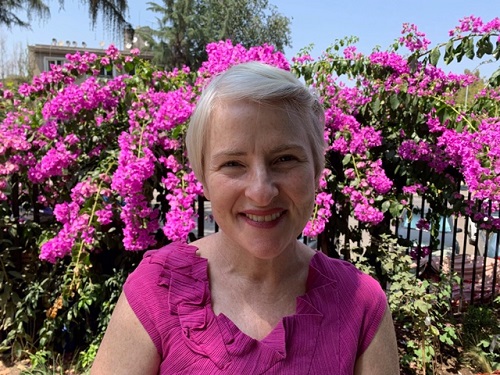
Maggie Nerz Iribarne is 53, lives in Syracuse, New York, writes about witches, cleaning ladies, struggling teachers, neighborhood ghosts, and other things. She keeps a portfolio of her published work at maggienerziribarne.com.
Check out HFR’s book catalog, publicity list, submission manager, and buy merch from our Spring store. Follow us on Instagram and YouTube. Disclosure: HFR is an affiliate of Bookshop.org and we will earn a commission if you click through and make a purchase. Sales from Bookshop.org help support independent bookstores and small presses.
 Heavy Feather Review