
At AWP, due to a last-minute cancellation, Suzanne Roberts was asked to fill in on a panel featuring writers who were accomplished at the writing their own lives in books, not one-off memoirs but multiple books. She said she and her husband rented out their house to collect California sized rent. They were temporarily living in their camper (albeit at some beautiful spot in Northern California) so she could just write. When she spoke of audience, she said that her mother was her audience, always. Until she died. And then Roberts felt free to write about the things she could never reveal to her mother, in this book, Animal Bodies. I was blown away by her ferocity on that staid panel, and I think the rest of the room was, too.
Roberts writes of death in a way that only those stripped of the protective barrier of living parents can, a freedom born of grief. Masterful and gnarly, infused with dreamscape and fragment, travelogue and dialogue, longform and listicle, Animal Bodies is emphatic and feminine, fierce as its author’s presence on that panel, and revealing in ways that empower us to consider our own depths.
“Becoming Bird” near the beginning of the collection is an elegy to Ilyse Kunetz, a friend and poet taken young by cancer, each section centered on a bird sighting. In “The Gull” Roberts recounts:
“Who gets brain tumors?” You ask me, the ocean, God. The only answer is You do. You did. But I just shake my head while the ocean rumbles and God stays silent.
A fisherman catches a gull on his line. The bird is frantic, swooping with jerky motions, straining against the line. Another gull flies by screaming. The man tries to catch the trapped gull, and I watch as if my life depends on it.
Another one of our poets helps him, and the man catches the bird, untangles her, and lets her go. And when the bird enters the sky, something giant and sad lets go in me too.
The big and the small serendipitous occurrences entwine, the poet’s way of being in the world. (Roberts has published several books of poetry.) The poet’s eye is what makes this essay and others in the collection transcend confession and turn toward incantation.
There are dramatic and wild tales of a life full of travels, and adventure. “Before seeing the caged meat dogs in Vietnam, we were hiking the coast-to-coast trail across England, and in the mornings we went for the English breakfast.” begins “Animal Bodies,” a world tour which takes on the “hypocrisy” and “paradox” (Roberts’ words) of loving animals and eating animals.
It is something Susan Orlean never does in her book of essays entitled On Animals, a book published contemporaneously. They sat side by side for a while in my reading queue and it made me think. About “the omnivore’s dilemma” to quote Michael Pollan, but also about ways to approach non-fiction, about how a writer can bring self into a piece, versus how a writer can bring Self into a piece. If the writing does not change the writer, what can it offer us?
Roberts’ trip to the Amazon is ultimately cut short by her own exasperation with the tourist trade, of the endangered monkey being placed on her head for a photo op and a tip one too many times.
Abortion is a topic in this book on multiple occasions, most strikingly when Roberts takes it on in bold journalistic fashion, which I do not think could happen in the same way in 2023. Roberts writes of attending a month-long writing residency in Alabama:
I had started asking locals what they thought about the recent abortion ban there. I asked the grocery store clerks, Lyft drivers, even the people on the street… “I’m for the new law,” the dad said. “A heartbeat’s a heartbeat. A life.”
“Even in the case of rape or incest?” I asked. “What about that?”
“It isn’t the baby’s fault,” he said …’
They are standing outside Nudie’s Honky Tonk.
“According to your definition of human life, those are lives, too,” I pointed out. Three young women in strappy sundresses stumbled past.
“I’ll have to think about that,” the dad said and rested his chin between his thumb and finger.”
In “The Danger Scale” Roberts’ technique is the suspenseful style of great short fiction:
The chairlift in front of us disappeared into the white haze, as if we were inside a snow globe someone had given a vigorous shake. We stopped talking, wondering at this strange white fog swirling around us … We skied off the lift …
Roberts is known for recounting her adventures on the John Muir trail in a previous book, so this is the kind of story that I imagine her fans are all in for. It lives to its promise.
In “Words Etched into Skin,” near the book’s end, Roberts reprieves the grief of her mother’s death:
My mother was the president of my fan club, and truth be told she was also my vice president and secretary …. This was all very cute and sweet until my husband gave my mother his old iPhone. I was shocked how quickly she took it up … The days when I could publish poems in obscure literary journals she would only read if I gave them to her were gone.
One of my subjects was how I was afraid of becoming my mother.
Animal Bodies is a fierce accomplishment, full of varied formal experiments with the essay yet dedicated to precise readable prose. It is a book to take on an airplane, to bring on long travels, to leave in some exotic place for the next traveler. Though you may not want to leave it, due to the circumstances, you are forced to travel light, and you feel its void in your pack, even though you have picked up another book to read on the way home. Roberts writes:
The essay determines how it will end. A story is a papier mâché carnation; the essay is a spotted purple orchid on your table. The one whose name you don’t know. The one that looks fake but is real.
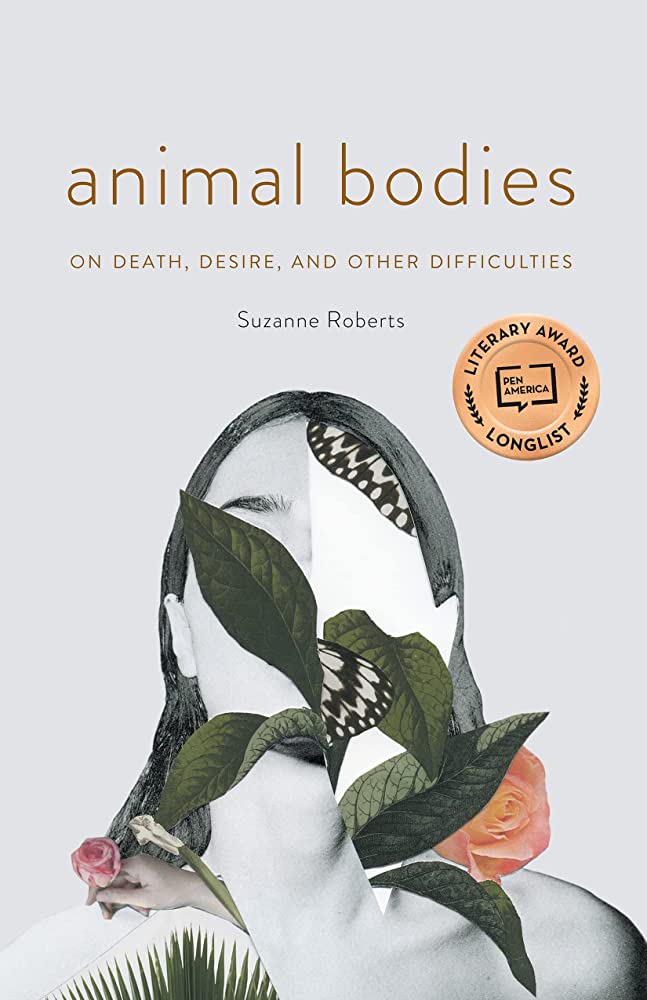
Animal Bodies: On Death, Desire, and Other Difficulties, by Suzanne Roberts. Lincoln, Nebraska: University of Nebraska Press, March 2022. 252 pages. $19.95, paper.
Karin Falcone Krieger’s recent reviews, stories and poems are in The Decadent Review, Tupelo Quarterly, Lit Pub, Santa Fe Writers’ Project, The Literary Review, Tofu Ink Arts Press, Viewless Wings Podcast, and in the anthology, A physical book which compiles conceptual books (Partial Press, 2022). She taught writing as an adjunct instructor for 20 years, and was an adjunct union representative. She earned an MFA at The Jack Kerouac School of Disembodied Poetics at Naropa, and published the zine artICHOKE from 1989-2008. She occasionally types poems made to order in public space. When not writing, she is probably organic gardening or cooking. Links to these and other projects can be seen at karinfalconekrieger.com.
Check out HFR’s book catalog, publicity list, submission manager, and buy merch from our Spring store. Follow us on Instagram and YouTube. Disclosure: HFR is an affiliate of Bookshop.org and we will earn a commission if you click through and make a purchase. Sales from Bookshop.org help support independent bookstores and small presses.
 Heavy Feather Review