
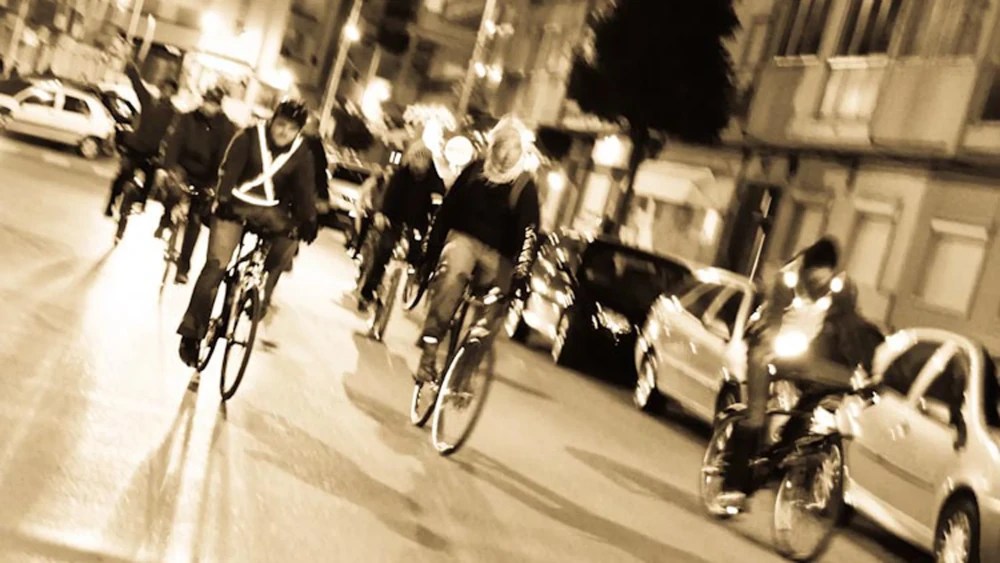
The bikers pass my apartment every afternoon, rising and falling in their seats like dolphins stitching through the waves. I observe them from my window, moved each time by the acrobatics, the revved wheelies and breakaways, the marriage of these swaddled bodies to the howling machines. My line of sight stretches down a long straight avenue lined with laundromats and pharmacies, allowing me to appreciate the complications of this organism in motion, its subtle positional hierarchies and musical charisma. For hours each afternoon the bikers circle the neighborhood with no clear objective beyond the simple act of movement, guarding the soil that is not theirs, asserting their interests. Last summer they took over the track around the reservoir, knifing down the narrow path united, scattering after-work runners and families out for a stroll. The bikers never expose their faces; they are a people, indivisible, with no time for traffic laws or the pedestrian’s right of way. My neighbor, an elderly Polish woman with an ancient dog called Cake, thinks they are assholes. “These kids with their fucking bikes,” she grunts as I cross her on my way down the stairs to retrieve a package. Cake is under her arm, looking trimmed and exhausted.
***
There are five gyms in the neighborhood, each with a fitness philosophy carefully calibrated to help members become their best selves: a cycling gym, a Korean boxing gym, a corporate chain called Plank Fitness, a CrossFit installed in a garage where muscle men with cartoon tattoos and high ecclesiastical hair patrol the roller door, and a gym called EVOLVE whose main point of distinction is that it’s open 24 hours a day. Sometimes, awake at 3 a.m., I like to think of white collar professionals EVOLVing in the middle of the night, shedding sweat onto the step machines or planting a wide stance for the overhead press while their neighbors sleep.
In a spirit of self-improvement I signed up for a membership at Plank Fitness a few weeks ago. I haven’t been yet, though I have begun to receive daily emails setting out the gym’s political opinions, which feels like a form of exercise in its own right. “Plank Fitness stands with the people of Ukraine against war, imperialism, and all forms of racial and economic injustice. Use the code below to refer a friend and get 25% off your annual membership. Keep plankin’!” The key fob I received as an entry pass now sits on my dresser, silently challenging me to become a better person and achieve, through exercise, a viable solution to conflict in the contested oblasts of the Donbas. Every time I catch sight of it I feel a jab of self-hate, the wink of the light off its lacquered surface a kind of mockery, a rebuke to my doughy midsection and lack of direction. “I’ll go tomorrow,” I tell myself. Tomorrow comes, and I never do. Could it be that I’m more of an EVOLVE type?
***
On Twitter, someone has posted the following list:
1. Bees declining This economy is not sustainable.
2. Ice disappearing
3. Emissions surging
4. Ecosystems collapsing
5. Photosynthesis malfunctioning
6. Oceans overheating
7. Overconsumption rising
8. Primates vanishing
9. Chemicals accumulating
10. Penises shrinking
***
Every piece of furniture in my apartment is mid-century modern, or a mass-produced 21st century impersonation of it. In a faraway land a fleet of workers I’ll never meet has given their bodies up to capital so I can decorate this room, display this taste, integrate into this milieu of just-so credenzas and armchairs not built for sitting. The first time Sam came over they circled my apartment in silence, noting my selection of books (the Offills and Cusks strategically placed at eye level, the Franzens and Foster Wallaces shoved into the bottom shelf), feeling the light-blocking curtain between their fingers, letting a hand pass softly over the brushed suede of the sofa. Next to my TV there’s an art deco lamp of a robed woman holding a bright orange globe. Sam stopped before the lamp and stroked the woman’s bronze limbs, dense and light, so perfect in proportion and weight. Later we found ourselves on the bed, not touching each other. On the app that brought us together Sam had listed their interests as “making out, body contact, nipple play, sucking dick and getting sucked, eating pussy and getting eaten, eating ass and getting eaten, fucking and getting fucked. Also music.” My profile said only “Bloop bloop,” which communicated much the same message but in shorter form. We marked our first meeting by not having sex.
Instead, we lay on top of the covers, an early summer breeze feathering through the open window, and Sam told me how they only consumed porn for the music. The most amazing, kinetic developments in music are happening in the soundtracks to hentai and sissification art, they explained, emphasizing the word “art”. Porn, they continued, was a motor for musical discovery more powerful and more interesting than any algorithm serving up generic lists on an app with names like “Introducing Chillwave” and “This is Kraftwerk!” Sam played me a piece of music off their phone they’d unearthed this way, a forgotten 2009 track called “Fico” by Italo disco DJ Mr. Cisco. The song’s only lyric was, “Ehhh ehhh ehhh ahhh ahhh ahhh sexy oh oh oh,” repeated over a smacking beat of synths and cowbells. Sam connected their phone to my bluetooth speaker, and we lay there pillowed by the breeze, Mr. Cisco’s breathy vowels punctured only by the squeaks of an elfin anime woman, out of sight on the face-down phone, getting fucked by a giant squid. Ehhh ehhh ehhh ahhh ahhh ahhh sexy oh oh oh, ehhh ehhh ehhh ahhh ahhh ahhh sexy oh oh oh.
“This is Eros, this is music,” Sam said.
***
According to Instagram the restaurant at the end of my block, a destination for the city’s mead lovers, has hired a new chef. This chef, the restaurant has written, applies a “metaphysical” approach to cooking and is in the process of revamping the menu to include “a selection of seasonal classics thoughtfully curated through an ancient Roman lens”. Four hundred twenty-nine people have liked this post, with many of them registering further approval in the comments. Woweeee, amazing, heart-eyes emoji, flame emoji, LEGO!!!
***
My mother has emailed me a link to a free public performance of a stage adaptation of Billy Budd in a park near my apartment. “Something for you?” she asks. Yesterday it was a link to a filmmaking competition (“No entry fee!”). Without prompting she has become my personal cross-country cultural concierge; emailed links are the glue of the parent-child relationship now, the seas of adolescence becalmed into a one-way stream of book recommendations and weakly compensated “professional opportunities.” On my laptop there’s a document open with a bulleted list under the headline “10 Signs Your Mattress Is Not Working For You”—another thought leadership piece to pen while collecting unemployment money from the government. Is this the “post-work” future everyone talks about? In my moments of extreme desperation I open up LinkedIn to check job listings. Today the first thing I see is a post by the founder of the world’s biggest hedge fund: “Understanding, accepting, and working with reality is both practical and beautiful. I have become so much of a hyperrealist that I’ve learned to appreciate the beauty of all realities, even harsh ones, and have come to despise impractical idealism. This, I believe, is the key to unlocking your potential.”
***
The bikers are sawing across the neighborhood’s grid again today, west to east, east to west, with the persistence of a migraine. I have heard them but not yet seen them. My neighbor is sitting at the top of the stairs, breathing heavily. Cake is sitting impassively by her side. I pass by her on the way to the basement laundry and notice her knee is bleeding. Strings of hair are plastered to her sweaty scalp. The stairwell smells of boiled cabbage and dust. I stop and ask my neighbor if she needs any help. “This is what happens when you get old,” she answers, then she looks straight at me, something she’s never done before. Her eyes are dancing with rage.
***
Now I’m lying on the roof of my building, allowing the sounds of the city far and near to wash over me: the strangled appeal of a distant fire truck, the warble of a helicopter somewhere overhead, a car alarm, the ventilation pipes all huddled in whispered communion on the rooftops. The building management has a strict policy prohibiting access to the roof, which is unfinished and has no guardrails; a graphic on the door at the top of the stairs leading to the top deck shows a group of people—drunk people, in the scenario as I imagine it—tripping over the edge of the roof and falling four floors to the street below. “DON’T RISK IT,” the sign says, offering implicit recognition that it will, despite this warning, be risked. There’s a man on my block screaming “EDDIIIIE! EEEDIIIE! EEEDIIIIE!” without end. On every block I’ve lived in this city there has been a man whose primary function in life is to scream in public. No other city I’ve been in can offer the same density of screaming man. (Did I come up with this thought myself, or read it somewhere online?) We are always being surveilled, assessed, measured, and sorted, which is really just another way of saying we are always sorting, measuring, assessing, and surveilling. In the face of this unyielding traffic of perception, screaming might be the only rational response.
***
Sam has brought me food from the ancient Roman restaurant. They’re unpacking it on the counter while explaining the history of drug use in musical expression. Fat ribbons of pappardelle, a whole fish dressed in dill and bejeweled with pomegranates, a salad of hefty leaves wet with citrus and oil: I guess Ancient Romans were just Italians? Sam is working on an album of psychedelic folk or Volkisch psychedelia, depending on which track you’re listening to. Sam tells me that without acid, music would still be stuck in the 1960s; there are small flakes of sea bass falling from their mouth as they talk, just the way the DJs of deindustrializing Detroit would have wanted. After dinner I suggest we watch a movie.
“A movie? Really?” Sam tells me I need to get out of the city for a bit. They think I’m stuck.
“Of course I’m stuck,” I reply. “I’m bisexual.”
On Twitter, someone has shared a story from a British tabloid with the headline, “DICKED BY DELE: Fading England star finds new role ‘in the hole’.” Before I can click on the link, my feed has refreshed and the story disappears into the ether. The mysteries of Dele’s dick remain unknown to me.
Sam leaves and I’m still hungry. I thumb a delivery app for options: Afro-Caribbean, Cuban fusion, Mexican, Chinese, Japanese, Nepalese, Sudanese, Bhutanese. I switch to a different delivery app; the same restaurants appear in a different font. The choices are intoxicating, and unbearable. A cafe three blocks from my apartment has posted an Instagram photo of a glass of pét nat with a caption informing us they are “open until 8 today, so swing by and enjoy a summer sparkler in the sun! Fridays are now laptop-free, but in return the lovely, smiling faces of @quesobitch and @scumchild will be on hand to take care of you and get you everything you need.” I like the post without commitment. On Twitter a fight has broken out about the ethics of using tissues.
“Still hungry lol,” I message Sam. Beyond the walls comes the sound of my neighbor struggling up the stairs to her apartment: the tinny plastic click of the walking frame, the grunt of each step cleared, click, grunt, click, grunt. On my music app I kill the bossa nova track that’s on pause and surf the algo, Olivia Rodrigo, Shakira, Tarkan, Fela Kuti, Pasteur Lappé, Mory Kanté, Priscilla Chan, Teresa Teng, Hiroshi Sato, Gang of Four, and Art Kinder Industrie, some of whose work I’m more familiar with than others, all leaving me unmoved. Eventually I settle for the machine’s most persistent recommendation: “Introducing Chillwave.” Click, grunt, synth, click, grunt, synth, click, grunt, synth, synth, synth, grunt, click, until the stabs of the frame into the carpet and my neighbor’s breathy exertions fold completely into the beat, the grind of flesh made frail concealed in a curtain of synthetic sound, nostalgia and sunsets, memories and longing, and my surrender to the noise is complete, which is why I mistake the crack, when I hear it, for a part of the song.
***
A small silence envelopes the crowd that has gathered outside my building. Moved and rooted to the spot, we watch as the two medics maneuver the stretcher down the stoop and through the narrow passage between two parked cars. There are three hospitals nearby: a small, private hospital attached to a secluded retirement home, a Presbyterian hospital known for its esophageal surgery unit, and a big public hospital with reviews on Google maps that run the gamut from “The worst hospital in the city” to “Do not not not not NOT go here!!” My neighbor is laid out on the stretcher unconscious, an oxygen mask fitted to her chalky face, hair curling in the hot wind. With some self-disgust I find myself thinking what a shame it is she never had the chance to do her research online before succumbing to this infirmity of the bones. Do not not not not NOT get old. The medics lift her into the back of the ambulance, the rubber soles of their shoes squelching against the tarmac as they plant into position for the final heave. One of them disappears into the cabin while the other instructs, “Yeah, just hook her up bro.” There’s a sound of belts fastening, the stretch of gloves, and paper packets being torn open. “I said hook her up!” the medic repeats, before hoisting himself into the vehicle and pulling the doors shut in one efficient movement. On the bumper of the ambulance there’s a DEAN 2004 sticker, which I assume is a joke since the past, at some level, is always funny.
A notification appears on my phone: “You’ve taken 12% more steps today than yesterday.” The ambulance departs with sirens unactivated, and the crowd melts away. Sam reappears, bounding toward my building holding a big brown paper bag with twisted handles, the kind you might get after buying expensive soap, an important scarf, or wine described as biodynamic, organic, or natural, depending on the winemaker’s precise approach to soil management, sulfites, filtering, and fining. “I brought a selection of signature whimsical toasts from the Australian small plates bistro,” they announce. Shoved into the windows of every building on the block, air conditioning units shudder and whistle against the season’s first real heat. A motorbike exhaust trumpets somewhere in the distance. The air is jam. This is the first time I’ve been outside in months.
***
“What do you think happened to Cake?” I ask Sam as the train emerges from the earth and continues across tracks built over the city. The dark of the subway disperses into the lurid glow of a computer-headache sky. ”Like, do you think a family friend is looking after her?”
“What?” Sam replies. “Who’s Cake? Oh I’ve seen this before,” they continue, squinting at the laptop, which is open on the tray table before us with what the streaming service has described as the “ravishingly sensual” 1999 film Beau Travail cued up and ready to play. In a spirit of “sensory underload,” Sam has insisted we play a movie with the sound off while taking our trip out to The Egress, a new art park tucked into the foothills on the city’s western edge. They click back to the main menu and begin scrolling, reading snatches of the capsule descriptions aloud in a hurried monotone as the cursor passes over each new film: dazzling sophomore feature, noir-tinged stunner, hallucinatory meditation on sickness and death, languid coming-of-age tale, an uncompromising and rigorously spare look, deliriously unhinged dark comedy, terrifying remake, unforgettable screwball comedy classic, shocked the world when it premiered at Cannes, visual sting, breezy and sexy summer-comedy gem, one of the screen legend’s most iconic roles, profoundly moving character study, breathtaking portrait, subtly ravishing passage through the halls of time and memory, jaw-dropping set pieces, his most personal reflection, one of the greatest films about film ever made, extraordinary dramatization, elegy of exile and an epic immersion, breathtaking study, moves and delights, stunning and deeply moving, an intense vérité drama, a complex portrait, a devastating portrait, not to be missed, was a critical and commercial flop on its release.
“Market failure,” Sam concludes. Rubber and aluminum come together in a cushioned clap as Sam shuts the laptop and looks up with an expression that suggests there should be a follow-up question. “When the market fails in this way, the state must intervene.” Sam has been “mainlining” Friedrich Hayek in an effort to challenge their own assumptions about society and politics, they continue, which they absolutely endorse as a way to “reset” amid the conformist tohu-bohu of life online, and with some shock and relief they have now discovered a deep affinity with the Chicago school and neoclassical price theory. Across the aisle a teenager with fake rhinestone nails is sucking the dregs from a jumbo cup of Coke. There’s a clear information asymmetry between the streaming service and the viewer, Sam explains as I listen with my phone unlocked, since the streaming service has perfect insight into the popularity of each of its films while the viewer faces a wall of generic descriptions that do little to differentiate between each film, each filmmaker, each actor, and each scene, which are nothing more than factors of production to be allocated and recalibrated according to the output desired under a given production function. On TikTok, a man famous for sea shanties has partnered with an indigenous throat singer to launch a boutique agency that will “help creators take their brands to the next level.” The people on Twitter have devoted half the morning to appreciating the cuteness of headlight wipers on cars. Sam offers me a crustless spam sandwich from the Japanese white bread cafe we diverted five miles to stop at on our way to The Egress, then introduces me to rational expectations. Pulling out from a station on the fringe of a redeveloped industrial neighborhood, the train lurches into its acceleration west as new passengers searching for spare seats scatter, stumble and clatter into each other, the city, the bodies, my phone’s aortic ticker of notifications and Sam’s ideas all coming together at once to inform me that the price of a chain-restaurant burrito is now too high thanks to minimum wage legislation, the bad politician’s feet are even worse, BILL GATES IS SATAN on a wall, LIFE SUCKS next to it and I WANT TO GO HOME underneath, economic actors are governed by rational expectations, people should stop saying “food is love,” people are deleting their apps to find love the old fashioned way (tending to a burns victim in an Italian monastery, reconnecting after ten years at a book reading in Paris, giving up), individuals are incentivized to maximize utility under income constraints, Shruti Lahiri is attending FEMININESHIP: Women Impacting Women Impacting the World, a new startup is not a bank but performs bank-like functions, FLATS FIXED WHILE YOU WAIT, TRY OUR FRUIT SALAD, the backlash against critical legal studies provides a clue to where the backlash against critical race theory might be heading next, the lines by the birria truck seem unreasonable, the link between homeownership and car ownership remains unsevered, “this sounds like a parody but isn’t,” until eventually, the city thinned out and the pulse of data undimmed, we round a corner and The Egress rises from the horizon, its mammoth shards of cross-laminated timber rising into the air like ski jumps to space, offering refuge and possibility, and Sam is silent.
***
“This would be a great place to fuck,” Sam comments as we sit on The Hill, a grassy rise overlooking The Egress’ main esplanade, which the structure’s many signs tell us is called “The ’Splanade.” In the distance we can make out the top tier of the amphitheatre (“The Amph”), where Sam’s friends have been given the 3 p.m. slot for a performance showcasing their blend of insult comedy and social justice activism titled “Look It Up.” At the foot of The Hill, as we began our ascent, the park’s staff offered us drawing paper and crayons without explanation. Around us adults of various ages are now sitting on the grass making sketches of sunsets and beaches while Sam and I watch.
“You mean like in the novel where the two dudes have anal sex at Auschwitz?” I ask.
“Oh my god I loooooove queer fiction!” Sam squeals, then adds, “So intertextual amirite scream emoji,” re-enacting the scream emoji for emphasis. They turn serious: “It was Dachau but whatever: there can be no anal after anal at Auschwitz.”
***
On the day The Egress opened, its celebrity architect strode to the microphone at which he was due to give his welcome address, tore up the typed speech that was in his hands, and announced to the stunned and ultimately enraptured hundreds before him (while many thousands more watched online), “The Egress is not for me, or for you, but for them.” He pointed to a group standing off to one side in traditional dress, descendants of the native people that originally inhabited the land on which the park, thanks to a public-private partnership bringing together the best of enterprise with the noblest civic purpose, was built.
The architect has said his design draws inspiration from indigenous fishing traps; now, just six months after opening, The Egress has become the preferred destination for anyone looking to “get out of the city” while not leaving the city. Every day thousands walk through its gates to experience their timed and ticketed two hours among the reclaimed slag heaps, walkways, gardens, and “sky bridges”—great pathways into the sky resembling the exposed sections of a native river snare—while enacting The Egress’ exhortation to “reset, recharge, escape, create.”
***
“come unstuck” commands a hologram in unthreatening lower case above the floor bell installation located at one end of The ’Splanade. A line stretches for a hundred yards as people queue for their allotted minute on the melodic grid, jumping from square to square in a musical evisceration of stress that happily doubles as a quick workout. Sam and I are drifting around the park, aimlessly filling in the hour until their friends take the stage at The Amph. My phone, which is in my hand rather than my pocket, lights up with a notification from the dog-themed language app I haven’t used in six months: “Woof! You’re only two quizzes away from making it to Lesson Eight: Asking for Directions.” A fleet of food trucks nearby offers “bites and sips” inspired by the city’s “rich pageant of immigrants, walkers, talkers and makers.” The chef behind the menu, Sam tells me, was recently forced to sever all ties with The Egress after an old series of social media posts surfaced in which he was dressed for Halloween, in brownface, as a halal meat cart vendor. “That’s the power of the market,” Sam tells me, taking up their earlier theme, adding that a desire to “effect change from within” is also the motivation guiding their friends, a troupe of anarchist performance artists, to accept the invitation to appear at The Amph. “The only way to correct the market is through the market. This chef will never sell a plate of lamb over rice again.”
Visitors sit at tables by the food trucks, looking dazed and dehydrated. I catch snatches of conversation as we slalom through the tables toward the start of the main circular walkway, which leads up and around The ’Splanade and Amph to the sky bridges, offering “spectacular views of the surrounding hills and city,” according to the park’s website, which is now open on my phone. I’m so fucking hungry right now … My job is to find ways to help non-profits succeed … And my mom just started trusting me with this stuff … It makes everything so stressful and anxious … I could do a TikTok about it …
At a microphone set up near the food trucks a group of performers appears in ball gowns and tails and begins singing “beloved classics of the opera repertoire,” according to the website, while people on Twitter debate (again, for some reason) whether Bernie would have won, a guy with a bio that says only “Oscillating. Sociotechnical” follows me on Instagram, two helicopters swarm overhead, Egress employees half-blow whistles to herd overstayers toward the exit, and the claps of an authentic clap stick installation set up at the entrance to one of the sky bridges reverberate across the whole park, leaving it impossible to hear any of the operatic classics. The singers continue, pushing their mouths into distressed and fleshy Os, eyebrows tremulating, mute against the ocean of sound in front of them, and at the entrance to the circular walkway a man is sitting on the ground in a t-shirt that says I CAN’T BE BOTHERED.
Scattered across The Hill and under the native shrubs and wildflowers that line the walkway are black rat traps, rectangular death boxes the size of a baby fresh from the womb. The visitors seem unperturbed by this disturbance to the egressive order of things. Heads bowed to their phones or raised, quickly, for selfies, they barrel around the walkway at Olympic qualification pace, up the sky bridges, then back down again. Once arrived at the end of the circle they begin again, a collective boomerang, round the walkway, up the bridges, down the bridges, round the walkway—power walking as decompression. Consulting the website I quickly understand why; any visitor registering more than 10,000 steps over the course of their two hours at The Egress is entitled to a complimentary plate of buffalo cauliflower “wings.” Looking at my phone I see I have already amassed 6,000 steps—not enough for fake wings, but enough for a doughnut. I take a screenshot and submit it to incentives@theegress.com.
***
From the top of the east-facing sky bridge the towers of the city center are barely visible through a russet smudge of smog. “Do you think they get many suicides here?” I ask Sam, and it’s only then that I notice they’ve been talking the whole time, talking through my 6,000 steps, talking without pause or engagement. “Under perfect competition, buyers and sellers of park services reach equilibrium,” Sam continues, “and when they don’t, the state must partner with private actors to correct the failure of the market.”
“Bernie would’ve won,” I reply, and begin the descent.
***
On stage the anarchists who seek an accommodation with power, all of them dressed in bodysuits reproducing the text of The Egress’ website, are contorted into standing contractions, their faces starch-white and still. They spring to the center of the stage then walk forward as one, chanting in unison with an African finger snap after each line:
It’s called starchitecture, look it up!
It’s called innovation, look it up!
It’s called gentrification, look it up!
It’s called progress, look it up!
It’s called redlining, look it up!
It’s called growth, look it up!
It’s called cultural appropriation, look it up!
It’s called fashion, look it up!
It’s called cultural appropriation, look it up!
They’re called dumplings, eat them up.
They then attack a platter of dumplings set on a table before them, grabbing at the steamed parcels and shoving them into their mouths with carnal abandon until there’s nothing left and the performers’ mouths, cheeks, chins, and arms are streaked with juices and dough. The performers break scene and bow in unison. There is a drizzle of applause.
***
Back by the food trucks I claim my prize alone, Sam having stayed at The Amph to congratulate their friends on effecting change from within. The doughnut sits before me uneaten, its glaze melting in the sun until the bun is in tears. The makers, talkers, walkers, and immigrants who toiled to make this treat possible would be disappointed in me. A panel discussion about justice and sustainability in food systems sponsored by American Express is set to begin when a scream pierces the curtain of ambient noise. At the foot of The Hill, near a miniature garden designed, according to The Egress’ website, to evoke the wonder and delight of childhood, a kid is propped against a thicket of milkweed, blinking in the barley light, a rat trap in his lap. A woman is running toward him shouting MI HIJO, MY SON, MI HIJO, MI HIJO, and days later, when I’m back at the window in my apartment, single and underemployed once more, watching the bikers with one eye on my phone, Instagram serves me ads in Spanish and English for an ethically sourced “cuddle box” of rompers, beanies, and booties for a newborn boy.
Aaron Timms is a writer in New York. He is working on a novel about aesthetics and politics, provisionally titled Jewgreek Is Greekjew.
Image: outsideonline.com
Check out HFR’s book catalog, publicity list, submission manager, and buy merch from our Spring store. Follow us on Instagram and YouTube. Disclosure: HFR is an affiliate of Bookshop.org and we will earn a commission if you click through and make a purchase. Sales from Bookshop.org help support independent bookstores and small presses.
 Heavy Feather Review