
The Short History of the Long Road
Some called you golden. Golden as in Kintsugi. Kintsugi as in America. America as in Dear America, what else could you give us? Giving as in holding hands at Thanksgiving and singing a prayer in praise of all the thank yous you’ve garnered over all the seconds in the past that will hold your chest together for hours for another year. Really, a year is about road tripping across the Southwest, just like it happens in the movies. But all you want are deep cuts and poster children and gold and gold diggers and turkey and Ford Pinto. Where does your road lead you? Route 66 or the church across the road? Beware of Gillette cuts, son, and remember that Nefertiti is the Goddess of the Sun. That’s what your dad said and that’s what you enter the world with. Shaving creams and Gods. That’s all you need to know about High Desert, California, where you spent your early years on a ranch, pasturing cows in the heat. Honestly, it was the best life. You loved it. And why wouldn’t you? You didn’t have to worry about politics or Twitter. Or political Twitter. Only politicians use Twitter. Does anyone use Twitter in the High Desert? Actually, that doesn’t really matter because the important thing is, when you were eighteen, you were in love with someone on Reddit who was in love with someone else on Discord. Of course, it was never meant to be. So you had your first kiss in college. Then all those years went by and you were left with unopened mail on your dining table along with old receipts of Chinese restaurants. Nebraska 2013 – Take a picture of this, the scribble on one of the receipts read. What picture? Did you ever have a camera? And why exactly were you in Nebraska in 2013? You go to your attic and find an old box filled with torn Halloween costumes, a bloody bandage, napkins, polaroids from your youth, and a rat trap. No trace of a camera. Where was the camera, you think to yourself. Did someone in Nebraska steal it? Why didn’t you call the cops? Suddenly you want to call 911 in a belated agony. You dial a number on your telephone as you stand near your window, looking outside at the light falling on the spring on the trees, making them alive and breathing. A voice on your telephone says hello. You realize from its lilt that you called Jeremy, the guy from the local gas station. You roll the telephone cord over your neck and imagine it choking you. Jeremy says hello over and over and over again as you stare far into the church across the road and think about exits. A long road it is, a thought comes to your mind. The rush of leaves outside reminds you of the days when you had a soft face. You remember how you haven’t played tag ever since you turned thirteen. How you failed your first driving test. How you never went to your high school reunion. How you never saw your grandparents. How you never got a dog. How you never went to Alaska. How the evening Sun or, well, Nefertiti makes your face glow as bright as light while tears roll down on your face slathered with Gillette shaving cream and scars. How your son is graduating college this month. How you haven’t told him about wounds and cuts and Gods and places of the past. How your tangerine-colored clock has been reading 3:28 ever since Christmas. How some broken things can’t be fixed with powdered gold. How you haven’t called your mom in years. How she always said, don’t drink Gatorade, they’ve put mercury in it[1]. How a problem written down is a problem always halved. How they called you golden.
Mini-interview with Harsimran Kaur
HFR: Can you share a moment that has shaped you as a writer (or continues to)?
HK: Recently, a friend remarked that words are merely metaphors for expressing our underlying emotions; that my chosen words and sentences plummet the repressed sentiments in my pieces. Essence has continued to lose itself in words each time my writing has entered a liminal space. For me, writing has always been an act of getting rid of disconcerting emotions in the least obvious way, even at the expense of distorted meaning—which I’m not sure is a good or a bad thing. This realization has only added density to how I seek nuance in language.
HFR: What are you reading?
HK: Cry, the Beloved Country by Alan Paton; The Vanishing American Adult by Ben Sasse; and A Little Life by Hanya Yanagihara.
HFR: Can you tell us what prompted “The Short History of the Long Road”?
HK: “The Short History of the Long Road” is written after the 2019 movie of the same name that I remember watching last year. Taking inspiration from its poignancy, I first wanted to write about liminal spaces, backdoors, and the transition that follows once everything subsides to the usual. The movie is about crisscrossing the U.S. in a refurbished RV, whereas my piece is about zigzagging through the objects of the past in a stream of consciousness. My piece is a block of text that holds so much together, unlike the RV: sentences that are islands of themselves, words that aren’t just mere metaphors, and vignettes that are derived from plausibility.
Flash fiction, in other words, is brevity constricted by invigorating the reckless, the abandoned, and the diabolical. Bit by bit, these forces come together and make something that is both devastating and innocuous. Maybe that’s why, in my story, things get broken but never fixed again. Calls never get returned because they were never made in the first place (in fact, wrong numbers are dialed.) In this way, there is incongruence in everything: from the broken tangerine-colored clock to the hypothetical camera that supposedly got stolen years ago. The narrator can’t fix things, not even when presented with the prospect of powdered gold [kintsugi] or the golden light that counterproductively escapes into oblivion …
Liminality was a keyword the movie gave me. My piece is just a subtle rendition of it.
HFR: What’s next? What are you working on?
HK: Currently, I’m revising a series of flash fiction inspired by Teen Dream, Beach House’s 2010 studio album.
HFR: Take the floor. Be political. Be fanatical. Be anything. What do you want to share?
HK: I wish we lived in a world where loving something was a good enough reason to do it all day. I wish that our institutions teach us to be better analysts and observers. I wish that the dimensions of language were more accessible and recognized. For me, language has never been political but rather personal. Writing exists as a self-fulfilling prophecy that transcends even lived experiences. I think that’s the single-most important reason why I turn to it on any occasion. And it will always remain this way.
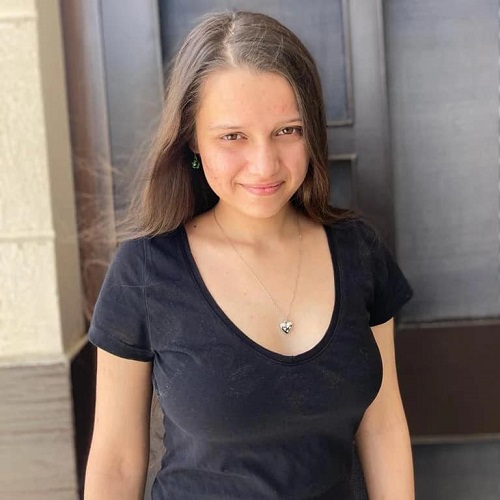
Harsimran Kaur has had stories published in JMWW Journal, Jellyfish Review, Milk Candy Review, Hobart After Dark, CHEAP POP, Okay Donkey Magazine, and elsewhere. Recent work has been nominated for the Pushcart Prize and the Best Microfiction anthology. She is the 2022 Commended Foyle Young Poet and was a student of the 2022 Adroit Journal Summer Mentorship Program. Recent work has been recognized by The New York Times, the Royal Commonwealth Society, the Poetry Society of the UK, and more. She loves Beach House, clementines, and liminal spaces, and will study literature at Bennington College in the fall. Find more at harsimranwrites.com.
Check out HFR’s book catalog, publicity list, submission manager, and buy merch from our Spring store. Follow us on Instagram and YouTube. Disclosure: HFR is an affiliate of Bookshop.org and we will earn a commission if you click through and make a purchase. Sales from Bookshop.org help support independent bookstores and small presses.
____________________________
[1] The line “How she always said, don’t drink Gatorade, they’ve put mercury in it” is inspired by this meme.
 Heavy Feather Review