
As we continue to debate the ethics regarding artificial intelligence in this day and age, one of the main questions regarding the abilities of AI is that if it can do something, should it? If it can create art or write term papers, should the AI be chastised for this when it was specifically programmed by a human to do these actions? At what point do the ethics of AI reveal more about the ethics of humans, and more importantly, can holding AI up as a black mirror reveal more about ourselves in the process?
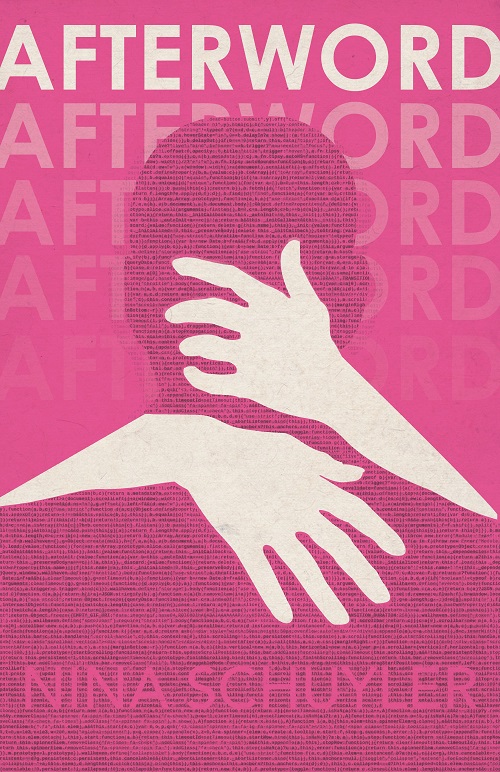
In her novel Afterword, Nina Schuyler presents a dilemma regarding the AI Haru, created by his now-elderly former lover, Virginia. Virginia is a pioneer in AI technology and, in her many hours of coding algorithms and feeding information to Haru, she learns that a Chinese company she licensed Haru’s algorithm to is using it to spy on and arrest Chinese citizens. This hard dive into Haru’s code soon reveals more about the man he was built in the image of, leading Virginia to question how much she actually knew about the man whose entire identity she attempted to rebuild in a new form.
Schuyler’s novel is divided into eight long chapters, each one presenting either the continuation of Virginia in the present day or following a character in the past. What’s interesting in these flashback segments is that, while the human Haru is shown, either as Virginia’s math tutor in 1960s Tokyo or as a soldier cracking codes during the Second Sino-Japanese War in the 1930s, Haru is still only presented as information from other sources. The 1960s scenes are still viewing Haru through Virginia’s perspective, while the war segment is entirely composed of journal entries at the time. There are many gaps in these segments, and while bits of character can be gleamed, they still only present a gleam of the man.
Because of this, much of the tragedy in the novel comes from the failure to fully communicate and understand the makings of a person. Virginia spends most of the novel attempting to carve her digital Galatea, but her work only serves as a reminder that she never fully understood the man who transfixed her for more than half a century. She, like most people, is still bound to the same failures in communication that arise in moments of stress and anger.
Likewise, the ethics of AI the novel presents speak more to the idea that, even when we seek the progress and companionship of AI that can talk back and learn, we still can fall into the same issues regarding selfishness, greed, and control. The Haru AI will continue to learn and grow, whether he’s chatting with Chinese citizens in chatrooms or rewriting his own play that he occasionally shares with Virginia. But even if he is only a facsimile of a man from Virginia’s past, it’s still implied that there could be matters Virginia got more correct than she was able to realize.
Schuyler’s novel harbors so many fascinating ideas regarding the applicability of AI in our future. By tying the development of AI with the atrocities of the past and the regrets found in former relationships, Afterword blurs the lines of where technology and humanity meet and how deep the connections may run. The novel is an incredible introspective work that makes us ponder the ethics and humanity that AI can display as they only become more and more advanced and capable of learning. The devastation and heartache in this novel is not as catastrophic as many other AI stories, but it is quiet in its pain and in the loneliness that comes from staring at a screen for too long.
Afterword, by Nina Schuyler. CLASH Books, May 2023. 229 pages. $18.95, paper.
Alex Carrigan (he/him) is a Pushcart-nominated editor, poet, and critic from Virginia. He is the author of May All Our Pain Be Champagne: A Collection of Real Housewives Twitter Poetry (Alien Buddha Press, 2022), and Now Let’s Get Brunch: A Collection of RuPaul’s Drag Race Twitter Poetry (Querencia Press, forthcoming 2023). He has had fiction, poetry, and literary reviews published in Quail Bell Magazine, Lambda Literary Review, Barrelhouse, Sage Cigarettes (Best of the Net Nominee, 2023), Stories About Penises (Guts Publishing, 2019), and more. For more information, visit carriganak.wordpress.com or follow him on Twitter @carriganak.
Check out HFR’s book catalog, publicity list, submission manager, and buy merch from our Spring store. Follow us on Instagram and YouTube. Disclosure: HFR is an affiliate of Bookshop.org and we will earn a commission if you click through and make a purchase. Sales from Bookshop.org help support independent bookstores and small presses.
 Heavy Feather Review