
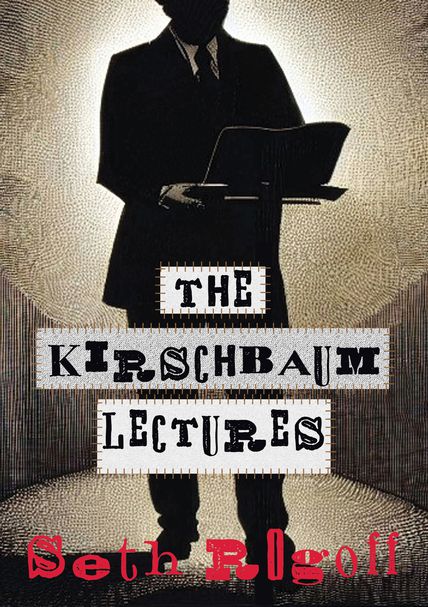
Who is Sy Kirschbaum? Is he a “neurotic anarchist” rebelling against society’s total systems of control as his analyst at Vermont’s Mountain View Clinic claims? Or is he a literary-translator-turned-mystical-gumshoe on a tortuous pursuit of purloined manuscripts and exegetic enigmas across Mitteleuropa from Weimar Berlin to post-Velvet Prague? And on which side of that diaphanous line between genius and madness has his manic fracture of an expedition deposited the hapless fellow? Seth Rogoff may or may not set out to answer these questions in his mature, pioneering and enthralling third novel, The Kirschbaum Lectures, which may or may not be a sequel to his innovative first novel, First, the Raven: A Preface (2017). Fortunately, in the spirit of Eco’s The Name Of The Rose and Pynchon’s V., the solutions to these conundrums prove far less consequential than the character insights and cerebral hijinks that are the author’s forte.
The structure of Rogoff’s novel appears speciously straightforward: Sy Kirschbaum, fresh off the blazing reception of his translation of novelist Jan Horak’s Blue, Red, Gray from Czech into English, has been invited by the unsuspecting dean of an American college to teach “Introduction to Literature” to undergraduates. However, Kirschbaum’s twelve digressive lectures, around which both course and novel are structured, do not follow a syllabus, fail to reference any texts to which Kirschbaum does not have an autobiographical connection, and radically defy norms regarding form, coherence, and decorum. What these sermons do contain are a smattering of texts composed by the lecturer’s acquaintances, as well as assorted documents, marginalia, psychiatric reports, and even official correspondence from the college’s administrative team regarding Kirschbaum’s pedagogical shortcomings. By piecing these together, as though assembling a jigsaw puzzle with manifold plausible solutions, we can decipher the various possible plots. The result is a mesmerizing intellectual adventure.
Numerous, interwoven stories within the primary narrative demonstrate Rogoff’s mastery of traditional narrative, as only a skilled draftsman of literary realism could produce such a rollercoaster of nuanced subjectivity without losing the thread—and us. Among the most captivating of these embedded texts is a short story, “Dress Shop Window,” purportedly published by Kirschbaum’s ex-lover, Jackie K., in the expat literary journal Loose Stitch. The tale relates the female narrator’s employment as a live mannikin in a designer’s shop window and the male voyeur who inspects her through the glass every day for months. Another captivating text-within-the-text is actually a rough précis of a novel (A Girl on the Beach) by German author, Anton Grassfeld, whose quasi-autobiographical tale of his embroilment in a transactional affair with a Senegalese refugee, Anita, leads to the birth of a child. Where truth ends and fiction starts—or arguable, where reality yields to delusion—is the subject of an enthralling and exquisitely choreographed pas de deux. The extent to which Kirschbaum’s own romantic pursuits (a love triangle with his childhood friend and the man’s wife; another unholy troika involving two fellow clinic patients, one of whom has written a novel about the other) exist beyond his own musings is never fully resolved.
Some facts do seem to be grounded in evidence—at least, if the claims of Kirschbaum’s shrinks and his own narrative are triangulated. The protagonist does appear to have relocated from the United States to Berlin and then to Prague in the mid-1990s; he likely has translated works by Grassfeld and Horak to significant acclaim, the latter endeavor consuming seventeen years; prior to the launch of his lecture series, he may well have escaped from Zelená Hora, a European mental hygiene clinic run by Dr. L. Hruška, and returned home to look after his ailing father, Professor Emeritus Walter Kirschbaum. Beyond those mileposts lies madness, but an organized madness that flickers with wisdom and feints toward sanity.
Admirers of Rogoff’s earlier works—and I count myself among these fans—will find in The Kirschbaum Lectures the craftsmanship of a theorist at the height of his philosophical powers. Throughout the text runs the leitmotif of struggle between God and Satan, embodied in multiple retellings of the Old Testament allegory of Jacob’s ladder. In one version, Jacob ascends the ladder to find heaven razed and abandoned by God. In another, a sheepherder named Hul climbs to heaven and murders God in service of rebellious angels. An extensive knowledge of theology coupled with an inventive instinct allows Rogoff to layer variations of the same episode in a manner that is simultaneously intellectually and emotionally unsettling.
The effective postmodern novel is an all-too-rare accomplishment. For every Philip Roth chasing his doppelganger or Moran on the trail of Molloy, the literary landscape is strewn with the corpses or would-be Becketts who mistake anarchy for innovation. How exceptional to find an “experimental” novel that is actually novel, whose structure serves its substance, rather than the opposite, and whose threads hang loose in precisely the right ways. The Kirschbaum Lectures is such a book: a finely-woven tapestry that harnesses traditional postmodern techniques in the service of psychological authenticity. Whether or not Sy Kirschbaum’s escapades intersect with reality, his lectures ring more revealing and more persuasive—and, above all else, far more entertaining—than any objective truth could ever be.
The Kirschbaum Lectures, by Seth Rogoff. Montclair, New Jersey: Sagging Meniscus Press, May 2023. 300 pages. $22.95, paper.
Jacob M. Appel is the author of twenty books including Shaving with Occam (2017) and The Amazing Mr. Morality (2018). More at: jacobmappel.com
Check out HFR’s book catalog, publicity list, submission manager, and buy merch from our Spring store. Follow us on Instagram and YouTube. Disclosure: HFR is an affiliate of Bookshop.org and we will earn a commission if you click through and make a purchase. Sales from Bookshop.org help support independent bookstores and small presses.
 Heavy Feather Review