
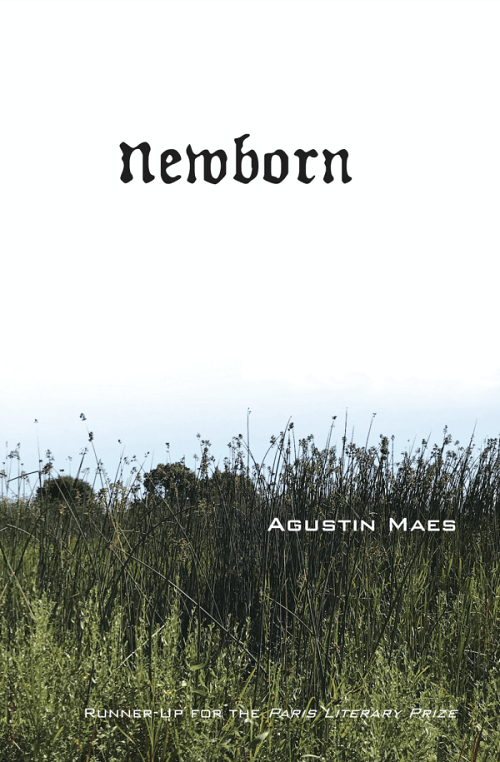
“It’s about a dead baby.”
This is what author Agustin Maes will reliably answer if you ask him about his book Newborn. Soft-spoken, and humble nearly to the point of bashfulness (this despite being a runner-up for the Paris Literary Prize his first time out the gate), he doesn’t always seem to grasp the weight of his own achievement, even as it deals directly with matters of the unfathomable divine. At 112 pages, it is both a pebble and a mountain; an afternoon and a lifetime. The compactness of its power both defies and inspires belief. This book contains multitudes.
I grew up in the church, but I’m not a religious person—anyone who’s read me the past few years will know that fact thoroughly and well—but my disdain for organized religion and skepticism of the supernatural only make work like Newborn stand out all the more. I’ve already spent a lot of time thinking about this stuff, so it’s a rare artist who makes me think about it anew; who reminds me, amid all the hatemongering and hypocrisy of the modern evangelical movement, what true Christianity is supposed to be about; who makes me not only reconsider my long-abandoned faith, but miss it.
Newborn has been out for four years now, so I’m not going to worry too much about giving away plot points here. It’s not exactly a whodunnit anyway, so much as a why; a working backward from the fateful discovery of an infant asphyxiated and tossed in a creek bed, to the heartbreakingly recognizable chain of events that brought it there; a work of forensic empathy. Employing a rich, impressionistic poesy and a sweeping, allegorical framework, Maes relays the story of Bitsy, a young woman cornered into unforgivable sin, and the seemingly impossible mercy by which she might yet be forgiven.
Flowing across time, the story swirls and takes shape around Elizabeth “Bitsy” Eddy, a 14-year-old girl in a world of trouble, rendered, as her name suggests, infinitesimally small by the rushing currents of her life’s circumstances. At the clarion cajoling of the 17-year-old roughneck Arthur “Art” Dolcini, and his pretty, empty, man-made promises of a sweeter life, she takes a calculated, one-time risk—wagering her childhood innocence against the allure of adult experience. Nine months later, scared and alone, with only the most tenuous of connections to her shrinking reality—a disconnected (or more likely fake) number for Art, immature friends in whom she dares not confide, some kindly firemen she passes while wandering the rat’s maze streets of her inescapably small town, skipping more and more school as her options dwindle—she gives birth in the bathtub of her abusive alcoholic mother’s tiny apartment. Awash in her own heady cocktail of ignorance, negligence, delirium, and fear, “so streaked with blood and sweat it was as though she herself had just been born,” and whilst quietly, desperately praying the word “please” aloud to she knows not who or what, she subsequently proceeds to kill her baby.
The next day, two young boys—the crude, braggadocious Donny Hogg and the sensitive, serious-minded Aaron Holiman—find the child’s body under the pretense of a tadpole catching expedition (though in actuality they’re visiting a clandestine nudie mag they stashed near the water)—and though the direct impact of their discovery is hard to quantify, we see their lives diverge irrevocably from that day onward, like the fruitful and barren halves of the double-trunked plum tree nearby. Meanwhile, a compassionate bakery girl offers Bitsy comfort and succor, and keeps her secret even as the police come calling and the whole town murmurs condemnation with downcast eyes, debating the merits of the death penalty over bulk purchases of industrial cleaning agents. It’s not until Bitsy is about to graduate college—presumably some seven to eight years later—that she finally, tearfully reveals her terrible secret to her doting stepfather Rex (a man whom we learn raised her as his own after her mother ran off—yet another in a long line of worldly abandonments) in one of the most deeply moving scenes I’ve encountered in all of literature.
This level of dense, metaphorical intricacy is not an easy thing to pull off. In the hands of a lesser writer, all the charactonyms and sacramental imagery and cyclically dovetailing threads of birth and life and death and renewal could have easily slipped into maudlin territory at one end, or dour sermonizing at the other. But Maes treats these characters with a rigorous emotional discipline that saves them all, good and bad, from judgement; an open-hearted love, and a measure of grace that credibly inhabits the watchful eye of God. Every word of Newborn is deliberate and considered; every shaft of light and ripple of water teeming with a larval animism that slowly blooms into the universal, miraculous truth of our existence. This is a writer who understands that life is long, and life is hard, and some people get further than others, and some people fall by the wayside through no fault of their own, and when the final bell tolls, things like “good” and “bad” and “right” and “wrong” have very little to do with who makes it how far and why. As the fireman who ultimately retrieves the child’s body from the stream notes, “death is an utterly banal thing; sloppy and plodding and thoroughly indifferent”—and the nature of our souls and their capacity for salvation is reflected in the epitaph of its sexless, nameless, pre-carved grave: “Known Only to God.”
Though I’m not a religious person, I’ve never quite had the stomach for atheism either. To feel so certain of anything, or nothing, one way or the other, has always struck me as the height of hubris and stubborn human arrogance. There is simply so much we do not, and cannot know. I don’t know if I’ll ever darken a church’s doors again, but I’ve never stopped holding out hope for something to believe in; searching for something larger than myself; something beyond this small world and my brief time on it. And it is in theologically humanist work like Georges Bernanos’ novel The Diary of a Country Priest, Lars Von Trier’s film Breaking the Waves, and Stephen Mitchell’s revelatory Biblical explication The Gospel According to Jesus that I have often found my greatest comfort that such a thing might exist. It is no small feat to now count Newborn among these ranks. Maes should be proud, and maybe a little less humble. It’s about a dead baby, sure, but it’s about so much more than that. It’s the rare book that’s truly about everything—all the questions, and all the answers—everything we know, and everything we don’t—and in a life devoted to searching, it’s the kind of generous, gentle work I will always continue to hope to find.
Newborn, by Agustin Maes. Whiskey Tit, December 2019. 112 pages. $12.00, paper.
Dave Fitzgerald is a writer living and working in Athens, Georgia. He contributes sporadic film criticism to DailyGrindhouse.com and Cinedump.com, and his first novel, Troll, was published in May 2023 by Whiskey Tit Books. He tweets @DFitzgerraldo.
Check out HFR’s book catalog, publicity list, submission manager, and buy merch from our Spring store. Follow us on Instagram and YouTube. Disclosure: HFR is an affiliate of Bookshop.org and we will earn a commission if you click through and make a purchase. Sales from Bookshop.org help support independent bookstores and small presses.
 Heavy Feather Review