
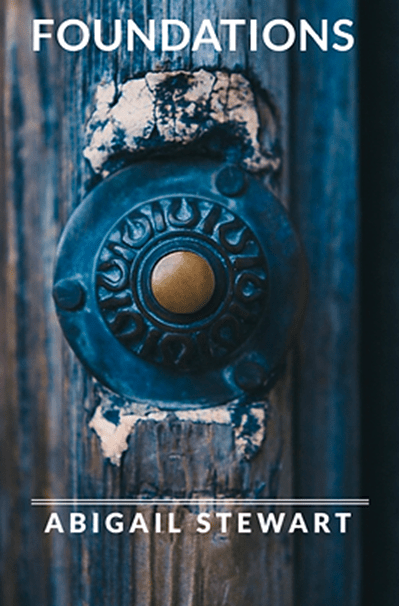
In three dazzling parts, Abigail Stewart’s Foundations follows a trio of women across time, all of them connected by a single Dallas house. Bunny is a housewife who longs for genuine connection and friendship outside of the oppressive suburban life she’s found herself moored to. Jessica is an actress fleeing LA to find something else, something inside herself she perhaps doesn’t even know she’s missing. Amanda is an underestimated and empathetic woman with a talent for design. Each woman is lonely in the limited world she finds herself, and yet each of them moves herself, not without pain and difficulty or loss, to a place of fullness and possibility.
An author of one previous novel and a short story collection, Stewart is an expert at crafting a scene in incredibly evocative ways. Like our third protagonist, Amanda, Stewart has a knack for creating a space which invites, informs, and transforms. Those of us interested in design, art, and DIY will delight in these details. Fringe lamps from the 20s, depression-era glass, a burgundy velvet tablecloth, a lush shag carpeting, an overgrown and weedy lawn, a hand-poured concrete countertop—the house welcomes with its antebellum columns and covered porch, itself becoming a living, breathing thing as it reflects both the time and the women who inhabit and adorn it. Bunny, trapped in an unhappy marriage, feels imprisoned by the space she so carefully tends: “There were no trees here, not really, just identical rectangles of grass like a patchwork of earth, sewn together by men who wished only to possess the piece of land they felt they rightly deserved.” When Jessica finds herself in the home, she allows it to go feral for a time just as she herself strays away from her life in what she would describe years later as “an ill-advised detour.” Stewart writes, “The immense hedges provided a hazy outline to the edges of her yard, though she felt no desire to explore them, to take ownership of the land. She didn’t want to tend to anything, in fact, she longed to cultivate nothing at all.” And, yet, the house gives her the space she needs to find herself again. When our third protagonist, Amanda, finds herself in the home, she imagines a space of creativity and love, and the house becomes her chance at a happiness of her own making.
As the world around them changes, the women re-imagine and re-make the house, because as the final inhabitant of the home knows, “times had to change.” Alongside the vivid spaces she creates, Stewart also makes environments magical and strange to varying degrees. Dust motes become moths in library stacks, mediums speak to spirits who smell like fresh bread, eerie text messages reveal unsettling truths, fireflies show their surprising and magic glow when most needed. Close your eyes; you will see it.
And, yet, these women are connected by more than the walls and foundation of a house. They are joined by their forbidden longings, their secret desires. Perhaps most importantly, these women each share a kind of bravery. Despite their positions of relative privilege in the American South, they are faced with so many barriers historically presented to women, especially those who wish to pursue alternative lives. To leave one’s husband, to practice Spiritualism, to seek solace from fame and responsibility, and to claim agency over one’s own future, to believe in astrology, or even to embrace the body’s changes and aging pushes these women to the margins. Expectations, spoken or otherwise, swirl around and stifle them. Little comments accumulate as strangers and well-meaning loved ones express their disappointment at their decisions to behave or believe in ways that stray from accepted norms. Whispers surround Bunny at a party as everyone speculates about her lack of children, her “melancholic” nature. Decades later, Amanda’s mother cringes as she listens to her daughter discuss her work, saying, “Well, honey. Are you still planning on keeping up with this life coach stuff? Part of the reason Daddy wanted to help buy this house for you was so you and David could get a good start.” Then, later, “Look, I love you, but no one is gonna buy the cow if they can get the milk for free.” These women begin to sink under the criticism of their life choices. Their work and creativity are devalued, belittled, and scorned. Stewart reveals the psychic struggles these women wrestle with as they try to belong in a world that does not seem to have a space for them.
Perhaps what I most love about this book is its portrayal of women’s love for each other and, even when it’s difficult, their love for themselves. Despite so many barriers, these women each make a home in the world in different ways, leaning on women friends and their own inner strength to grow and manifest the lives they want to live. Stewart illuminates how even small, silent acts of taking control of one’s own future become both inspiration for and model paths forward for each of us. As feminist and scholar Caroline Heilbrun once wrote, “Women must turn to one another for stories; they must share the stories of their lives and their hopes and their unacceptable fantasies.” May Foundations be a reminder of this for all of us, a catalyst for our us to pursue unacceptable fantasies of our own, an invitation to manifest both a life and a world that brings us all a little more joy.
Foundations, by Abigail Stewart. Whiskey Tit, March 2023. 154 pages. $16.00, paper.
Hayli May Cox is a PhD Candidate studying English/Creative Writing and Women’s and Gender Studies at The University of Missouri-Columbia, though she’s really a Michigander. Her stories and essays have been published online and in print, and she is currently working on two book projects. In her free time Hayli paints, builds with Lego, critter watches, and hikes around with a backpack full of field guides.
Check out HFR’s book catalog, publicity list, submission manager, and buy merch from our Spring store. Follow us on Instagram and YouTube. Disclosure: HFR is an affiliate of Bookshop.org and we will earn a commission if you click through and make a purchase. Sales from Bookshop.org help support independent bookstores and small presses.
 Heavy Feather Review