
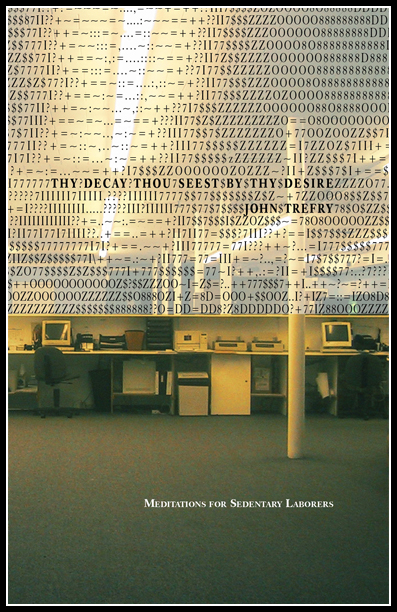
Thy Decay Thou Seest by Thy Desire, a title both seductive and confounding, is the second work of John Trefry, released on Inside the Castle in 2015; the independent press he founded and named after Kafka’s final novel. Almost a decade later and the work demonstrates even more so, as described by writer Rachael de Moravia, “The horrors of the internet in book form.” Trefry’s text is made up of 250 numbered sections and presented on the page in two vertical columns. Each section is headed with its first and last words, joined together by a small horizontal arrow. A work of systematic collage, the novel reads like a voracious watermelon salad, a piggish devourer of absolute trash, shredding its way through the most abject and mundane of online detritus: true crime trivia, the dregs of Wikipedia, insipid celebrity gossip, black metal, midnight horror (Argento’s Tenebrae, Fulci, Hellraiser, Phantasm), and a lot of Tom Cruise, who drifts through the book like a strange and empty cipher. Forming an obscene mosaic, the book is noted as “a work of unrelenting appropriation and parataxis,” where short, stark sections of text or images are placed together, often without conjunction. And yet, Trefry’s machine-gun text somehow captures a sense of bombardment of online content we face on a daily basis and the peculiar avenues through which we consume information; peering into the windows of reality television (ABC’s Extreme Makeover: Home Edition is mentioned) and celebrity culture. A school shooting retweeted by Melrose Place’s Courtney Thorne-Smith, Lindsay Lohan discussing the plight of Palestinian children on Instagram Live; reading Thy Decay Thou Seest by Thy Desire is like watching an atrocity on Paris Hilton’s princess-pink iPad, an obscene prism of images—kaleidoscopic and wrong.
Tristan Tzara once wrote, “Art needs an operation.” Huffing from a mask of nitrous oxide, Trefry’s surgical extractions range from the poetic: “No dreams breed in breathless sleep”; the baffling: “JOHN HUGHES’s fat cousin, fat JOHN CARAVAGGIO was a staunch supporter of Charles I and even hosted the King’s stay at the family home, Place, in Fowey”; to the jaw-droppingly horrific: “ABIGAIL has big brown eyes, a dazzling smile and at just 6 years old she had already competed in local swim meets. A search of the pool filter turned up ABIGAIL’s intestine.” Like Chris Morris’ deadpan newsreader-jester in Brass Eye, we are blitzed with an onslaught of homicidal, violent, and pornographic imagery that is often laugh-out-loud funny. From the bizarre titles of the pieces, “A blind pianist → heh-heh-heh,” “Elizabeth Hurley → a corpse face,” “Jean Genet → Nokia 6620,” to its accelerated passages, “What BALLARD’s admirers desire is his short story collection ‘Vermilion Sands,’ set in an eponymous desert resort town inhabited by forgotten starlets, mad mullahs, CONDOLEEZZA RICE, murderous butchers, insane heirs, hecklers, AYN RAND …”, the novel is a frozen grin in a blizzard of data, providing a sick yet giddy whiplash. Reading the text mirrors the pleasurable drive of the internet, its wicked speeds, our brains addled with dopamine as we juggle fifty-four open Google Chrome tabs. An exquisite corpse uploaded to SendSpace and fed through an IBM plant. This is confetti corrupted.
Celebrity “news” sits alongside disturbing stories of abuse and murder, which bleeds into the graphic plots of horror films: the account of a power drill entering a human skull. “A man who believed he bore the biblical ‘mark of the beast’ used a circular saw to cut off one hand,” becomes a grim reflection of an arm hacked off in Tenebrae. It is reported that, “The family’s neighbours include two slightly older teenage girls who use the 14-year-old brother as a practice object for oral sex, asking him to judge which of them does it better.” We face the insidious nature of the internet, our consumption far greater than the days of television news that Morris once skewered. In a rubbernecking culture obsessed with celebrity court cases, we are told of Paris Hilton that, “If HILTON wants to prettify her bloody infanticide self in her cell’s polished-metal mirror, she can buy a compact, eye shadow, an eyebrow pencil and package of hair colouring from the jail commissary, where she can draw from a prepaid account.” We learn of Mark Wahlberg who, “Among his practices – administering yoghurt enemas; and discouraging female masturbation by the use of carbolic acid.” As Guy Debord writes, “The spectacle is not a collection of images, but a social relation among people, mediated by images.” And as Trefry’s title possibly indicates, we see through the myriad desires of the internet; its dazzling kings and queens, its massacred innocents. Like Richard Kelly’s Southland Tales, we sit around a glistening, hypnotic fire on a Californian beach and listen to the war on terror discussed by porn stars, their perfect bleached teeth.
Tom Cruise, a vacuous phantasm of fame, offers some of the funniest moments of Thy Decay Thou Seest by Thy Desire. The text documents, “Then he set tongues wagging in Hollywood and elsewhere with an hourlong appearance on May 23 OPRAH show, during which he jumped around the set, hopped onto a couch, presented burnt offerings: a thousand male rams, and a thousand male lambs, fell rapturously to one knee and repeatedly professed his love for his new girlfriend, the actress KATIE HOLMES. ‘I am in the 11th grade,’ Miss HOLMES said.” Trefry later summarizes, “The Internet Is still Dead and Boring,” but the condensed version here is head-spinning, often exhilarating. A way of reading the text might be the arrow above each section, a simple point from A to B. I remember a professor at university stating that the history of the novel altered with Kafka because he took his pen for a walk across the page. As Trefry writes, “There, a young man in shorts pulls out a Dan Brown novel and begins to skim with his finger.” Reading as the navigation of a zone. Kafka’s K. drifting through a village of the titular castle, each room indiscernible from the next. My high school mathematics teacher made us fold our pages vertically so we could write our equations in two columns. Trefry presents raw data of the internet, smashing blasphemies together into a perverse algebra without reason or explanation. The multitudinous appetite of an algorithm, its shallow quest through a vague language. No dreams breed here.
Thy Decay Thou Seest by Thy Desire, by John Trefry. Lawrence, Kansas: Inside the Castle, December 2015. 103 pages. $13.00, paper.
Matthew Kinlin lives and writes in Glasgow. His published works are Teenage Hallucination (Orbis Tertius Press), Curse Red, Curse Blue, Curse Green (Sweat Drenched Press), The Glass Abattoir (D.F.L. Lit), and Songs of Xanthina (Broken Sleep Books).
Check out HFR’s book catalog, publicity list, submission manager, and buy merch from our Spring store. Follow us on Instagram, Bluesky, and YouTube. Disclosure: HFR is an affiliate of Bookshop.org and we will earn a commission if you click through and make a purchase. Sales from Bookshop.org help support independent bookstores and small presses.

