
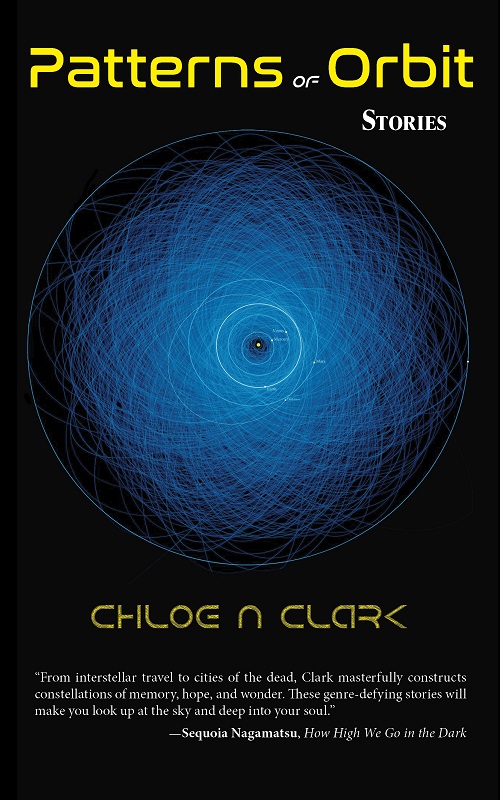
In a letter frequently quoted in craft essays and books on the art of fiction, Anton Chekhov wrote that writers of short fiction should “[l]et two people be the center of gravity in your story: he and she.” Underlying this assertion is the prime directive that Chekhov issues to writers: in the private solar system of narrative, all things must orbit (and must be drawn to) character. Chloe N. Clark’s Patterns of Orbit models this premise in a collection of twenty-five flash fictions and short stories, which ferry us from the depths of the oceans, into the heart of cursed words, through the uncanny stillness of suburbia and cities, through the otherworld of dreams, and into the silent expanse of space.
The stories in this collection toggle between fairy tales, fabulism, science fiction, fantasy, and surrealism, so “Chekhovian” might not be the first adjective that most reviewers would attach to this collection. But the stories in Patterns of Orbit are Chekhovian in their lustrous compression, their careful calibration of character and circumstance, their dramatic—almost play-like or cinematic—movement. Moreover, the stories crackle and bristle from the powerful charge of each character’s private, inner lives. Added to Clark’s uncanny knack for crafting stories that harmonize with an eclectic choir of pop culture references, this attention to the gravity of her characters’ inner lives renders Clark’s stories at once modern yet timeless, and meditative yet brisling with urgency.
Take, for instance, “Out in the Dark,” a science fiction romp imbued with the icicle-to-the-heart quiet and fear that saturates Ridley Scott’s Alien. (“In space,” Clark writes in this story, “the darkness was forever.”) At its core, the story documents the return of Olivia Ross to a space station; she had been sent on “a routine circumnavigation,” one that “could have been done by anyone … by anything.” Her pod’s return to the docking bay hints at the devastated state of the space station. “Barely lit” and “devoid of movement,” the bay’s stillness incites a childhood memory of watching her ant farm, as the ants’ industry and bustle slowed to an affliction from a parasitic fungus. Like the best of science fiction, the story weaves the threads of the present crises to the narrative: Olivia’s confinement against the station-wide infection mirrors the ongoing COVID pandemic and the pop culture sway of cordyceps-zombie game (and now TV show) The Last of Us.
But the real marvel in “Out in the Dark” is its precise staging and its redeployment of the “bottle episode” trope: the story’s restricted movements from the ominous docking bay to lonely barracks to threatening sterility of the station’s medical center becomes a tour of Olivia’s confinement and isolation, her drive for survival. Clark’s other stories are similarly filmic, with the narrative camera focused always on character. And, much like a play or a film, Clark’s stories imbue their props, objects, and settings with the characters’ emotional energies. “A Sense of Taste” opens with such a prop, a piece of fruit: “I think I fell in love with my husband because of an apricot,” says Mira, the food scientist who narrates this story. After her husband Mark’s death in a space expedition, Mira receives a call from a former colleague of Mark’s to write a taste profile on a strange new fruit; the colleague claims that the fruit is genetically engineered to grow in lightless environments, but Mira suspects that the fruit is in fact alien in origin. Still, the taste of the fruit churns in Mira’s mouth and her mind, whipping together a mélange of grief and memories. Mira notes, “The taste spectrum hit me again: that piney resiny sweet lingered. It made my eyes water. We’d honeymooned by Lake Superior, hiking in the national park, all those trees, the smell of pine sometimes made me weak in the knees. I swallowed down the flesh of the fruit.” The mysterious fruit invokes different memories (and different flavor profiles) for whoever tastes it, but Mira attempts to swallow the lingering hurt of Mark’s death along with the morsel of pulp.
Indeed, all of the stories in Patterns of Orbit chart similar trajectories, always tracking the gravitational pull between Clark’s characters, their friends and family, and their remote pasts. In “Who Walks Beside You,” a concussion destabilizes Cameron’s sense of reality, and he senses a shadow trailing after him as he meets up at bars with a pal that he can’t quite rank as a friend: “they were acquaintances who just bumped into each other often enough that they eventually made a habit of bumping into each other.” “The Ocean Is Not Empty” fragments the love story of space photographer Andra and ocean explorer Tony across time. Through photography exhibits, an ultrasound, and the spectral audio recordings of a submarine accident, Andra reckons with the voids left by Tony’s death. Andra is keenly aware of the object lesson embedded in a photograph from the exhibit where she met Tony: “a little girl sat cross-legged on the floor of her bedroom and a shadow seemed to hover right behind her, as if it was watching over her.” The shadow is simultaneously the shield and the spear, both protection and imminent harm.
This same pull between health and harm reappears elsewhere in the collection—like in a parker ranger’s desire to help despite ominous folklore about the woods in “Even the Veins of Leaves” or a researcher’s search for questions against the backdrop of her brother’s disappearance in “Static.” This tension also informs the collection’s exploration of life and death, as in the story “Wearing the Body.” Here, young Conor acquires the ability to see Dead Ones—the departed who “can’t stay still” and remain attached to the mortal plane. Through his ability to see and speak with these unliving souls, Conor unravels a contentious and pressing secret, one at the core of his family’s history. Conor’s journey stitches together the ability to see the dead, as in The Sixth Sense or the manga Mieruko-Chan, with a Burton-esque use of bright but abject detritus: the Dead Ones have their fatal wounds repaired with “a hand made of leaves,” or a man’s “chest stuffed with dog fur and feathers,” or a woman whose eye is replaced with “a cat’s eye marble.” Even when healed or repaired, these denizens of the afterlife carry and display their damage—a lesson not lost on Conor.
This is only a partial tour of the worlds in Clark’s collection, only a partial introduction to the characters whose lives sway these narratives. Reading the luminous stories in Patterns of Orbit is like entering into the planetarium of Chloe N. Clark’s imagination and observing all these parallel realities blinker into existence. Yet, even as these stories constellate around us, Clark never abandons that Chekhovian prime directive—that the characters must generate their own gravity, and pull us toward them.
Patterns of Orbit, by Chloe N. Clark. Reno, Nevada: Baobab Press, April. 2022. 169 pages. $16.95, paper.
Patrick Thomas Henry is the fiction and poetry editor for Modern Language Studies. His work has appeared in West Branch online, Carolina Quarterly, Lake Effect, and Sundog, amongst others. His short story collection manuscript, Practice for Becoming a Ghost: Stories, won the 2022 Northeast Modern Language Association Creative Writing Book Award. He is an assistant professor and the coordinator of creative writing at the University of North Dakota. You can find him online at patrickthomashenry.com or on Twitter and Instagram @Patrick_T_Henry.
Check out HFR’s book catalog, publicity list, submission manager, and buy merch from our Spring store. Follow us on Instagram and YouTube. Disclosure: HFR is an affiliate of Bookshop.org and we will earn a commission if you click through and make a purchase. Sales from Bookshop.org help support independent bookstores and small presses.
 Heavy Feather Review