
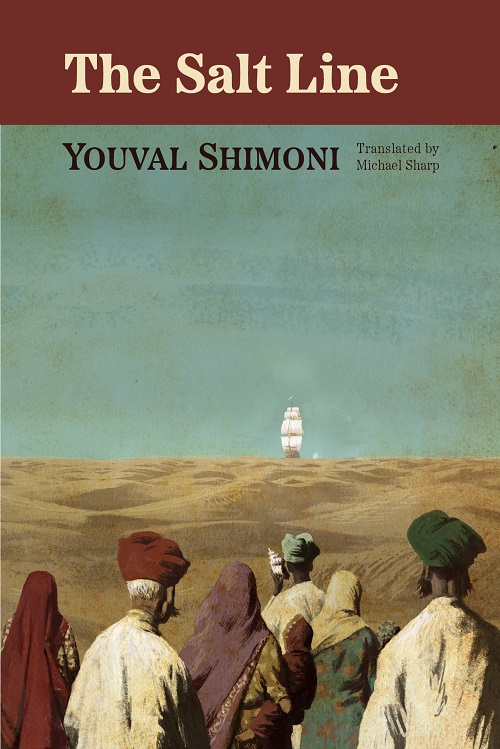
Youval Shimoni’s 2014 novel, The Salt Line, presents us with an intriguing literary paradox: a story about myths that questions the search for meaningful stories, and an epic novel written in a postmodern age of perishable texts and shortening attention span.
Two myths stand at the center of the novel, one fabricated the other implied. The fabricated myth is concocted by Dr McKenzie, a young English physician, whose wife has left him for a renowned Italian archaeologist during their honeymoon. It is the early 1900s and the embittered Mackenzie moves to the edges of the British empire, to the city of Leh in northern India, where he hatches a plan to avenge his betrayal by shaming the man who stole his wife. He fabricates archaeological evidence in the hope of luring the Italian archaeologist and then exposing him to the world as a fraud. McKenzie is assisted by another embittered man, the Jewish Polyakov, who fled Russia after witnessing a horrific pogrom in his hometown and a failed attempt to assassinate a Russian government minister in response to it.
McKenzie and Polyakov fabricate their myth by piecing together bits from various other myths—the tower of Babel, the paradise story, the crossing of the Red Sea—to make up a story about a vanished culture, which once lived on the shores of a great sea and was abandoned by its gods as punishment for its hubris. The gods got into ships and after sailing away turned the sea of water into the desert of sand that stands there today.
The implied myth is the story of Zionism. Unbeknownst to him, Polyakov is also the father of a child he sired from a brief encountered he had before he ran away. The woman is sent to Palestine to hide the family’s shame and her grandchild, Amon, scarred by Israel’s wars, spends the last part of the novel looking for traces of his maligned grandfather. The trauma that sends Amnon looking for his revolutionary grandfather took place during the Lebanon war in 1982, when Amnon was exposed to the terrible civilian cost of one of Israel’s most controversial wars.
Both myths, the fictitious and the real, meet at the end of a novel that examines the stories we tell ourselves about the meaning of our lives, or, to paraphrase Claude Levi-Strauss, about the value of myth as fiction. What is the value of myth for someone like McKenzie, who feels life has no meaning? And what about us, the readers, what role do grand narratives play in our lives?
The Salt Line is also a very long novel and an epic of sorts that stretches over more than a century and is full of action. And yet the characters in the novel refuse to play heroes as the epic space they occupy demands. All three men, McKenzie, Polyakov, and Amnon, are anti-heroes, who try to escape history and refuse to take any action. In fact, the myth McKenzie and Polyakov fake is a direct attack on the human attraction to great and heroic stories of meaning and the terrible price they exact.
And so, the connections the novel makes between myth and epos are puzzling. The myth turns out to be false and heroism is absent altogether. And yet, The Salt Line extends nearly a thousand pages and unfolds in the shadow of momentous historical events—the Bolshevik Revolution, the Second World War, the Zionist revolution—that beg for meaning; a meaning that may be found in the inherent contradictions of this unheroic epic, a novel whose length defies the fleeting texts of our online age, a novel whose preoccupation with mythology challenges our postmodern skepticism.
The Salt Line, by Youval Shimoni. Translated by Michael Sharp. Chicago, Illinois: Crowsnest Books, 2014. 860 pages. $29.99, paper.
Yaron Peleg is the Kennedy-Leigh Professor of Modern Hebrew Studies at the University of Cambridge.
Check out HFR’s book catalog, publicity list, submission manager, and buy merch from our Spring store. Follow us on Instagram and YouTube. Disclosure: HFR is an affiliate of Bookshop.org and we will earn a commission if you click through and make a purchase. Sales from Bookshop.org help support independent bookstores and small presses.
 Heavy Feather Review