

Goddammit, Ted. You’re gone. And you left us with an unfinished manuscript.
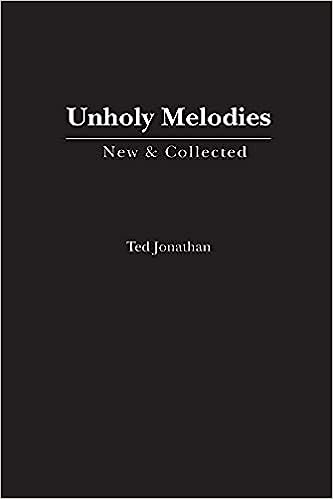
NYQ editor Raymond Hammond and poet Tony Gloeggler put together a fine collection in your memory, Unholy Melodies: New and Collected, which includes your three previously published books and the final manuscript, the titular Unholy Melodies. They did an honorable job.
NYQ Books provided scanned pages from Ted Jonathan’s first book, spiked libido, which includes a forward by NYQ founder William Packard. By presenting black-and-white scans of Ted’s early work, NYQ Books preserves the world as experienced and seen by Ted Jonathan. This editorial choice is one of respect and trust in the artist. It’s unlike what John Martin of Black Sparrow Press did to the work of Charles Bukowski after his passing, changing words and phrases and thus diluting the energy and rawness that was Bukowski.
There is a rawness in spiked libido. Its world is violent and uncaring. The language reflects this world. The prose is unadorned; no flowery language allowed. The punctuation is unconventional. As Packard tells us, it very much reflects Ted Jonathan’s perspective and experience: “Even the arbitrary punctuation of these poems adds to the dense texture of violence and immediate need which is the pain and dissonance of contemporary life in the Bronx.”
In terms of style and topics, this early book reminds me of the early work of Bukowski. It’s peopled with gamblers, drug dealers, and addicts; outsiders, weirdos, and petty criminals. Serial killer David Berkowitz makes his appearance here (and in the later books as well). It’s written and presented in a way that says: here is my world, unfiltered and unadorned, no matter what you think of it.
The world according to Ted in spiked libido is wild and reckless, bizarre and violent, uncontrollably absurd in its depiction of human behaviors. They remind me of the title of this posthumous collection, Unholy Melodies. These are melodies that should not be sung to children. They evoke the original stories of the Brothers Grimm, where there are real-life consequences to one’s ignorance and mistakes, i.e., Little Red Riding Hood being eaten by The Big Bad Wolf.
In the center of this world is the father who appears throughout Ted’s work. Sometimes he shows up unannounced in poems that are about something else, as if Ted couldn’t unshackle his mind from this father figure. The father in these poems is a haunting presence, the originator of childhood trauma. In one of our earliest encounters with the father, in the prose poem “Tommy Boland” in spiked libido, the father is heard screaming in his “raggy, rage-filled voice” at the speaker’s mother and throwing furniture around. The speaker and his sister sleep in the only bedroom in the apartment; their parents sleep on the sofa bed in the living room.
Ted writes, “If I dared go out—it might stop. Sometimes my mother would come into my room sweaty and scared and sleep with me. And we slept. Months might have passed between beatings, but the threat was—always—there.”
Tragically, that threat stops when the mother’s life ends. We are told that the speaker and his sister are sent to live with their maternal grandparents, who are “old and infirm and I kept an eye out for them.”
The mother’s death is retold in later poems—some with the same title, while others with completely different titles, such as the heartbreaking “The Boy Who Never Came of Age.” As the title of this poem suggests, the mother’s murder haunts the speaker and stunts his development. In these poems, the speaker seems to carry guilt over her death. And whatever he does, this shadow hangs over him.
We learn a few things about the speaker in “Tommy Boland.” One, he is a good person. He helps; he protects. Ted writes, “So, I’d get up to piss a lot and stay up and go out and come back and do what my mother told me.” In that same vein, he is also a good older brother and grandson. Regarding his sister and grandparents, the speaker tells us, “I kept an eye out for them.”
We also learn in this prose poem that the speaker’s mental state starts to topple. He tells us, “increasingly I was crazy—of course—look who my father was.”
In “Falling,” in Ted’s third collection, Run, the speaker and his friend sit in the front row of a theater’s balcony. The friend reveals his urge to plunge off the balcony. The speaker ups the ante by saying, “Unclenching my teeth. I let him / know that I’d already imagined myself locked in / a life-or-death clinch with the harmless stranger seated / at my side, and was now frightened that when I stand / a demon in the row behind will calmly shove me.”
Nowhere is this examination of the speaker’s mental state more pronounced than in “this has nothing to do with willpower,” placed right after the aforementioned “The Boy who Never Came of Age,” in the fourth and final book. In the poem, the speaker admits, “your heartbeat’s not right // loud constant static / of exact random sentences / or number sequences pound / ceaselessly in your head same / sentence same number sequence / no letup no room for anything else // you are the symptom.”
Returning to “Tommy Boland,” we also learn that the speaker chooses self-medicating for both the pain of losing his mom at the tender age of thirteen and the madness that comes afterward: “And liquor made me feel better and liquor and pills made it better to feel nothing and I felt nothing when I OD’ed at 16, and it was better. I should know.”
In spite of the violence and brutality, the senselessness that life has thrown at him, the speaker finds brief moments of light, where meaning can be found, where joy can be relished.
First, there is his friendship with a guy named “Tony G.” The speaker and Tony are old buddies. They attend poetry readings together and shoot the breeze at New York diners. They check out concerts and talk music, sports, and poetry. In “Why I Wish I Were More like Tony G,” the speaker attends a Jackie Green concert even though he has no interest in the featured act. He’s there “to spend / time with Tony, talk shit and share a laugh.” When Jackie Green starts rocking, “Tony’s eyes are shut, head’s bopping. On my feet happy, / I tap into his groove for half a minute before / my lack of feel-good staying power kicks in.”
But the half-minute of happiness still counts. Such happiness, however brief, changes the tempo of one’s life and the monotony of mundane living. Then there is Tony, who presents to the speaker a different point of view. When Jackie Green covers a Grateful Dead song, the speaker wants to leave, to which Tony responds, “they might play something I like next.” Tony’s message is one of hope in the future; it is a belief that something good could happen.
Humor can also be found elsewhere in Ted’s poetry, in particular his list poems. In the series “advice to my unborn son,” the speaker provides a list of advice to his future son. Some items on this list are earnest and fatherly, such as that from the second poem “more advice to my unborn son,” in Unholy Melodies: “if a guy you’re / about to fight / assumes / a karate stance / he can’t fight … if you’re lucky / enough to be a loving / girl’s first boyfriend / do it right.” Some are strange: “keep a plastic urinal / under your car seat.” The poem ends with this quip: “be very wary / of my trying to / do my life over / through you.”
The humor in these poems is shaped by the speaker’s tough Bronx upbringing as well as his childhood. It is oftentimes dark, a sideways wink at us, creating this complicit understanding between the speaker and us that the world is mean and cruel.
The speaker turns to art, in particular music, poetry, and film, as a way to work through his pain. It is where he places his faith. In “Tractus,” a poem dedicated to William Packard, the speaker is no longer content with the ritual of self-medicating: “The nightly ritual (washing down valium with / Heineken), while intently watching The Arsenio / Hall Show (muted) no longer knocked me out … // Knew I’d rather be dead.”
He ultimately turns to poetry for salvation. But he finds his first poetry teacher asinine and the class discussion “group therapy.” Instead of returning to the same class, he turns to the music of Neil Young and the works of Coleridge and Bukowski.
With renewed faith in the arts, the speaker gives poetry class another chance. His second poetry teacher is none other than Packard, with his “vast knowledge and roaring laughter / of wakefulness.” When a student in the front row “peppered [Packard] with daddy, daddy please notice / me questions,” the teacher tosses her out. The speaker explains the effect this has on him: “It warmed my heart. / Here was my chance to get something right.”
Poetry promises the speaker a chance to do something right with his life. It replaces the booze and alcohol that he has been using to numb his feelings and it allows him the opportunity to make right what was wrong with his life by examining his childhood and confronting his traumatic past.
The speaker’s mother appears in many of these poems, and she adores him as much as he adores her. In “The Paisley Shirt,” the speaker’s mother takes him shopping for clothes for the school year. For him, it is the experience of being with her that is more meaningful than the paisley shirts that they could afford. In “Boychick Exquisite,” the speaker is cherished by both his mother and grandmother. As a baby, he had long curly hair, a “boychick exquisite;” truly a blessing to his mother. In “My Sister Tells Me,” we see a loving and protective mother who gives the speaker’s sister what is needed to survive the world. As a result, the sister has grown into a strong and independent woman, who “lop[s] heads from / the hydra we call life.” The speaker is obviously proud of his younger sister.
In more than a few poems, the speaker is told by friends and teachers alike that he is a smart and intelligent boy. In school, he has a handful of caring and thoughtful teachers. There is Miss Marten in the poem “Geometry,” who gives out gum to the class after handing out a test. Such empathy moves the young speaker. By the end of the poem, the speaker tells us, “[W]hat I really wanted was to lay / my pained head on her shoulder and learn to cry.” There is also Miss O’Gorman, the fifth grade teacher in “What Mattered Most.” She praises the speaker’s reading skills to his proud and happy mother. The poem ends with the speaker revealing that what matters most is not his mother’s pride, but how proud and happy he feels about himself that day.
Such moments of happiness, joy, and pride are rare in this 300-plus page collection, but they are there, glowing and glittering like diamonds, if we look for them.
One of my favorite poems of Ted’s is “In My Hands,” in his fourth and final book. In the poem, the speaker takes his niece and her friend to Carvel for ice cream. He holds each of the girl’s hands as they cross the street. The speaker explains: “7-year-old’s hand in my left hand. / 7-year-old’s hand in my right hand. // The girls— / will be safe.” Good-hearted and kind, the speaker is very protective of the girls, making sure they are safe from the senseless cruelty and violence in this world.
The poem concludes with the speaker being asked by the server if he wants anything, to which he answers, “‘Nothing.’ // Going back: / I can’t help but feel good, / whole, even happy, / as I again get to say, / ‘Okay girls, let’s hold hands.’”
This is one of the happiest poems in Ted’s work. The speaker is made “whole” by taking care of his niece and her friend and just by being with them. I’m reminded of “The Man Who Conquered the World,” where the father is exhausted from working overtime at his blue-collar jobs and coming home to a berating wife. As he is dying from cancer, the father looks back on his life and is proud of how well his two children turn out. He has no regrets: “Happy, he’d get up, loving them / more than he cared for himself.”
Oh, Ted, as I combed over your posthumous collection in the last days of 2021, going over the poems and stories, thinking about how each piece speaks to form a cohesive whole, and seeing how much you had grown as a writer and poet, from spiked libido to Unholy Melodies, from earlier shorter lines to longer Gloeggler-influenced lines, imagining more poems you could have written, I wished you were here. I want a do-over in the New Year, where you are alive and well, the country and the world reach herd immunity, and I take my children to visit you in New York City, where you always belong. You can take my kids to Carvel for ice cream, hold their hands, and feel “whole, even happy” all over again.
Unholy Melodies, by Ted Jonathan. Beacon, New York: NYQ Books, August 2021. 312 pages. $25.00, paper.
Bunkong Tuon is a Cambodian-American writer and critic. He is the author of three poetry collections and a chapbook. His prose and poetry have appeared in New York Quarterly, Copper Nickel, The Lowell Review, Massachusetts Review, The American Journal of Poetry, carte blanche, Diode Poetry Journal, Paterson Literary Review, Consequence, among others. He teaches at Union College, in Schenectady, NY.
Check out HFR’s book catalog, publicity list, submission manager, and buy merch from our Spring store. Follow us on Instagram and YouTube. Disclosure: HFR is an affiliate of Bookshop.org and we will earn a commission if you click through and make a purchase. Sales from Bookshop.org help support independent bookstores and small presses.
 Heavy Feather Review