
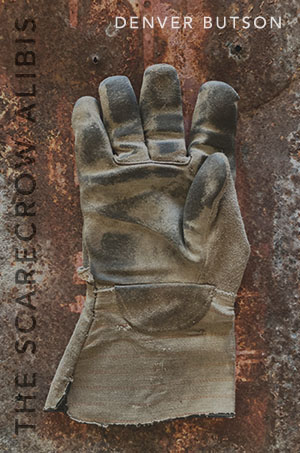
In his fifth book, The Scarecrow Alibis, Denver Butson articulates the strangeness of being human in a manner befitting one of the best contemporary poets today—from the perspective of a scarecrow. The work contained in this book might be the poetic anthem of multiple generations whose longings transcend time and space. It’s possessed, with haunting accuracy, the gravitas of being stuck between having and lacking agency simultaneously.
Although it was published in 2022, the idea of the scarecrow came to Butson around 2011 (during a self-imposed publishing gap of seven years). Perhaps the time it took to write these poems would please Wordsworth who believed in poetic origin as “emotions recollected in tranquility,” or Matthew Arnold whose prevailing beliefs about poetry included the concept that “poetry is the criticism of life,” and directly related to poetic truth and beauty.
The Scarecrow Alibis conveys the weight of wanting, longing, and the desire to escape with every linguistic turn. Irony, contrast, and tension resonate throughout. Invention and creativity persist in every poem.
In “lullaby,” Butson writes:
scarecrows have no skeletons. just ask the orthopedist of scarecrows. he’s broke. and has no broken bones to heal.
scarecrows have no skeletons. just ask the scarecrow’s skeleton. hanging in your closet. he’s broke. and he isn’t really there.
he isn’t really there. at all.
In the above example, irony and tension are, in part, what make the poem pop off the page and into our consciousnesses. However, it’s the surprising connection being made between scarecrows, skeletons, and closets that sears this piece into our minds.
Open-endedness cinches up the seams between every poem, making the work, collectively, take on moldable qualities for us. From beginning to end, we question whether the scarecrow is more than Butson’s invented character. Does he represent the poet—or is the scarecrow, in fact, a reflection of us or perhaps an alter ego?
The poet himself comments on this uncertainty. In an Author’s Note entry published on Parhelion Literary (along with five poems from The Scarecrow Alibis), he says of the scarecrow and his poetic inspiration, “Are they about me? About an alter-ego? Is the scarecrow a consistent character? […] Or, is the scarecrow just nobody identifiable at all? I don’t know. I keep thinking that I might find out. Or, hoping that I never do.”
In the piece titled, “thoughts in Brooklyn at 3AM,” he writes:
the scarecrow is the polar opposite of the scarecrow. if you were to take everything the scarecrow ever invented and subtract from it the moon. you would have nothing left but the absence of the moon. you have seen miles-long traffic jams. you have watched parades go by. but you have never seen anything as painstaking and beautiful as the scarecrow moving slowly across the horizon.
In the example above, the sense of tension spawned by contrasting possibilities, which exist on polar ends of an imagined spectrum, is present in every single piece of contained in The Scarecrow Alibis. Just as the scarecrow’s creator is unable to “let go” of the scarecrow, so too, are we unable to forget the scarecrow. Contrast, as ironic as it may seem, is another unifying element of this work.
Look at this excerpt from “if the scarecrow has one regret”:
it’s this. he was at the wrong café. that afternoon. when he was supposed. to meet her. at the café. he sat there for hours. drank two espressos. and then a grappa. and then another espresso. and then another grappa. and then he walked back to his hotel. and never saw her again.
He concludes the poem with:
wind stops. and just before the wind starts up again. when he hears kids playing. in the housing development. that used to be. the next farm. up over the hill. past the tobacco fields. in a world he will never know. no matter. how hard he wishes it.
Butson relies on honest expression in his work. Of course there is imagery, but the prevailing technique appeals to emotion with emotional distance and stays true to this poet’s use of irony. This scarecrow that appeals to our imaginations by “trying to start the old / motorcycle that the farmer hasn’t used in / decades,” becomes the middleman for the farmer and the crows in the piece titled “per agreement,” becomes the filter through which we view our own lives. Longing, grief, and the desire to simply be something else or somewhere else may be the most honest approach to poetry today.
One of the most outstanding poems in this—or any other collection I’ve read recently—is a piece titled, “a brief correspondence between the scarecrow and the sunflower,”. As you might imagine, the exchange between the scarecrow and the sunflower represents more than a brief friendship / near romance. Its allegorical implications, however, could be applied to grief and / or loss for multiple scenarios (aging, first love, death).
Ultimately, the scarecrow in The Scarecrow Alibis, makes his way, figuratively, off the stake in the farmer’s field—if only to arrive in our minds and hearts. This work by Denver Butson is more than a clever book—it’s art—in every sense of the word.
The Scarecrow Alibis, by Denver Butson. Cloudbank Books, 2022. $16.00, paper.
Yolanda Pena Wright is a poet and educator living near Dallas, Texas. She earned her MFA from the University of Houston-Victoria. In addition to writing and teaching, Yolanda also serves as an associate editor for the San Antonio Review. Some of her work has appeared in Script: A Journal of Arts and Literature, Poets Unlimited, and the San Antonio Review.
Check out HFR’s book catalog, publicity list, submission manager, and buy merch from our Spring store. Follow us on Instagram and YouTube. Disclosure: HFR is an affiliate of Bookshop.org and we will earn a commission if you click through and make a purchase. Sales from Bookshop.org help support independent bookstores and small presses.
 Heavy Feather Review