
Winning Poem
I try not to let it get to me.
After all, what has poetry done for them?
Did it stop the Khmer Rouge from making
Ghosts of neighbors and family members?
Did hands let go of sickles,
Were throats spared?
Did poetry fill ditches with lotuses
And streams with fish?
Did it bring back loved ones?
What does it matter that my poem
Won a prize and I am asked to read
In Boston?
The real prize is survival.
Everything else is for the next generation.
Be a doctor, lawyer, engineer,
Anything but a goddamned poet.
So I take the Orange Line to the city,
Read the winning poem.
On my way back I stop at a Burger King,
Spend my prize money on a Bacon King,
Two large fries, and a Dr Pepper.
I eat and eat until my poem is no more.
Mini-interview with Bunkong Tuon
HFR: Can you share a moment that has shaped you as a writer (or continues to)?
BK: Being an orphan is a big part of my identity and also growing up as a refugee, an outsider, an “other,” have played a role in my life and work. I write to address loss and grief, to heal and recover from it, and to imagine a better life for myself and loved ones. You can see the same kind of work in my teaching (the classes that I design, the books that I choose, how some novels and poems move me to tears as I stand in front of students) and in my parenting. I see parenting as a do-over for a childhood I never had.
HFR: What are you reading?
BK: Well, I’m teaching a class on contemporary Black poetry. Some of the books that I have read recently for this class are Claudia Rankine’s Citizen: An American Lyric, Joseph Ross’ Raising King, Matthew Henry’s the Colored Page, Patricia Smith’s Incendiary Art, Jericho Brown’s The Tradition, Eve L. Ewing’s Electric Arches, Danez Smith’s Don’t Call Us Dead.
I’ve also recently read Cartilage (Bottlecap Press), a beautiful chapbook by my former student Nick Soluri. It’s a joy, pure wonder to see how much your student has grown and surpassed you in the poetic craft. I’m proud of him. And I’m so looking forward to Rebecca Schumejda’s Sentenced (forthcoming from NYQ Books).
HFR: Can you tell us what prompted “Winning Poem”?
BK: I was raised by Cambodian uncles, aunts, and grandparents. I turned to literature to find guidance and wisdom. Like others, I write to make sense of the world and find my place in it. But, in the back of my head, I wonder from time to time if my refugee uncles and aunts understand this deep emotional, spiritual, and political significance of poetry. I know they survived the Khmer Rouge (but I did too, although I was young), so poetry doesn’t play an important role in their new life as refugees. “Winning Poem” is a dramatization of this sadness, as most of my writing are about and for the people I care, love, and admire most, including my elders.
HFR: What’s next? What are you working on?
BK: I’m working on my fourth poetry collection. But I’m in no rush. I want it to be the best of me, so I’m taking my time.
HFR: Take the floor. Be political. Be fanatical. Be anything. What do you want to share?
BK: The Zombies are better than The Turtles. The Sex Pistols are truer to punk than The Clash. And The Velvet Underground & Nico is the best rock album ever.
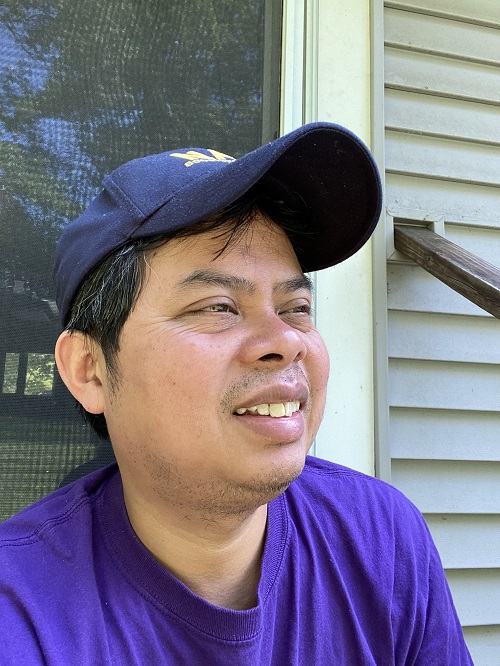
Bunkong Tuon is a Cambodian-American writer and critic. He is the author of three poetry collections and a chapbook. His prose and poetry have appeared in New York Quarterly, Copper Nickel, The Lowell Review, Massachusetts Review, The American Journal of Poetry, carte blanche, Diode Poetry Journal, Paterson Literary Review, Consequence, among others. He teaches at Union College, in Schenectady, NY.
Check out HFR’s book catalog, publicity list, submission manager, and buy merch from our Spring store. Follow us on Instagram and YouTube. Disclosure: HFR is an affiliate of Bookshop.org and we will earn a commission if you click through and make a purchase. Sales from Bookshop.org help support independent bookstores and small presses.
 Heavy Feather Review