
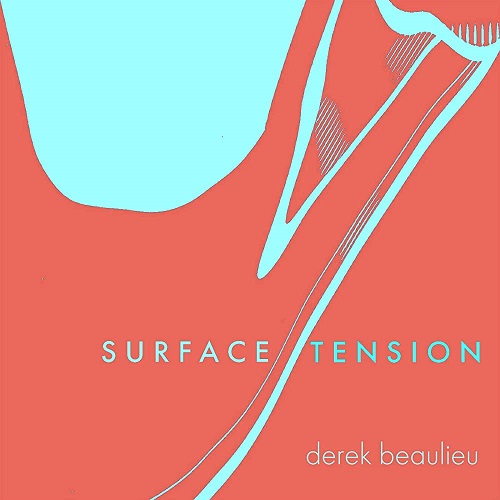
In Derek Beaulieu’s words, Surface Tension is “[a]t its core … a series of delicate, balanced poems, each symmetrical, palindromic, and made by hand using Letraset.” As such, it feels like familiar ground for the famed visual poet. But, as one proceeds through the book, that familiarity quickly fades. Through a process of manipulating base Letraset images on the platen of a photocopier, Beaulieu introduces varying degrees of distortion to his sequence of visual poems. These distortions morph the relatively static and visually stable base images into flowing, dissolving, and dynamic sequences of poetic suggestion, evolving the images well beyond their initial appearances. These sequences are then interspersed with meta-poetic statements that evoke sections of a manifesto postulating the conditions of a modern poetics. Overall, Surface Tension is a layered and complex exploration of the possibilities of poetic expression in the current era.
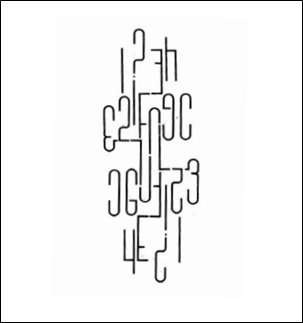
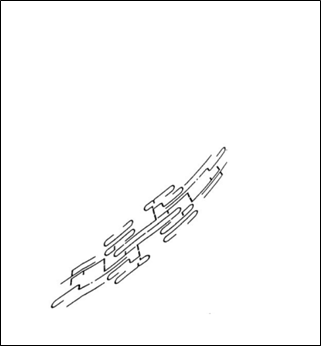
As a practitioner of visual poetry, I found myself very interested in the technique that Beaulieu used to create his images. With customary openness and generosity, he explained the process thoroughly to me. Sometimes, he noted, base images are subjected to a single treatment on the photocopier, as is shown in the except from the section entitled “Performance Adjustment / Appeal Process” below. Here’s Beaulieu describing the procedure, “the ‘clean’ original poems were placed on the platen and then moved with or against the photocopier’s scanning.” The result is lovely, delicate, and, in this instance, so suggestive of falling leaves that I am reminded of lyric poetry:
“Performance Adjustment / Appeal Process”
“Performance Adjustment / Appeal Process”
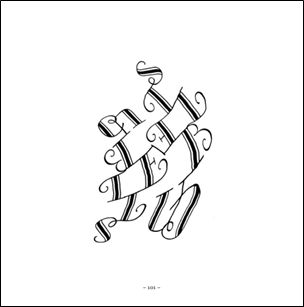
In other sections, particularly as one moves toward the end of the book, single images are subjected to repeated treatments on the copier, as in the selection of images from the beginning, middle, and end of the section entitled “Dendrochronology” presented below. Here again is Beaulieu describing his process: “Dendrochronology” is “sequential manipulations; with manipulated copies made of manipulated copies (all on the copier without digital intercession once again).” The results are dramatic, and, I think, revelatory. Rather than leading to the dissolution of recognizability, or to the collapse of meaning, the manipulations and distortions reveal underlying parallels between nature and the physical material of language. In other words, through manipulations of lettered images, Beaulieu reminds us of our place in nature: Letters, or the tools we use to create meaning, easily transform into a semblance of tree rings, evoking the notion of “reading” in the abstract, while calling attention to the fact that all human activity occurs as natural phenomenon. As Beaulieu writes in the manifesto-like section called “All That Signifies Can Be Sold,” this is “[l]anguage to be looked at and/or things to be read.”
“Dendrochronology” – pg. 101
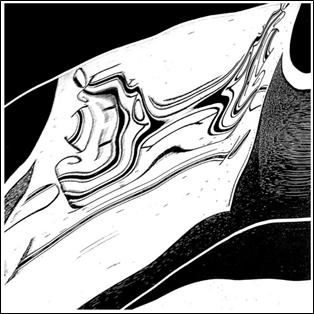
“Dendrochronology” – pg. 114
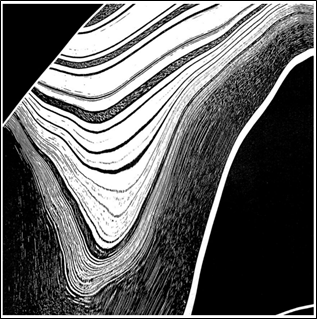
“Dendrochronology” – pg. 124
Often, even within series of visual poems, pieces tend to stand on their own, striving, I think, for an existence outside of time, toward a representation of an infinite and ineffable present. While the images in Surface Tension can be understood in this way, Beaulieu also highlights the temporal element in the presentation of any sequence of images. In my mind, this emphasis on the temporal is evocative of the typical way we read. From the beginning of a sentence to its end, from the first page of a book to its last, our progression through a text marks and enacts the passage of time. Other elements of the book also develop within a temporal context, such as the increasing degrees of distortion that occur as one moves from the beginning of Surface Tension to the end. Yet, this is not the usual kind of reading. It is sped up, condensed. It is not semantic in the usual way of interpreting the meaning of words. Nevertheless, it is still reading. As Beaulieu notes:
Readability is key: like a logo, a poem should be instantly recognizable. Poetry, here, endeavours to render all language into poetic icons, much like how everyone can understand the meaning of a folder icon on the computer screen.
In essence, Surface Tension is an effort to define and perform a modern poetics simultaneously. It begins with the assumption that “the usages of language in poetry of the traditional type are not keeping pace with live processes of language and rapid methods of communication at work in the contemporary world.” Then, through poems manipulated on photocopiers that trouble notions of “poetic logic, perfection, and power narratives,” Beaulieu seeks “to present a more liquid, a more natural, a more warm and welcoming unmoored form of poetic.”
Surface Tension, by Derek Beaulieu. Toronto, Ontario, Canada: Coach House Books, September 2022. 136 pages. $23.95, paper.
Andrew Brenza is an American experimental writer, collage artist, and librarian. He is the author of numerous collections of visual poetry including Compass (RedFoxPress) and Smear (BlazeVOX Books). He is also the founder of Sigilist Press, a micropress devoted to the publication of experimental writing. Weaving together prose narrative, visual poetry, and free verse, WRYTHM, his experimental speculative novel, was recently released by Montag Press.
Check out HFR’s book catalog, publicity list, submission manager, and buy merch from our Spring store. Follow us on Instagram and YouTube. Disclosure: HFR is an affiliate of Bookshop.org and we will earn a commission if you click through and make a purchase. Sales from Bookshop.org help support independent bookstores and small presses.
 Heavy Feather Review