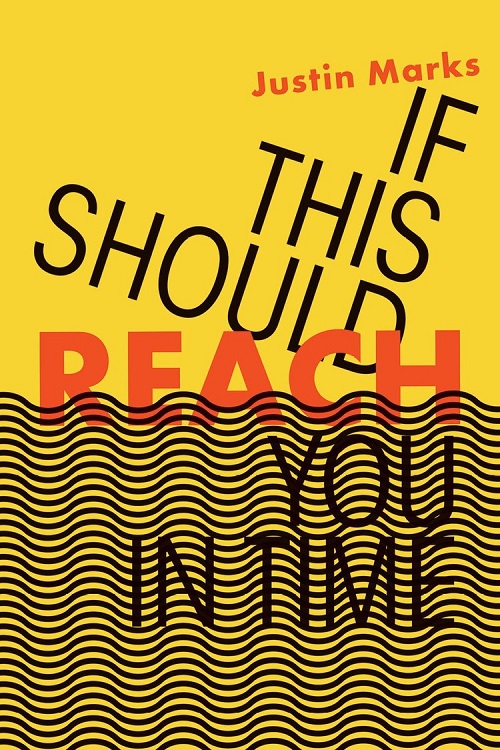
If This Should Reach You in Time, by Justin Marks, is a collection of poems related by feelings of isolation and by the perception of failure in the systems we depend on, natural and political.
If the news about school shootings, fake news, and migrant families has made you feel unsettled, these are poems for you. If you identified with anyone in the November 2016 SNL skit in which everyone but the two Black guys (Dave Chappelle and Chris Rock) is surprised by Donald Trump’s victory, if you were alarmed when you found out that Earth’s average surface temperature in 2022 was tied with 2015 as the fifth warmest on record, if you were outraged by Brett Kavanaugh’s confirmation to the supreme court, and if you felt helpless and isolated during the months when most people in the world stayed home, you’ll feel in good company reading these poems.
Isolation is shown by the spacing of the poems—they are sparse, the type often double-spaced and the stanzas rarely more than couplets. The first poem, “An Incantation,” invites us to consider “Resistance,” and to “sit / in its words Inhabit them / Their sounds Sit / and be still.”
In one of the most alarming poems, “Along for the Ride,” the speaker says “there’s no way around / not being part / of the problem” and grapples with the idea that “the best case scenario / is long term disaster.” Although there’s an image of the “sun falling” and of “gutted deer” to make us think of nature, the words of the poem steer us also towards “war,” human-made disaster going on while “angels watch.”
The title poem, “If This Should Reach You in Time,” continues for 16 pages, some of them widely spaced to indicate silence and absence, like the long white space after “it wasn’t enough.” The poem is focused on climate change, although since the 45th president issued an executive order that for every new environmental regulation put in place two had to be eliminated, it’s been difficult to separate political anxiety from environmental anguish.
The title, “if this should reach you in time,” is repeated with variation four times throughout the poem. Here is the first:
If this should reach you in time know
that we didn’t see
the disaster coming
That it wasn’t
imaginable, hadn’t
existed until, gradually
it was, and did
Or that we saw it
and refused to believe
Or saw it and thought
something or someone
else would save us
Or, as in some Hollywood disaster movie
we’d set aside
our differences, rise
to the occasion and save
ourselves
Later in the poem we’re told that “occasionally / we’d see it clearly,” but that “our worst selves / it turns out / are our true selves” and eventually we will leave only “a crust roamed / by what animals remain” and a few “things to look back on,” like the poems of this volume–messages in a bottle that might not reach anyone in time.
Some of the lines of these poems are so sparse they are almost code, as in “Doing More Is Never Enough” with this play on “woke”:
some of us just
waking up
some of us
awake already
Every good thing we do
Every bad thing
As if there were
nothing wrong in America
A few of lines seem to come out of a sermon, like these from “Aging Out”: “the sin of freedom is / how we use it / against others.” Others emerge from the sermonizing or the adaptation of cliches, like “abstinence / that makes the heart / grow fonder” to pose a question or frame an idea that we might not have considered before, like “sometimes I hear the last words / of people who aren’t dead yet.”
Occasionally the spaces invade the lines of some poems, as when we get the image of “an ecosystem / burning Fish circling / our legs as we wade.”
What is best in these poems are the moments when the poet shows how the everyday inevitably impinges on bigger ideas and events: “I feel safest / when my phone / is fully charged.” Who doesn’t? I think there are probably lots of us who got in the habit of checking the news every hour after November 2016.
But the everyday becomes less ordinary from a distance. In “Lone Figures at a Distance,” a characteristically long poem with lots of spaces, the speaker desires “escape / from suffering and other / impossibilities / yellow leaves falling back / onto trees.” Sometimes, the poem suggests, our desperation can become so profound that it can make us feel as helpless as children. Later in the poem, the speaker declares that “it takes it out of you / this life occupying / a body.” Especially in the wake of the pandemic, when many of us stayed home making and eating comfort foods and sleeping more than usual, these lines resonate. And as the poem goes on the speaker considers the tension of having to “plod on / under a weight / you’re certain / you can no longer / bear / and then / bear,” which speaks to readers like me who stayed home and gained weight—the physical and also the psychic weight of prolonged isolation that we still have to drag around with us.
The cumulative effect of the words and the spaces in this volume will make us feel close to despair but perhaps not yet immobilized by it. While there’s no false hope, “we get sad / move on.” The poems in If This Should Reach You in Time offer the faint hope that the effort to make each action of daily life less destructive can matter, that continuing in the face of paralyzing doubt and fear might eventually amount to something.
If This Should Reach You in Time, by Justin Marks. Barrelhouse Books, December 2022. $17.00, paper.
Jeanne Griggs is a reader, writer, traveler, ailurophile, and violinist in the Knox County Symphony. She directed the writing center at Kenyon College from 1991-2022. Jeanne earned her BA at Hendrix College in Conway, Arkansas, and her doctorate at the University of Maryland, College Park. Her conference papers include “A Survey of Reanimation, Resurrection, and Necromancy in Fiction since Frankenstein,” and “Climate Change Predictions in Octavia E. Butler’s Parable of the Sower and Parable of the Talents.” Published by Broadstone Books in 2021, Jeanne’s volume of poetry is entitled Postcard Poems. Jeanne reviews poetry and fiction at Necromancyneverpays.com.
Check out HFR’s book catalog, publicity list, submission manager, and buy merch from our Spring store. Follow us on Instagram and YouTube. Disclosure: HFR is an affiliate of Bookshop.org and we will earn a commission if you click through and make a purchase. Sales from Bookshop.org help support independent bookstores and small presses.
 Heavy Feather Review