
Anecdotal Evidence
I.
a. A man’s hand amputated at the lumberyard maintains a distal phantom structure through pins and needles continually fingerpicking “Wildwood Flower”; more research is needed into phantom limbs as a grief of the body.
b. Necromancy cannot call up legs blown off in Belgian trenches, in part because there is nothing to tell the missing limbs, and in part because they have nothing to say to us.
c. Caresses of deceased salsa dancing partners are not well understood.
II.
a. It is not supported by science that a husband and wife will begin to resemble one another after a long marriage, smiling and scowling into the mirror of one another until their faces wad together like fitted sheets in the closet; moreover, beyond anecdotal evidence of men with confused looks waiting in Dodge pickups as their spouses wander alone through newly renovated Walmarts, it has not been demonstrated that bonded pairs may be separated and still carry on their reflexive expressions.
b. Nor is it scientifically accurate to say that a man will take on the physical attributes of the English bulldog who shadowed him for fifteen years, although the man may remain salt-and-peppered with its fur long after the dog, wrapped in its favorite fleece blanket, has been buried down the hill with yellow roses planted over its grave; nevertheless, the passenger seat of the man’s Buick LeSabre may remain reserved, and in a sense therefore occupied, by a musky towel which the man may glance toward at every stoplight while assuming a jowly, canine underbite.
III.
a. One study found rabbit mothers separated by a great distance from their litters will scream when their kits are bludgeoned, but these findings have not, so far, proven reproducible.
b. Uterine pain awakens the post-menopausal mother several states away from where her adult son has just been shot.
IV.
a. While it is not the case that humans conform to the shape of their containers, we are largely liquid and have no exoskeleton.
b. It has been observed that rooms surrounding us occupy a dialectical relationship with the structures we build in our minds: our clutter presents cognitive obstacles; the burglar violates our deepest interiors; in dreams grief presents as horsehair plaster over the lath of dead relatives whose hand-tinkered spoon rings glint from under the baseboards like the eyes of field mice. We do not haunt the house; the house haunts us.
Mini-interview with Edie Meade
HFR: Can you share a moment that has shaped you as a writer (or continues to)?
EM: It’s hard to pinpoint a moment of epiphany. I think I have to learn things the hard way. I used to write poetry as a little kid, and songs as a teenager, but put it all away when I had my first son. After a divorce, going through a few jobs, and I guess reclaiming myself, the urge to write crept back to me.
HFR: What are you reading?
EM: Currently reading Gathering Moss by Robin Wall Kimmerer, The Great Alone by Kristin Hannah, and Girl in a Band by Kim Gordon of Sonic Youth fame.
HFR: Can you tell us what prompted “Anecdotal Evidence”?
EM: I’ve been thinking about grief and ghosts. When my dad died, the grief felt almost like being possessed. Being haunted, being gripped by it. I don’t believe in ghosts, or gods, or the afterlife. But what if our “ghosts” were an extension of grief, of loss, of a lack of closure or certainty? Ghosts are built into our language and expression. “Phantom limbs,” “ghost pangs.” I found the voice of a scientific researcher, collating footnotes in a literature review, to be a shield from the pain.
HFR: What’s next? What are you working on?
EM: I’m revising what is hopefully my debut novel, about a girl who has to escape her father’s violent survivalist war against the government. And tinkering with another, epistolary novel about a young family in the clutches of a radical political movement. And writing an album of songs mostly about cars, staying alive, running away from problems—you know, all American staples. I guess all my work is pretty centered on staying alive right now.
HFR: Take the floor. Be political. Be fanatical. Be anything. What do you want to share?
EM: It shouldn’t be controversial to say, but everyone needs to wear good-fitting N95s in public settings, social distance and care about your fellow human beings. A pandemic doesn’t end because some people are bored with talking about it. Society is not a collection of individuals—in fact, the “individual” is a creation of society and if you want to throw away society then you are throwing away yourself. Okay, maybe that’s a little controversial, but we were born in struggle, baby, so I’m happy to fight.
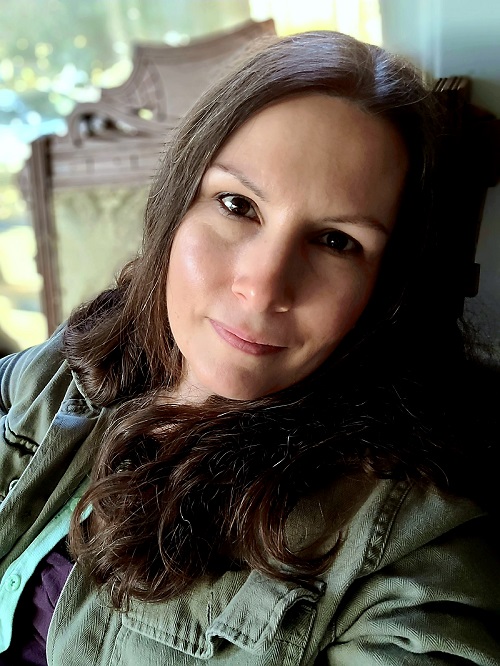
Edie Meade is a writer and artist in Huntington, West Virginia. Recent work can be found in Invisible City, New Flash Fiction Review, Atlas & Alice, The Normal School, Pidgeonholes, and elsewhere. Say hello on Twitter @ediemeade or ediemeade.com.
Check out HFR’s book catalog, publicity list, submission manager, and buy merch from our Spring store. Follow us on Instagram and YouTube. Disclosure: HFR is an affiliate of Bookshop.org and we will earn a commission if you click through and make a purchase. Sales from Bookshop.org help support independent bookstores and small presses.
 Heavy Feather Review