
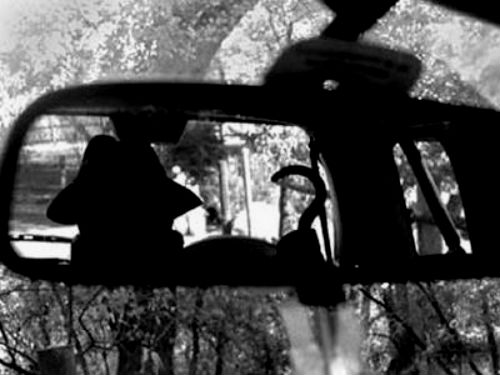
Lovers’ Lane was a lake, an ancient crater, faintly heart-shaped, about a mile outside of town. On any Friday night, it was guaranteed that the shore overlooking the water would be lined in Pontiacs and Oldsmobiles; they were candy apple red, dusty rose, Tiffany blue—all parked with just enough space between for privacy. Fireflies, hundreds of them, hung in the night sky, as though each one had been placed painstakingly with the tip of a paintbrush, their numbers doubling when reflected on the water’s surface. Listen for it—a nervous giggle, a moan, the muffled croon of Andy Williams, all over the harmony of a cricket summer song.
In Bud Collins’ Chevrolet, the only sound was the rustling of fabric as Carole smoothed her skirt over her knees.
“It’s beautiful out tonight,” Carole said.
“It’s beautiful in here, too,” Bud said. When Carole smiled, Bud took it as an invitation, and he placed a hand over hers.
“Maybe we ought to put on some music.” Carole pulled her hand free and fumbled for the radio knob.
“—escaped—” The voice that came over the speakers was a brief squawk, cut short as Bud turned the radio off.
“I don’t want to listen to music.” Bud was across the bench seat in a flash, one hand on the back of Carole’s seat, the other gripping the door. Carole reared back, and her head bounced off the passenger window. She turned away from Bud’s approaching mouth and his lips pursed around the pearl in her earlobe.
Outside, the moon was bright and the fireflies bobbed lazily, and Carole saw something—just the faintest outline in the night. “Bud,” she said, “there’s someone out there.” She squinted into the dark and found broad shoulders, a wide-brimmed hat—and something with a curve, something that caught the light and held it briefly.
“Bud,” Carole whispered, pleadingly. “There’s someone just outside and I think—I think he has a hook for a hand!”
“Aw, come on, Carole. There ain’t no one out there. And if there is, it’s just some guy taking a leak.” Bud put his lips on a course towards hers again, kept his eyes open. One hand cupped her breast through her cardigan; he squeezed and it hurt.
Carole’s own hand was a blur when it caught him across the cheek. The sound of the slap cracked across the car, a miniature thunderclap that surprised them both. “You’re not listening,” she said. “And get off of me.”
The passenger window exploded into the car, glass finding its way into Bud and Carole’s mouths, their eyes. They pushed against each other in panic, tried to use the other’s body to leverage away from the ragged hole and the rusty hook that was thrusting into the space between them. The hook caught Carole’s arm, sliced one of Bud’s eyebrows in half, lodged in that soft space between Carole’s thumb and index finger, again and again, each time finding a new spot and leaving another hole.
Carole’s scream sailed across the lake, sent minnows diving for the depths, spurred a crane to fly, and stopped in a gargle.
#
Carole cleared her throat. Bud was talking about the state championship—a story he had told her at least twice before. Goosebumps ran up her arms, spread across her back, and fine hairs stood on the nape of her neck. She shivered.
“Everything okay, babe?”
“I’m fine,” Carole said. “Just a moment of—someone walked over my grave, I guess.” She looked out the window; fireflies swirled over the surface of the lake. “That’s a weird saying, right? What does that even mean?”
“I bet you’re just cold.” Bud put his arm around her and pulled her against his side. “So anyway, there’s only three seconds left in the game and—”
Carole pushed her mouth against his. More than anything, it was so he would stop talking. Warmth tingled at the base of her spine and flushed her cheeks. Sure, there was shame, but also something that she wanted; it pulled at her stomach, her hips, like that moment at the top of the arch of a swing, of being suspended in midair before the drop. Carole gave in and her body pivoted against Bud’s. Her thighs spread as she straddled his; her skirt slid up over her knees. Her lips parted and so did his. Her palms slid down his chest, his stomach, where a thin layer of baby fat still clung. She gripped it and he tensed under her thumbs.
Carole caught Bud’s bottom lip between her teeth. His fingers dug into her backside. She pulled at his belt buckle, wondering fleetingly what good girls would do, and rode the red-hot static that ran through her body.
Something hit the driver’s side window, leaving a web of fine cracks. Another impact and glass rained in. An arm reached through, a hook at the end. It caught Carole in the back of the neck and yanked her from Bud’s lap. As the world went dark, she fought to call out for help, but in the shock and suddenness of it all, her teeth remained clenched.
#
Carole frowned out the window. It was a beautiful summer night, but she couldn’t shake the feeling that something was off. A sharp itch lingered at the nape of her neck, no matter how many times she tried to rub it away. The waters of Lovers’ Lane were undisturbed; fireflies swirled in the air, neon embers of a bonfire, fueled by teenage passion. There were other cars out there, other couples doing what they would in the shadows. Carole could see their fogged-up windows. Bud massaged her shoulder, tried to get her to loosen up. But her hands remained clasped in her lap, that tight grimace on her face.
“Smile,” Bud said. Carole turned to look at him, annoyance in the arch of her eyebrows. “You’re prettier when you smile.”
Carole did not smile.
The passenger door swung open, and a man stood there. His face was cloaked, unknowable under a wide-brimmed hat and the high collar of his dark coat. There was a hook where his right hand should be.
“What the hell do you think you’re doing?” Bud tried to sound tough, but his voice squeaked.
The man grabbed Carole, got a fistful of her sweater and pulled, and then she was gone into the night. The only thing left of her was a shoe, a lone mule, slightly rocking side to side on the floorboard of the Chevy. Bud meant to go after her, do something—do anything—but he was frozen. Through the open car door, he could hear the thwacks of the hook against her body.
#
Bud rapped his fingers against the dashboard, a sloppy rhythm that drowned out the voice of the person on the radio, saying something about a local mental hospital. Carole was miles away. “I keep having déjà vu,” she said.
“I don’t know what that is.” Bud rounded out his drum solo with a flourish and gave her knee a squeeze for good measure.
“It’s French, I think. It means when you feel like you’ve already experienced something before.”
“I never pay attention in French. Babe, you’re so smart.” Bud squared his shoulders toward her. She could tell by the look on his face that he wasn’t really listening, that he was ramping up to his big move. He leaned forward and began to kiss her, and she kissed him back. But then she felt the pressure of his fingers sliding up her thigh, and it sent a spasm of fear up her back, like she could feel a dark shadow moving in.
“Wait.” Carole caught his hand, twisted his fingers softly in hers. “I think we should wait. I want to wait.”
“Sure,” he said, disappointed.
It wasn’t really what she felt, but it seemed like the right thing to say. “We’ve been steady since sophomore year. Everyone thinks that’s where we’re headed anyway. Besides, Liesl says that Mrs. Wallace can tell when a girl has, you know, done it. And I just don’t know that I could face her on Sunday if that were true.” Carole hoped that evoking the name of the pastor’s wife would conjure an image for Bud—thick calves under stretched nylons, the dour slant of her lips—that always seemed to give him a particular reaction.
Bud made a face. “Yeah. I hear you,” he said, and something unclenched inside Carole. They decided it was time to go home—no reason to tempt fate. But when Bud turned on the Chevy and began to reverse, they saw something strange in the low beams: a tall man in a dark coat, pacing the shores of the lake.
Carole remembered this detail and shared it excitedly when the news spread—a dangerous inmate had escaped from the sanitarium just outside of town. She didn’t mention that it had been her and Bud necking at Lovers’ Lane. She said she’d heard it from a friend of a friend.
“I don’t hold with gossip,” said Carole’s mother as she frowned over a ladle of brown gravy.
Carole’s brother Tommy spoke up. “You know what they say: ‘telephone, tell a friend, tell a woman.’”
Their father snorted a laugh.
“Besides, why would someone escape the sanitarium and go to the lake?” Carole’s mother asked, finally taking a seat, having readied everyone’s plates. “What would be the point, really?”
“Do you think they’ll catch him, Dad?” Carole asked.
“I’m sure they will, sweetheart.”
“I heard he carved his way through four nurses before he finally escaped!” Tommy stabbed his fork into his pot roast and laughed. The table erupted into half-hearted scolding and threats before all quieted down enough to eat.
For several nights, Carole dreamed of a hook glinting in the dark. After a few days, the town seemed to have forgotten about the escaped patient—all, maybe, except for the children telling stories at slumber parties, their faces hovering over a flashlight.
And then Carole and Bud graduated from high school. At Carole’s graduation party, Bud got down on one knee and proposed, surrounded by all of their friends and family. The ring had belonged to his grandmother, a simple white gold band with a pear-shaped diamond. It was fine, Carole thought. But every time her mother inspected the ring, she would rave about it. “How elegant,” she would say, dissolving into tears and throwing herself into Carole’s father’s arms. “Oh, Ed!” she’d wail.
They were married in October. Carole expected to catch a chill in her gown but the air was still and the sun was warm, high and bright in a cloudless sky—an objectively perfect day. Carole was readied in the back room of the church, tucked away just behind the chapel. The dress, the veil, even some of what was under it all, had belonged to Carole’s grandmother. The whole getup was unassuming enough on the hanger, but, on her body, Carole felt like she’d been seeded with lace. It wrapped her body, which was pulled into itself with steel boning; lace ran down her arms, up her neck and tickled her jaw. The veil rested lightly on her hair, which was pulled so tight she could barely blink. Lace bound her middle, pulled her in even tighter, and was woven with her father’s robin’s egg handkerchief, her something old, borrowed, and blue.
It wasn’t how Carole had imagined it. She had pictured flowers in her hair, an outdoor wedding.
So many hands touched Carole.
Liesl, her maid of honor, a soft, lingering touch at the back of her neck, smoothing down flyaway hairs.
Carole’s mother, sliding in bobby pins, more than Carole thought her hair could hold, murmuring, “So pretty. Like a picture book.”
Mrs. Wallace, whose hands were rough and hard, knotting that lace bow around her, tighter and tighter, said, “A twenty-three-inch waist. Can you believe?”
And then, stillness.
The other women were gone, attending to last-minute powder room breaks and putting the finishing touches on their own dresses. Carole was alone in that back room, surrounded by old music stands, sitting on a brown couch covered in plastic. This would be the time, she thought with a suddenness that made her jump, if there was ever going to be a time, if she really, truly wanted to run, she could slip out the door, just maybe, and make a break for it, out the back entrance of the church, down the stone steps, and through the fields straight into the horizon.
Across the room, the door to the little closet unlatched and creaked open an inch. High up in the thin gap, Carole thought she could see the brim of a dark hat.
Then movement, as the women poured back into the room, a frenzy. Carole’s heart beat quickly and she struggled to catch her breath, the tightness of the dress distributing that much effort across her whole body, so that she felt it in her fingertips.
“How do you feel?” Liesl asked.
Carole opened her mouth, then closed it. How did she answer that question? “I feel—”
“It’s time!” Mrs. Wallace yelled because it was, in fact, time. Carole could hear the organ music as she was pulled to her feet, pulled out the door and into the packed chapel, a bouquet of white roses in her hands, each one cut alive from the stem.
That night, Bud unwrapped her in their hotel room. There were lace flowers imprinted on her shoulder blades, long red marks where the corset had gripped her. He took her, finally, while she was exhausted, while bobby pins and bits of dry rice fell out of her hair.
They honeymooned in the Poconos. Their cabin had a round bed and a heart-shaped hot tub on the deck. They took walks and sipped champagne. They made love nearly every night and Carole enjoyed it more, felt like she was getting better at it, but held something aside—a secret bit of her that she wasn’t comfortable giving, an extra lift in her hips, an extra decibel in her moan. When they returned home, Bud carried her over the threshold of the tiny house that was waiting for them.
It was different living with a man that she was not related to. Bud said things that she found curious, made comments about her body that made her wonder if her father and brother were the same kind of men behind closed doors. His hands found her whenever he wanted—his thumbs pushing into the divots in the small of her back while she washed dishes, hot breath on her neck the moment he walked into the house. She enjoyed it but kept that to herself and pretended that she wasn’t often bored with the contours of Bud’s familiar body.
Carole cooked and became good at it. She made beef Wellington, pineapple upside-down cake, a perfect hollandaise, deviled eggs, tuna casseroles, crown roasts. Whatever she made, she served with an expertly shaken martini, two cocktail onions, placed just so on the table when Bud got home from work at his father’s insurance company. Soon, Carole felt her dresses pull snug across her stomach.
“One too many crab puffs,” Carole said. Her mother showed her how to let out a seam, a knowing smile on her face.
William Jr. was born just two days shy of Bud and Carole’s first wedding anniversary. He had held stubborn for thirty-four hours of labor, and then finally ripped through her in the early evening. Carole screamed, her legs up, torn wide enough to require stitches, while Bud smoked a cigar with her father in the waiting room.
When everyone was cleaned up and put back together, the nurse laid William Jr. on her breast.
“A healthy boy.”
“A boy,” Carole repeated. His head was oddly shaped and crowned in blue veins. Carole felt herself falling asleep and handed him off. She dreamed of a tall man in a dark coat—he stepped in close and pulled back the lapel to show her that his body was made of misshapen baby skulls.
Bud went back to work almost immediately and Carole found that the days she spent alone with William Jr. were long, somehow dark even in the full light of day. He cried in a way that made time stop; Carole would rock him, bounce him, try over and over again to feed him, and he would turn his head away and squawk. When William Jr. cried, her breasts would ache and leak through her blouse, and then she would cry as she cleaned herself up, wishing that her body would stop, just stop, and go back to being the body that she was familiar with.
Sometimes, when William Jr. cried, Carole would shut herself in one of the closets and smoke cigarettes in the dark.
And then Bud would get home, just in time to see Carole’s freshly washed face, makeup reapplied, dinner on the table, and William Jr. in a new diaper. All traces of the day’s darkness scattered. After supper, Bud sometimes would put on a Chuck Berry album and bop around the room with William Jr. in his arms. The music was loud and Carole would watch them from the kitchen sink, her legs and arms aching.
Carole stepped into the living room. “Sometimes when I look at his face, I get scared because I don’t feel anything,” she said.
Bud looked up, hadn’t heard her enter the room. “What?” he asked over the music.
“Nothing.” Carole went back to the dishes.
Her body took a long time to heal. Surprisingly, Bud was not as disgusted with her new shape as she was; in fact, he seemed invigorated by it. He would come to her, ready, over the laundry and pin her against the dryer. He would climb onto her in the middle of the night, startling her awake. After, she would slip out into the kitchen for a glass of water. In the stillness and the dark, a half-memory of a man with a hook would come to her and she could imagine him waiting for her just around the bend in the hallway.
“Hello?” she whispered. Be quiet or he will find you—a voice in her head—and she would say, “Are you there?”
William Jr. had just started putting words into sentences when Carole took a bite of tomato casserole and vomited into her napkin. She and Bud stared at each other in shock—Bud unmoving and pale while waves of nausea held her to her chair.
They would need a bigger house for another baby, so they moved into a ranch-style a little bit closer to her parents, who were excited to help out with their grandchildren. When she had realized she was pregnant, Carole worried that she wouldn’t make it through again—but somehow the fog lifted. There was something different. Maybe it was the change of location, maybe it was experiencing this pregnancy alongside William Jr.’s excitement, when he put his ear against her stomach and listened for the baby. Her maternal instinct finally kicked in, chased away the darkness, and she felt herself responding to both children, William Jr. and the one inside of her.
When little John came, it was faster than his brother—so fast, in fact, that he hadn’t had time to straighten out, and they had to go through her to get to him. Bodies heal, but Carole knew hers would never be quite the same, not after having been torn through twice; the C-section scar would always be a reminder of that. Even so, with Johnny, there was none of the depression afterward. There was a dependable lightness, happiness, really, a routine, but always marked with exhaustion.
Carole felt that tiredness so sharply one Sunday, after the church spring potluck, when William Jr. was four and Johnny was two and Bud carried them both, sleeping, on each hip. He had lost the baby fat over the years, cut a nice figure in a suit—but he never seemed to be quite as tired as she always was.
“I’ll go lay them down,” Bud said and disappeared into the hallway.
“Their faces need to be cleaned off,” Carole called after him. Both boys had the remains of chocolate cake streaked across their cheeks. Bud reappeared in the doorway and Carole realized he was waiting for her to get a washcloth. But then there was a knock at the front door. “Do you think you can handle that? So I can get the door?”
It was Mrs. Wallace, still in her church best, holding a cleaned dish in her gloved hands. “Casserole Carole strikes again,” she said. “Your cake was obviously a hit. I barely had to scrub the dish.”
“Thank you, Mrs. Wallace.” Carole took the dish.
“Everything you make is positively gourmet. I don’t know where you find the time.”
“It was mostly just canned fruit, Mrs. Wallace. No time at all, really.”
The pastor’s wife didn’t make any move to turn around and head back down the walk. All Carole wanted to do was close the door, kick off her heels, and sit down. She didn’t want to be rude by not inviting Mrs. Wallace in, but she just couldn’t bring herself to say the words.
“Do you have coffee?” Mrs. Wallace asked, not weighing the same concerns.
“Oh, sure.”
Mrs. Wallace followed Carole to the kitchen, commenting on everything she saw. “Is that a new rug? … The boys look so handsome in their Christmas pictures … Look what you’ve done with that China cabinet …”
Carole pulled the tin of Nescafé out of the cabinet.
“Where are the boys?” Mrs. Wallace asked.
“Oh, Bud’s putting them down. They were just tuckered. You know, so much excitement for one day.”
“I’ll bet.” Mrs. Wallace sat down at the table, absently picked up a piece of mail and looked at the return to sender, placed it back. “Are you going to have any more?”
Carole was taken aback, but kept measuring out the coffee. “You know, I don’t know. It’s not something we—I don’t know. Um. You know, maybe not. Two is just such a good number, I think, and—”
“Well, I’m sure it’s not my place, but Reverend was telling me that Bud was talking to him about it, and he thinks Bud really wants a little girl.” Mrs. Wallace tugged the gloves off her thick fingers, settling in. “Not that he’d just come out and say so. You know how men are. But it’s really kind of cute, isn’t it?”
“Yes, Mrs. Wallace,” Carole said. “Cute.”
Just the talk of it rekindled the phantom pain low in Carole’s stomach, made the healed incision across her abdomen feel tight, as though the rest of her skin were pulling away from the puckered roughness of the scar. There was an uncomfortable heat in her groin.
“You know, I always kind of thought I’d be a veterinarian.”
Mrs. Wallace was quiet for a moment. “A veterinarian? Like a doctor?”
“Yes, Mrs. Wallace. The very same.”
“Well, Carole, I’ve known you since you were a little girl, and I just did not know that.”
“No one ever asked.” Carole flattened her hands against the apron of her dress, ran her palms over her stomach and felt the stretch of fabric over the slight bulge. No one knew yet. She hadn’t mentioned it to Bud, not her mother—had barely acknowledged it herself. But she could tell, could feel it in the tightness of her clothes, the way her gorge rose at the smell of tomatoes. She was putting off thinking about it, having to go through it all again.
Liesl knew about a man over in Jackson; he could take care of this for her for $100 in cash. Carole realized that she’d subconsciously been thinking of nothing else for a week. Liesl would take her; Carole would lie and say she was going to a Women’s Leadership overnight, and when she got back, it would no longer be an issue. No one else would know.
Yes. Right then, the decision was made.
There was a loud knock at the door that led from the kitchen into the backyard—a slam, actually, hard enough to shake the door in the frame. Another impact and bits of wood slivers clattered across the linoleum. One more, and a ragged hole appeared in the door, around a large hook.
“What in the world?” Mrs. Wallace stood up and knocked her chair over. Bud hollered from the other side of the house.
A hand reached through the hole and unlocked the door. A tall man in a long dark coat stepped into the kitchen. He had a hook for a hand and he swung it, swung it, swung it, swung it until everything in Carole’s pristine kitchen, the freshly cleaned casserole dish, the coffee cups, even the pastor’s wife, was covered in red.
Mrs. Wallace wailed.
#
Little Richard screamed “Tutti Frutti” over the radio. Outside the Chevrolet, fireflies eddied lazily in the thick summer air.
“You’re so beautiful,” Bud said as he went in for the kiss.
Carole didn’t react as his lips worked against hers. She was processing it all, the summer night, her unblemished teenage body, all against the fading daydream of church socials, scars, martini glasses.
“No,” she moaned.
Little Richard was cut off, mid “awop-bop,” when a man began speaking. “This is a breaking news bulletin—”
Bud punched the radio off. “What do you mean ‘no’? Boy, you can be real hot and cold sometimes, you know that? It’s just a kiss!”
Bud leaned back in, his mouth open. Carole threw her hands over her face. “No!” she screamed, a chorus joined by the tinkling of broken glass. The flat side of a hook glanced off her temple, and she thought distantly of the meteor that had crashed into the earth and left the lake they were parked beside. The hook caught her in the shoulder, just moments before the world went dark.
#
Bud’s hand was on Carole’s shoulder. “You are so beautiful.”
“Wait,” she said, “stop. We’ve been here before.”
He laughed. “No, we haven’t. Not here. I mean, gee, Carole, have you been parking up here with one of your other boyfriends?”
Carole scanned the night outside her window. “Shut up. I mean that this has all happened before. The crickets, the radio, yeah, yeah, yeah—it’s all the same. I’m so beautiful. The fireflies. The gosh-all fireflies. It’s not just déjà vu.”
“I don’t—”
“It’s French, Bud.”
“What’s gotten into you tonight? Carole, you’re acting really weird.”
“Turn on the lights, Bud!”
“What?”
“The lights! Turn on your goddamn headlights!”
“Okay, okay!” Bud flicked on the low beams, and they stared out over the waters of Lovers’ Lane. There, between the front of the Chevy and the edge of the water, was a tall man in a hat and coat. He raised one hand and flashed a hook at them.
“It’s him!” Carole leaned forward over the dashboard, a snarl spilling between her lips. “It’s the escaped mental patient!”
“What are you talking about? Who is that guy?” Bud’s voice was broken, reedy.
Carole screamed, shifted her weight against Bud’s, and slammed her foot on the gas pedal. The tires spun, throwing sand and gravel into the air. She took the wheel with one hand, wrenched the shifter into gear with the other, and the car lurched forward.
The Chevy closed the gap in a flash, bounced once against the uneven sand, and connected with the man with the hook for a hand. His head bounced against the windshield and left a bloody smear across the glass. He flailed both arms and reached around with one long arm and wedged the hook against the driver’s side door handle. Carole hit the brake, and he was torn back, his body flung free of the Chevy. He landed hard on his neck, skipped across the sand a few times, and came to rest, broken and twisted, in the shallows.
The hook had ripped entirely free of the arm it was attached to, still looped over the door handle, and clanged in the breeze.
Michael Cole is a writer living in Wichita with his husband and son, and their two dogs. He has an MA in English Literature and an MFA in Creative Writing. He is a co-author of the graphic novels The Cardboard Kingdom and The Cardboard Kingdom 2: Roar of the Beast, published by Knopf in 2018 and 2021, respectively. His first solo novel, Across Brandis, a YA-adjacent portal fantasy, will be released in the near future. You can find him at michael-cole.com.
Image: scaryforkids.com
Check out HFR’s book catalog, publicity list, submission manager, and buy merch from our Spring store. Follow us on Instagram, Bluesky, and YouTube. Disclosure: HFR is an affiliate of Bookshop.org and we will earn a commission if you click through and make a purchase. Sales from Bookshop.org help support independent bookstores and small presses.

